

Australia has plenty of workers. They’re just in the wrong jobs
Author: Ben Selwyn | Posted On: 14 Apr 2026
The economic case for retraining into trades has never been stronger. That’s not why people aren’t doing it.
Australia’s official unemployment rate sits below 4%. The construction sector is running 77,700 homes short of the national housing target. Fifty-six per cent of employers can’t fill a vacancy within a month. These three facts exist at the same time, and the standard explanation, that Australia has a skills shortage, only accounts for part of what’s going on.
The fuller picture is a workforce where people aren’t moving. White-collar workers are staying put in jobs they’d normally have left by now, not because they love those jobs, but because the economy feels too uncertain to take a risk. Meanwhile, trades and construction are crying out for workers with the kinds of transferable skills, project coordination, problem-solving, client communication, that sit in offices all over the country. The wages are competitive. The job security is genuine. The demand is not going away. But the movement isn’t happening, and the reason why has very little to do with money.
Four things the data tells us
- Workers are staying put, not thriving. Only 51% of workers sought new roles in early 2026, down from 59% the prior year. People are holding onto jobs they’ve outgrown because leaving feels too risky.
- The trades shortage is structural, not a blip. Construction has recorded seven consecutive years of productivity decline. Housing approvals fell 15.7% year-on-year in January 2026 to a 19-month low, not because Australians stopped wanting homes, but because the industry doesn’t have enough people to build them.
- The demand pipeline is only getting bigger. The federal government’s 1.2 million home Housing Accord needs a significant lift in construction capacity. Add the renewable energy buildout, hospital construction programs, and transport infrastructure, and the need for skilled trades workers is locked in for years, not months.
- The pay isn’t the problem. A qualified electrician, plumber, or carpenter earns as much as, if not more than, many degree-qualified office workers, with better job security and more day-to-day autonomy.
So what is stopping them?
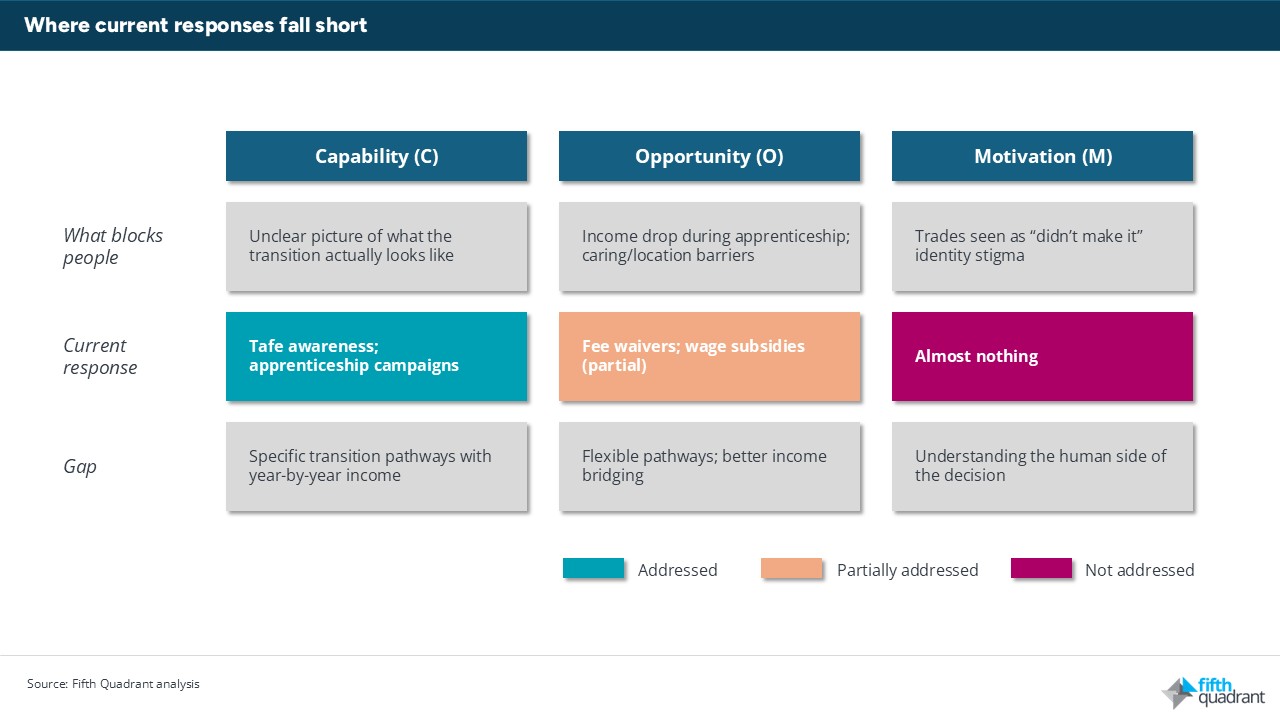
The COM-B behaviour change framework asks a useful question when economic logic fails to explain what people do: what are the actual barriers? It breaks them into three categories: Capability, Opportunity, and Motivation. When these are applied to the retraining decision, it reveals a very different picture to the one most policy and employer responses are built around.
Capability: Skills programs have spent years making sure people know that TAFE exists and that apprenticeships are available. That work has largely succeeded. What’s missing is a clear, honest picture of what the transition actually looks like on the ground. Someone sitting in a project coordinator role, genuinely curious about becoming an electrician, doesn’t need another government brochure. They need to know what their income looks like in year one, year two, and year three. They need to know what the working day actually feels like. They need to know whether their existing skills count for anything or whether they’re starting from scratch. That level of specificity is almost never provided, and without it, the uncertainty is enough to kill the decision before it starts.
Opportunity: An apprentice wage is well below what a mid-career office worker currently earns, and for someone with a mortgage and kids, that gap is a genuine obstacle. But there are other barriers sitting underneath it. Trades apprenticeships often require being on site at specific times, which doesn’t work for people with caring responsibilities. Placements aren’t always near where people live. And there’s a subtler pressure that doesn’t appear in any policy document: the social cost of going backwards, at least on paper. Telling your family you’re leaving a salaried job to start an apprenticeship at 33 is not a simple conversation, even when the numbers make sense.
Motivation: Trades work still carries a stigma in Australia that wages data alone hasn’t shifted. It gets framed, subtly and not so subtly, as the option for people who didn’t quite make it academically. That framing is absorbed early, from schools, from parents, from the broader culture, and it doesn’t dissolve just because the pay is good. For someone who built their sense of professional identity around a degree and an office career, retraining into a trade isn’t just a financial decision. It means reconsidering who they are and how they expect others to see them. Skills programs and employer incentives that treat this as a rational calculation are fundamentally addressing the wrong thing. It’s a question of identity.
Why current responses keep falling short
Government skills programs have put real money into this problem. The results have been underwhelming. The pattern, consistently, is that programs address Capability and take a partial run at Opportunity (fee waivers, wage top-ups), while Motivation goes almost entirely unaddressed.
The same blind spot shows up in how employers approach the problem. Construction companies and infrastructure firms are offering signing bonuses, partnering with schools, and expanding their apprenticeship programs. The employers who are starting to move the needle though are the ones who’ve invested in understanding what a career-changer needs to believe before they’ll commit, not just about the salary, but about where the role leads, what existing skills count for, and where it might take them. That’s a human question, not a compensation one.
Looking ahead
The conditions driving this problem aren’t going to ease. The housing pipeline, the energy transition, and years of underinvestment in trades training have created a structural demand that the current workforce supply can’t meet.
The economic case for retraining will keep getting stronger, but the last few years have shown that a strong economic case doesn’t move people on its own. The organisations that make real progress on this will be the ones prepared to understand the human side of the decision. The question worth asking is a simple one: what would actually have to be true for a 35-year-old project manager to become an electrician?
It’s an answerable question. Most organisations just haven’t tried to work out how.
Fifth Quadrant Market Research helps organisations uncover the real drivers of workforce behaviour so you can design strategies that actually shift people, not just policies. Contact us today to see how deeper insight can turn intent into action.
Posted in Social & Government, Auto & Mobility, Uncategorized