

Automotive workforce retention is the critical gap
Author: Ben Selwyn | Posted On: 14 Oct 2026
Why is automotive workforce retention becoming as important as recruitment in addressing Australia’s skills shortage? The answer lies in whether the people already working in the industry can see a future worth recommending.
For most of the past decade, the answer to the automotive skills shortage has been to recruit harder. Industry campaigns, apprentice incentives and skilled migration have all aimed at bringing more people in, and the Motor Trades Association of Australia still estimates a shortfall of 38,000 motor trades professionals and technicians.
Research Fifth Quadrant conducted for the Mining and Automotive Skills Alliance (AUSMASA) found that a conversation with someone who already works in the trade makes young people far more likely to consider it. New workforce data suggests however that many of those people are reluctant to make the case. So automotive workforce retention also decides who joins the industry, because how people experience their careers shapes what they tell others.
Young people choose trades through people they know
The AUSMASA research found that almost two-thirds of high school students were unaware of the range of careers automotive offers. Talking to someone in the industry made a large difference. Young people who had done so were far more likely to consider an automotive career than those who had not, but most had no friends or family working in automotive to talk to.
That puts a great deal of weight on the people already in the workforce. Every technician, service advisor and parts interpreter is a potential recruiter.
Most of that recruiting happens informally. It happens when a technician talks to a neighbour’s teenager, hosts a work-experience student or turns up at a school careers night. Employers can make it easier by releasing staff for school visits, offering structured work experience and putting apprentices and recently qualified technicians in front of students. What those staff say depends however on how they feel about their own prospects.
Recommending the career
The latest Australian Automotive Workforce Pulse from Mechanic.com.au shows the problem. People working in automotive are broadly positive about their day-to-day jobs. Asked whether they would recommend automotive as a career, far more were negative than positive. Even among those who were happy in their role, 47 per cent would not recommend it.
A workshop where staff enjoy the work may still not have the advocates the industry is counting on.
Career pathways and automotive workforce retention
The dividing line is whether people can see where their career goes next. Workers who can see a clear path are close to neutral about recommending automotive. Those who cannot are strongly negative.
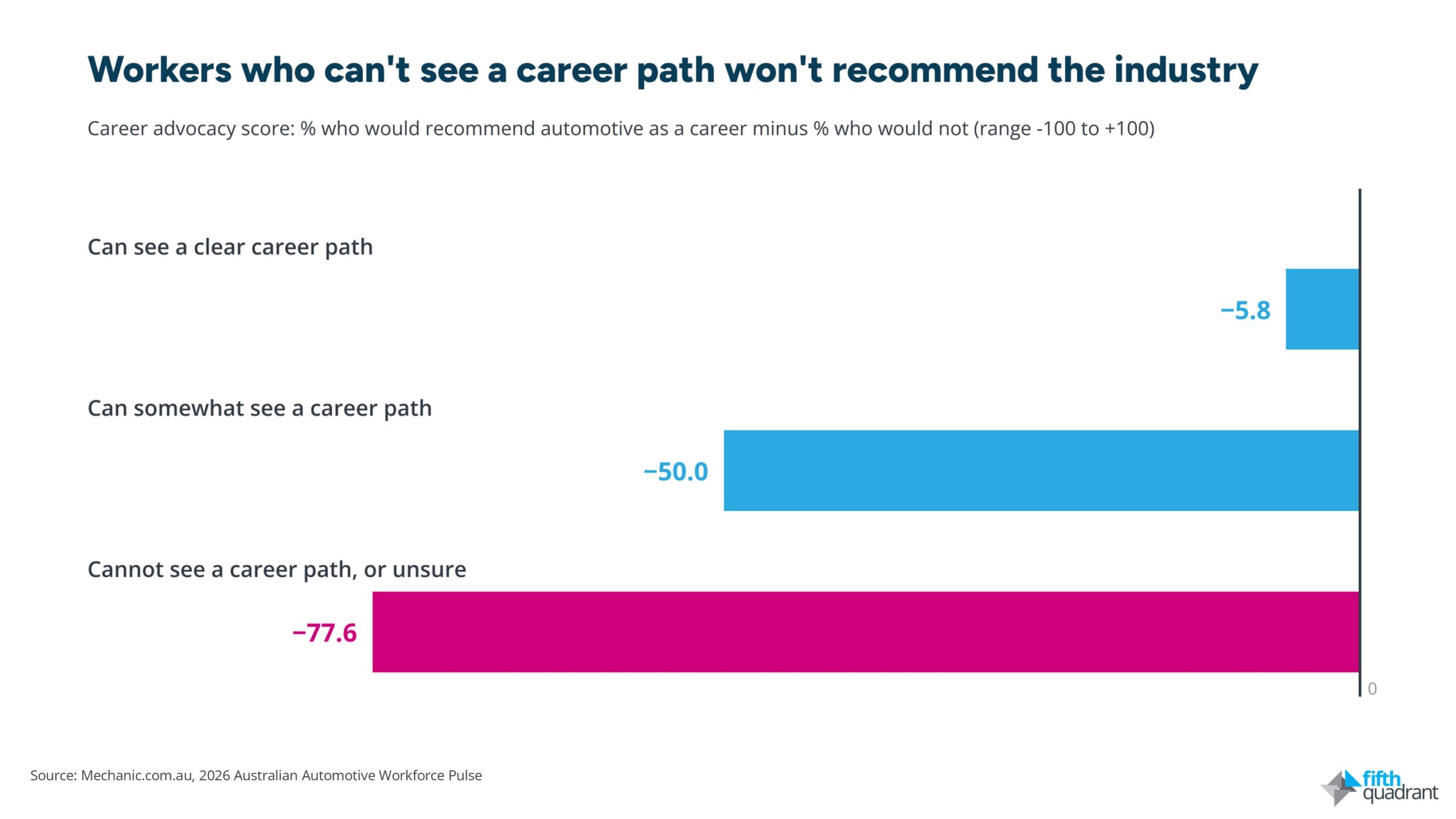
The AUSMASA research found a similar pattern. Unclear progression and limited professional development came through as drivers of attrition, particularly among apprentices and qualified tradespeople. Current workers were keen to specialise in areas such as ADAS calibration and electric vehicles, but many could not see where to start.
The mid-career years
Both studies flag the years after qualification. In the AUSMASA research, qualified tradespeople described their enthusiasm for the work fading over time. The Workforce Pulse found people six to ten years into their careers had less clarity about their future than more experienced colleagues.
Losing someone at this point is expensive. A technician six years in has finished an apprenticeship, built diagnostic skills and may have picked up hybrid or EV competency. Replacing that capability takes years, in a labour market where vacancies are already hard to fill. They are also close in age and experience to the young people the industry wants to reach.
What employers and industry bodies can do
Dealer groups can link a defined career ladder to paid credentials in diagnostics, ADAS and high-voltage systems. That builds the capability the service department needs and gives technicians a reason to stay for the next step.
Independent workshops cannot offer the range of roles a large group can, but they have options networks find harder to match, such as a route to workshop management, profit share or part ownership. Spelling these out early, rather than when someone resigns, turns them into retention tools.
Parts suppliers and workshop networks can build training and specialisation into what they offer members, giving small businesses a progression path they could not fund alone.
Mentoring belongs on every employer’s list. The AUSMASA research found a lack of structured support and mentoring held people back, especially apprentices. Pairing apprentices and newly qualified technicians with an experienced mentor is a low-cost way to show them what the next five years could look like.
Industry bodies can give retention the same attention as attraction. Campaigns that bring young people into the industry will work harder if the people they meet when they arrive can see a future for themselves.
The industry has invested heavily in telling young people what automotive careers offer. Employers and industry bodies now need to put the same effort into the people already working in the industry.
At Fifth Quadrant, we bring deep expertise in Auto & Mobility research. Explore our latest automotive insights or get in touch to discuss your next move.
Sources: Motor Trades Association of Australia (MTAA), Automotive Workforce Must Be Part of Australia’s Skilled Migration Priorities (September 2026); Mining and Automotive Skills Alliance (AUSMASA), Perceptions of Automotive Careers Research, conducted by Fifth Quadrant (2024, published 2025); and Mechanic.com.au, 2026 Australian Automotive Workforce Pulse.
Posted in Auto & Mobility, B2B