

Building input costs are rising at their fastest pace in three years
Author: James Organ | Posted On: 06 Nov 2026
How much are building material costs rising in Australia in 2026, and what does this mean for builders and home buyers? The cost of materials used to build a new house is rising faster than at any time in the past three years.
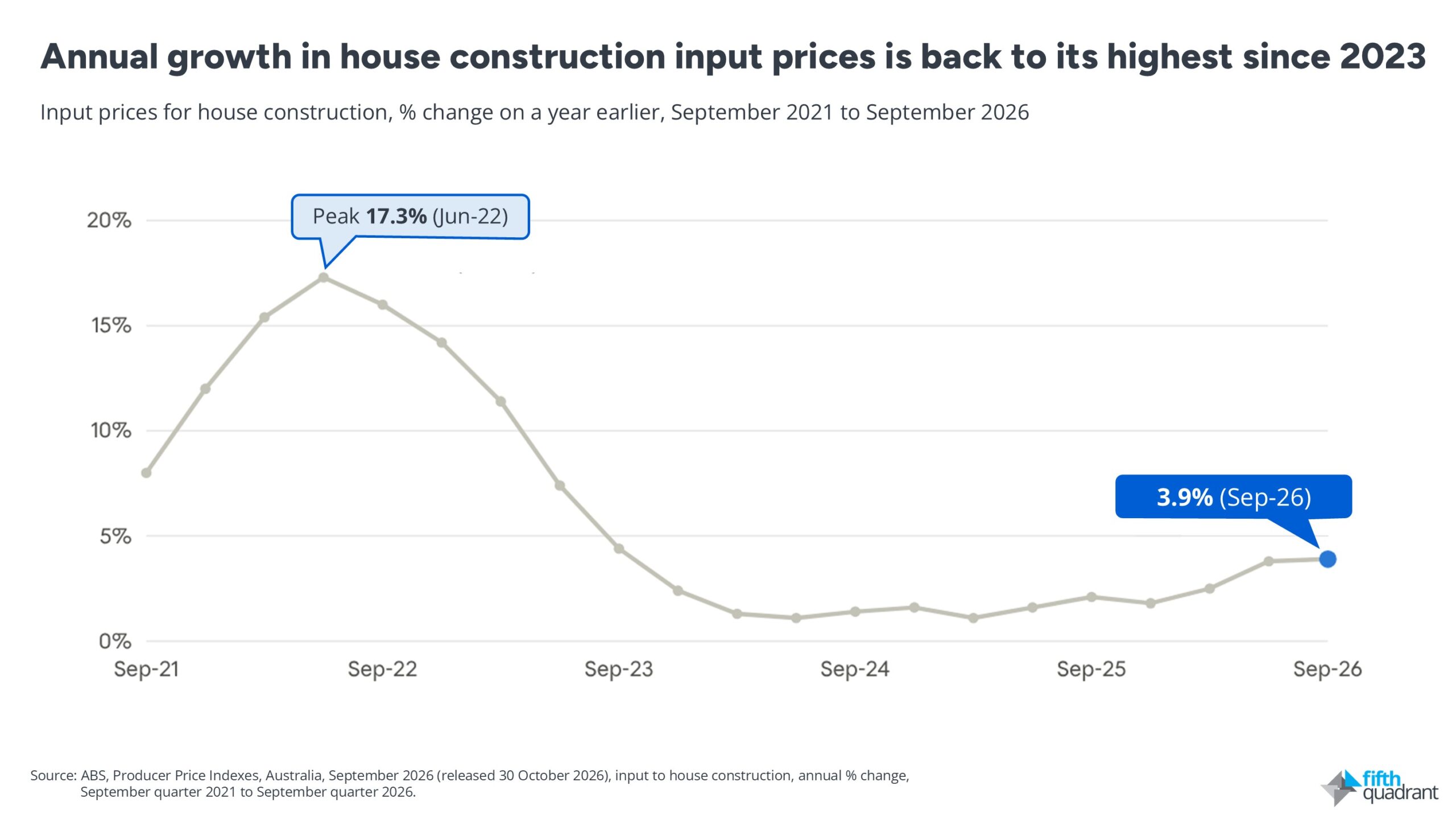
New Australian Bureau of Statistics (ABS) producer price figures show that input prices for house construction rose 3.9% in the year to September 2026. That is still well short of the double-digit rises of 2022, but it ends two years of relatively mild growth and comes as interest rates are rising again.
What the latest figures show
Input prices for house construction were 3.9% higher in September 2026 than a year earlier, according to ABS figures released on 30 October. That is the biggest annual increase since September 2023. Much of it came in the past six months, with prices rising 2.1% in the three months to June and a further 1.0% in the three months to September.
The increase in Australian building material costs was broad across the capital cities. Annual growth ranged from 3.4% in Melbourne to 4.9% in Brisbane, with Sydney at 3.7%, Perth at 3.6%, Adelaide at 4.2% and Hobart at 4.5%.
Which materials are driving the rise
Three groups of products did most of the work, and the ABS links two of them to global commodity prices.
- Plumbing products were the largest contributor, up 3.7% in the three months to September and 9.4% over the year. Plastic pipework and fittings rose 9.0% in the three months as plastics and resins followed higher crude oil prices.
- Electrical equipment rose 2.3% in the three months and 14.5% over the year, which the ABS attributes largely to high copper prices.
- Other metal products rose 0.7% in the three months and 5.0% over the year, with copper pipes and fittings up 9.5% in the three months.
Timber, board and joinery were much steadier, up 1.6% over the year. The pressure this time is concentrated in plumbing, electrical and other fit-out materials, where prices track oil and copper markets that builders have little control over.
A rise from a low base
The longer view puts the latest figure in context. The annual rise peaked at 17.3% in the year to June 2022, then eased to between 1% and 2% for most of 2024 and 2025. It has picked up again since late 2025. Comparing ABS index values, input prices are about 30% higher than five years earlier, so the new rises are landing on an already high cost base.
What builders are charging
The same ABS release tracks the prices builders charge for finished work, which also reflect labour, overheads and margins. These rose faster than materials over the year to September.
| Output price measure | Three months to September 2026 | Year to September 2026 |
|---|---|---|
| House construction | 1.0% | 5.7% |
| Other residential building | 1.3% | 4.1% |
| Non-residential building | 1.7% | 4.8% |
| Heavy and civil engineering | 1.3% | 4.6% |
Source: ABS, Producer Price Indexes, Australia, September 2026.
House construction prices rose 2.0% in the three months to June, then 1.0% in the three months to September. One period of slower growth is not yet a turning point. NSW and Queensland made the largest contributions to the national rise in house construction prices.
Why it matters now
Higher building material costs are arriving alongside higher borrowing costs. The Reserve Bank of Australia lifted the cash rate target to 4.85% on 3 November, and Master Builders Australia has described building materials inflation as sitting at a three-year high.
For builders on fixed-price contracts, rising copper and plastics prices can squeeze margins on homes that were priced months ago. For developers and home buyers, higher construction costs add to the cost of projects that are already finely balanced.
The pressure is not limited to construction. In Fifth Quadrant’s SME Sentiment Tracker for September 2026, cost pressures remained the biggest challenge small and medium businesses expected to face over the following three months.
What to watch
A 3.9% annual rise in building material costs is a warning sign rather than a return to the conditions of 2022. Whether it becomes a lasting problem depends on copper and oil prices, and on whether the next six months of data confirm the pick-up.
The ABS will publish figures for the three months to December on 29 January 2027, the same release in which it plans to reweight its construction indexes. For anyone pricing projects, ordering materials or lending against construction, the cost base deserves closer attention now than at any point since 2023.
Fifth Quadrant provides built environment market research to help businesses better understand their customers, markets and demand. Get in touch to discuss your research needs.
Sources: ABS, Producer Price Indexes, September 2026; Master Builders Australia, 30 October and 3 November 2026; RBA, Monetary Policy Decision, 3 November 2026; and Fifth Quadrant SME Sentiment Tracker, September 2026 (n≥400 SMEs, weighted by industry, state and business size).
Posted in Built Environment, B2B, Consumer & Retail