

Entry level hiring falls amid AI rise
Author: Dr Steve Nuttall | Posted On: 20 Jan 2026
Entry level hiring in Australia is contracting sharply, mirroring a global pattern that has seen junior job postings fall 29 percentage points since January 2024. According to Randstad’s 2025 Global Workplace Blueprint, organisations worldwide are pulling back on graduate and early-career recruitment. In Australia, Fifth Quadrant’s SME Sentiment Tracker shows just 9% of small and medium enterprises were actively hiring in December 2025, down from 19% in October. The question now facing employers, graduates and policymakers is whether this represents a temporary hiring pause or a more fundamental restructuring of how work gets done.
Australian SMEs pull back on recruitment
The data reveals a sustained decline rather than a sudden drop. Australian SMEs with job vacancies fell from 22% in FY24 to 15% in FY25, and stand at just 12% in FY26 year to date. December’s figure of 9% represents the lowest point in the past 12 months. For businesses with fewer than 20 employees, the contraction is even more pronounced.
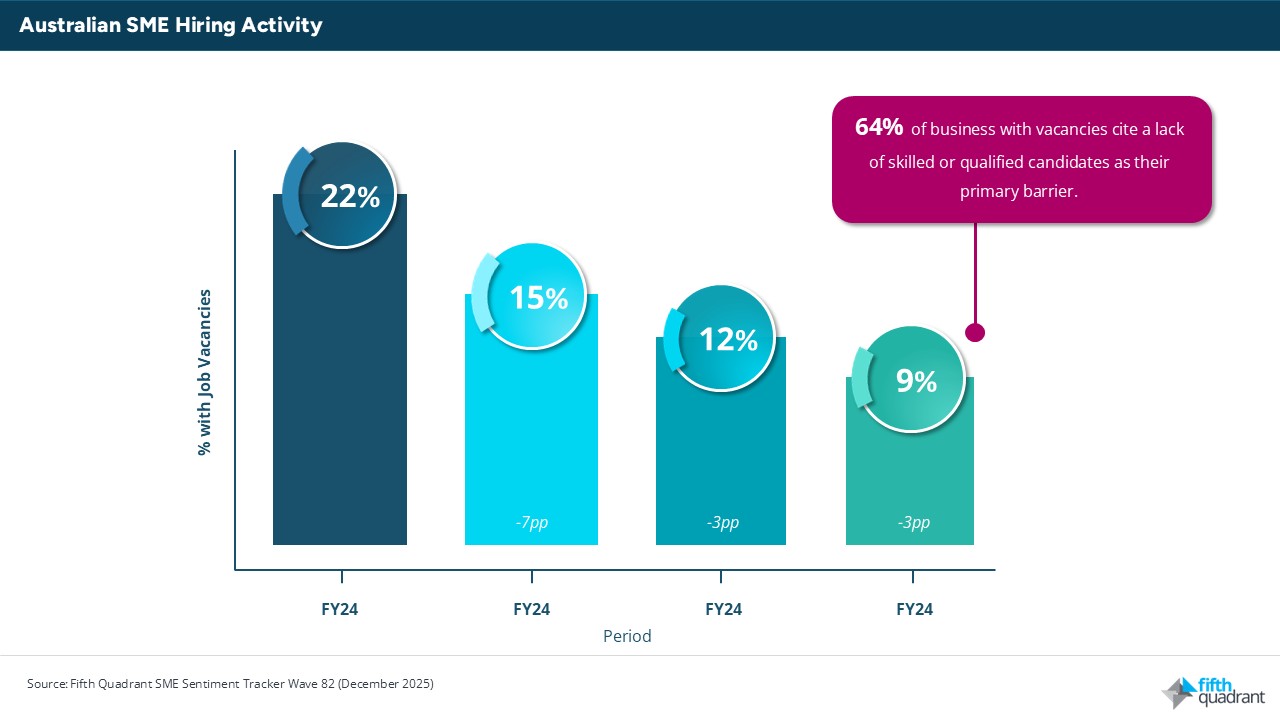
Yet even as hiring slows, employers report persistent difficulty filling the roles that remain. According to Wave 82 of the SME Sentiment Tracker, 64% of businesses with vacancies cite a lack of skilled or qualified candidates as the primary barrier. Wage expectations that exceed what businesses can pay (45%) and insufficient applications (34%) compound the challenge. Smaller SMEs feel this most acutely, with 38% of businesses with 0 to 19 employees reporting roles are difficult to fill, compared to 16% among larger firms.
AI adoption accelerates as hiring contracts
These hiring trends coincide with accelerating AI adoption. Fifth Quadrant’s research for the National AI Centre shows that AI adoption among Australian SMEs continues to grow. The most common applications include data entry and document processing (29%), generative AI assistants (29%), and marketing automation (24%). Larger businesses are moving fastest, with 78% of SMEs with 200 to 500 employees now adopting AI, compared to 36% of micro-businesses with fewer than five employees.
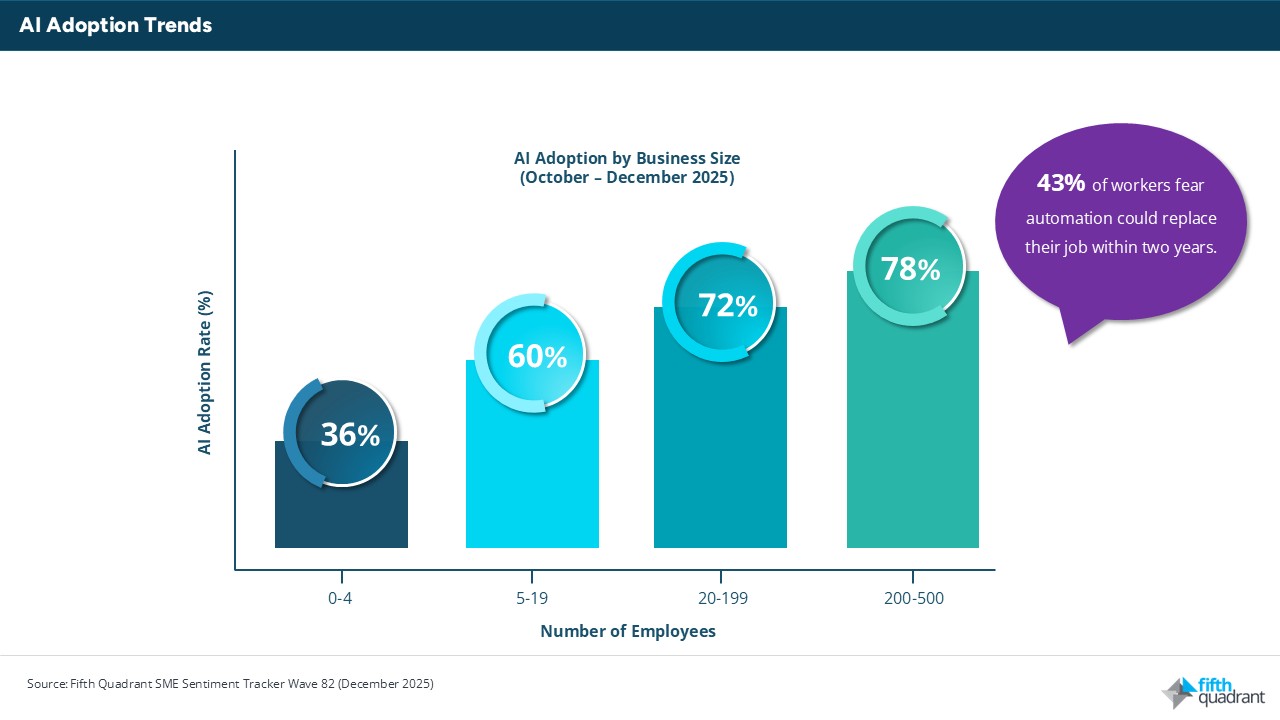
The global picture is similarly stark. ManpowerGroup’s 2026 Global Talent Barometer, released at Davos this week, found that 43% of workers fear automation could replace their job within two years, up five percentage points from 2025. Yet 55% of employees report receiving no workplace training in the past year. In the United States, computer programmer employment fell 27.5% between 2023 and 2025, while the 15 largest technology companies reduced graduate hiring by 25% over the same period.
The skills paradox intensifies affecting entry level hiring
This creates an uncomfortable paradox. Entry level roles are disappearing while employers simultaneously complain they cannot find qualified candidates. Part of the explanation lies in changing expectations. Roles once labelled entry level now often require two to three years of experience or specific technical competencies that recent graduates lack. The World Economic Forum’s Future of Jobs Report 2025 projects that 70% of skills required for the average job will change by 2030.
For graduates and career changers, the message is clear: generic qualifications are no longer sufficient. Those who can demonstrate specific AI literacy alongside traditional competencies will find themselves better positioned in a contracting market. For employers, the immediate cost savings from automation must be weighed against the long-term risks of hollowing out the talent pipeline. Without entry level roles, where do tomorrow’s experienced professionals come from?
The 29% decline in entry level hiring is not merely a cyclical correction. It signals a structural shift in how work is organised, who performs it, and what capabilities are valued. Australian businesses that fail to invest in workforce development risk finding themselves without the human capital needed to deploy AI effectively.

Fifth Quadrant tracks Australian SME sentiment, hiring activity and AI adoption through our monthly SME Sentiment Tracker and research partnership with the National AI Centre. Explore our B2B research capabilities or get in touch to discuss how workforce and technology trends are shaping your sector.
Posted in B2B, Consumer & Retail, Financial Services, Social & Government