
Federal Budget 2026: The Disengagement Reality
Author: James Organ | Posted On: 28 May 2026
Federal Budget 2026: The Disengagement Reality
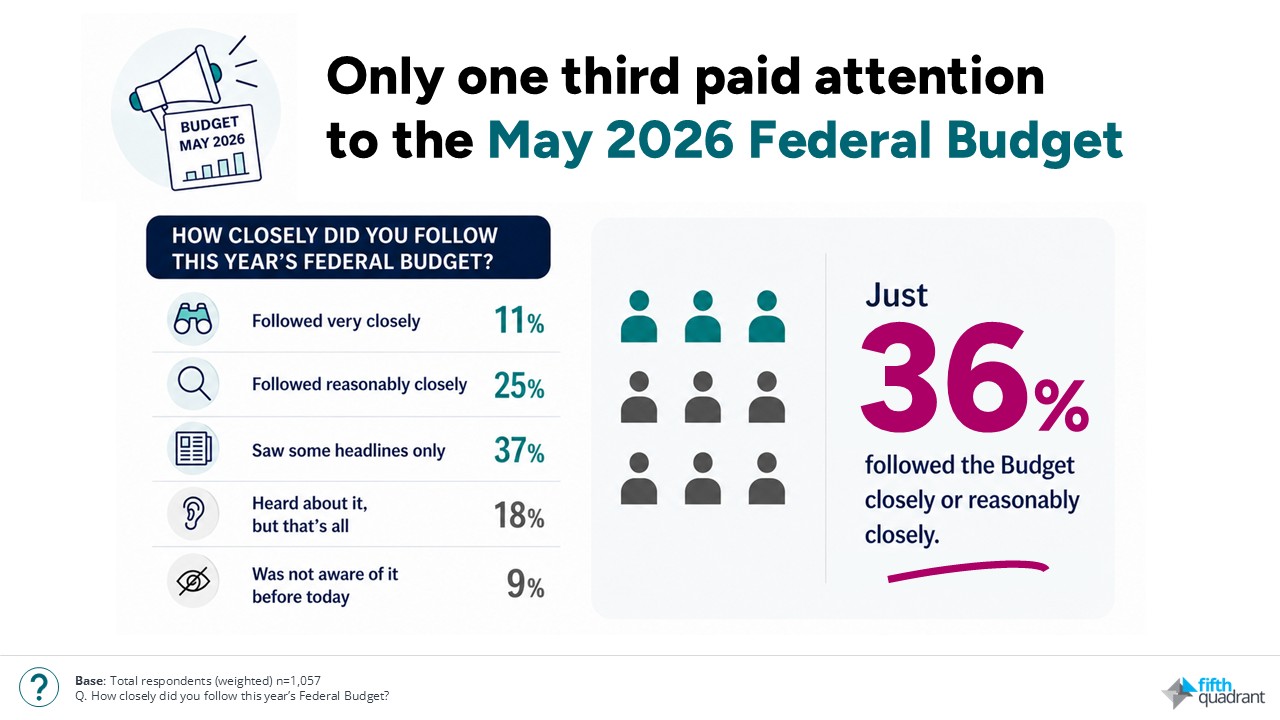
For weeks politicians and media had called it the most consequential Budget in at least a decade. A fundamental reset of the investment landscape. An attempt at structural reform. The end of a 30-year housing cycle. So Fifth Quadrant asked Australians how closely they’d followed it. Nearly one in ten didn’t know it had happened. Around half can’t tell you whether it was good or bad for them personally. Two-thirds didn’t meaningfully tune in.
That’s the real story of this year’s Federal Budget. Not the policies, not the politics, but the audience that wasn’t there. After all the build-up, the country the Treasurer was speaking to was, in large part, not listening.
A nationally representative survey of 1,057 Australians, fielded in the days after Budget night, tells the story in numbers.
Is anybody there?
Only 11% of Australians say they followed the Budget very closely. Another 25% followed it reasonably closely. The remaining two-thirds either skimmed headlines (37%), heard about it in passing (18%), or weren’t aware of it at all (9%).
Is it good or is it bad now? No idea?
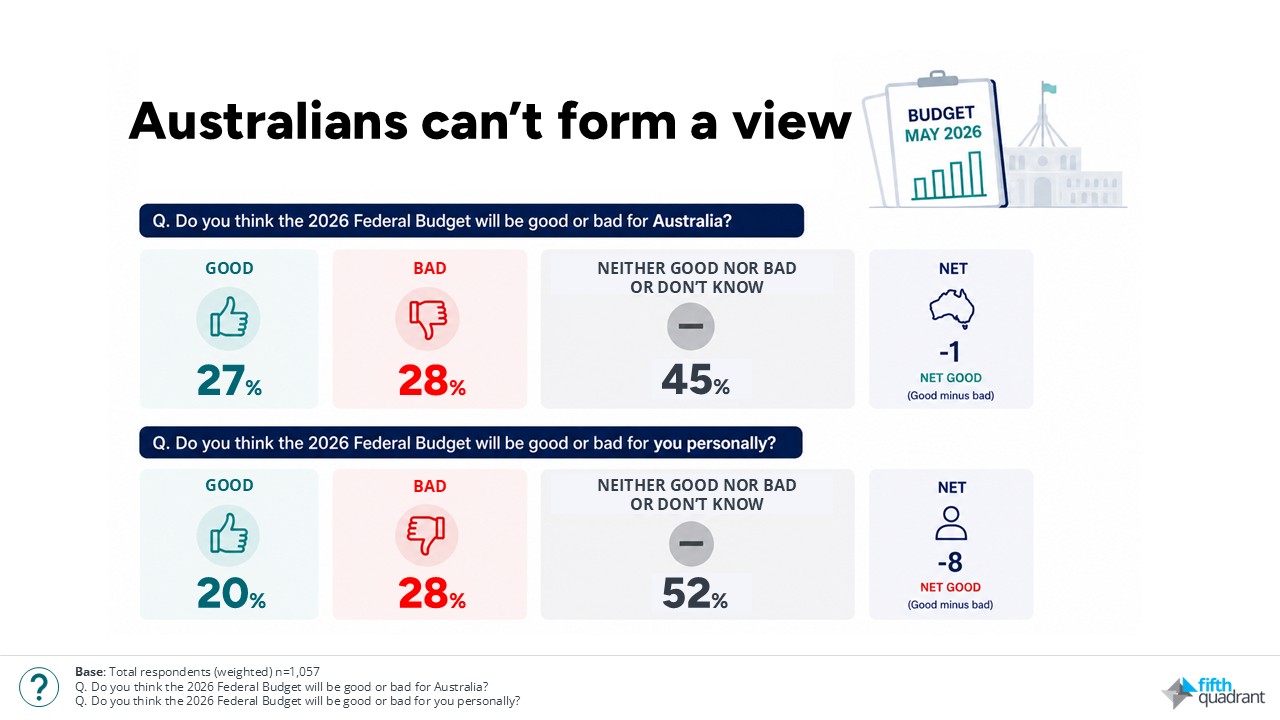
Asked whether the Budget was good or bad for Australia, 45% sat in “neither good nor bad” or “don’t know”. On personal impact, that figure climbed to 52%. A majority of Australians can’t form a view about how the Budget will affect their own lives. This is happening despite saturation media coverage. Treasury lockup. Wall-to-wall broadcasts. The Treasurer on every morning show. Two weeks of opposition rebuttals and analyst takes. All of it landing on about a third of the country.
So who is watching?
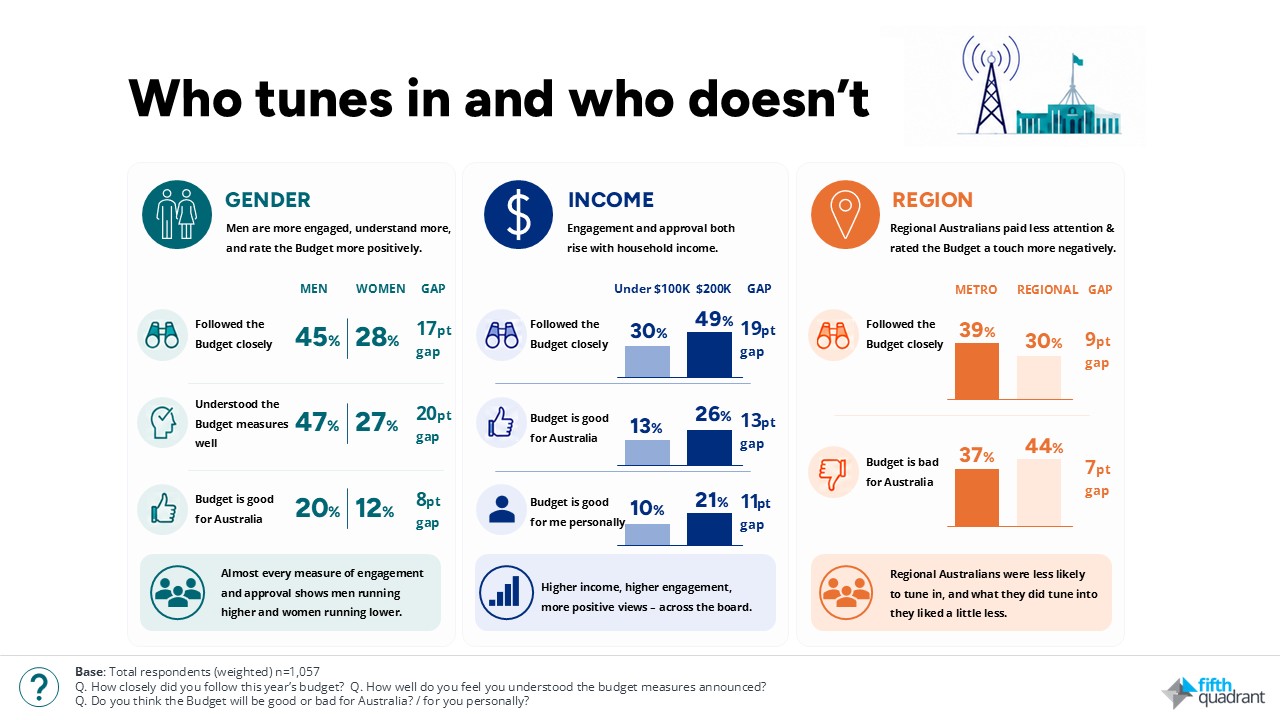
The Australians who tuned in look noticeably different from those who didn’t. Gender, income and geography all shape engagement with the Budget.
Gender. 45% of men followed the Budget closely, compared with just 28% of women, a 17-point gap. 47% of men say they understood the Budget measures well, against 27% of women. And 20% of men say the Budget is good for Australia, versus 12% of women. Almost every measure of engagement and approval shows men running higher and women running lower.
Income. Engagement and approval both rise with household income. 30% of Australians earning under $100,000 followed the Budget closely, against 49% of those earning over $200,000. Only 13% of lower-income households say the Budget is good for Australia, versus 26% of $200K+ households. On personal impact, the gap doubles. Just 10% of sub $100K households see the Budget as good for them, against 21% of high earners.
Region. Regional Australians paid less attention than metro and rated the Budget a touch more negatively. Metro engagement runs at 39%, regional at 30%. 37% of metro Australians say the Budget is bad for Australia, against 44% of regional and rural residents. Regional Australians were less likely to tune in, and what they did tune into they liked a little less.
When Australians did form a view
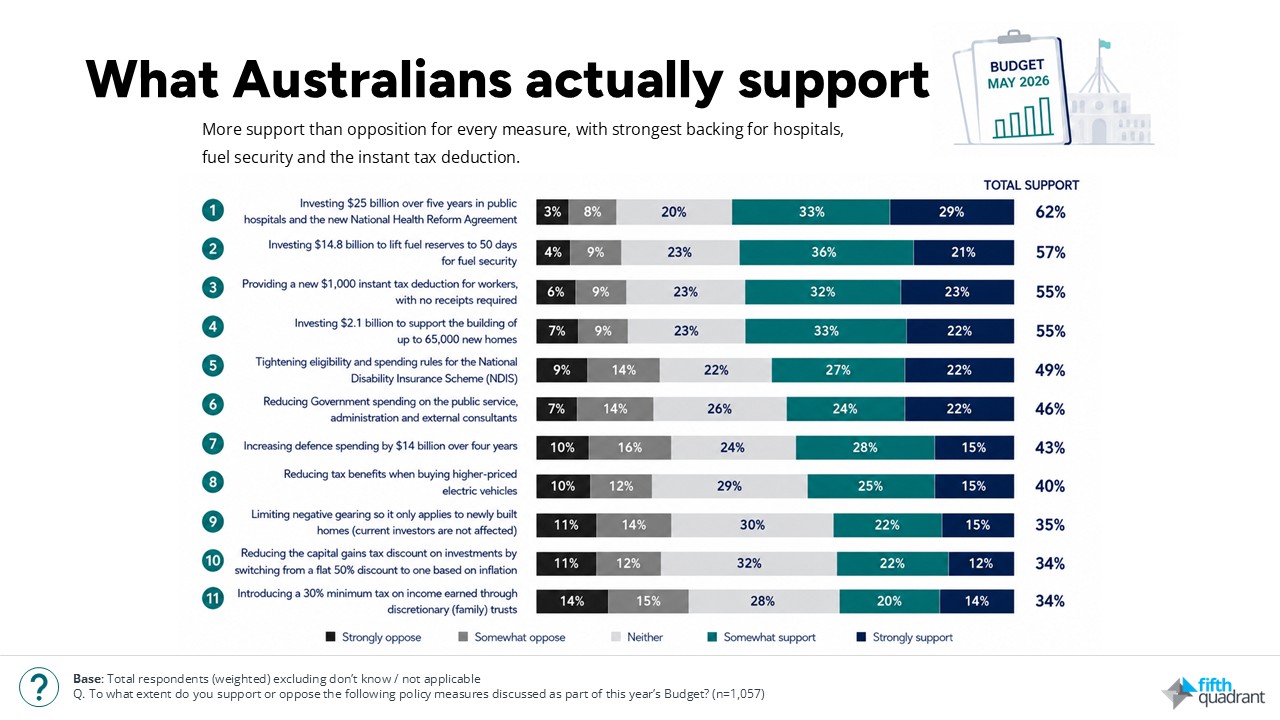
When Australians do respond to specific Budget measures, the reaction is generally more positive than negative.
Hospital funding attracts the strongest support, with 62% backing the Government’s $25 billion investment in public hospitals and the National Health Reform Agreement. Fuel security measures follow at 57%, while the proposed $1,000 instant tax deduction records 55% support.
Housing supply initiatives also perform relatively well. The proposal to support the construction of up to 65,000 new homes attracts 55% support, suggesting Australians remain more comfortable with supply-focused housing measures than broader structural tax reform.
Support softens once the measures move into areas like negative gearing, capital gains tax and discretionary trusts. Even there, however, opposition remains relatively contained.
Importantly, many measures also attract large neutral responses. Around one-quarter to one-third of Australians sit in the middle on several of the more structural reforms, reinforcing a broader theme running through the research. Many Australians simply are not engaged enough with the Budget to form strong opinions about it. For a Budget framed politically and economically as highly consequential, that disconnect between the political conversation and public attention continues to grow.
The question of broken promises
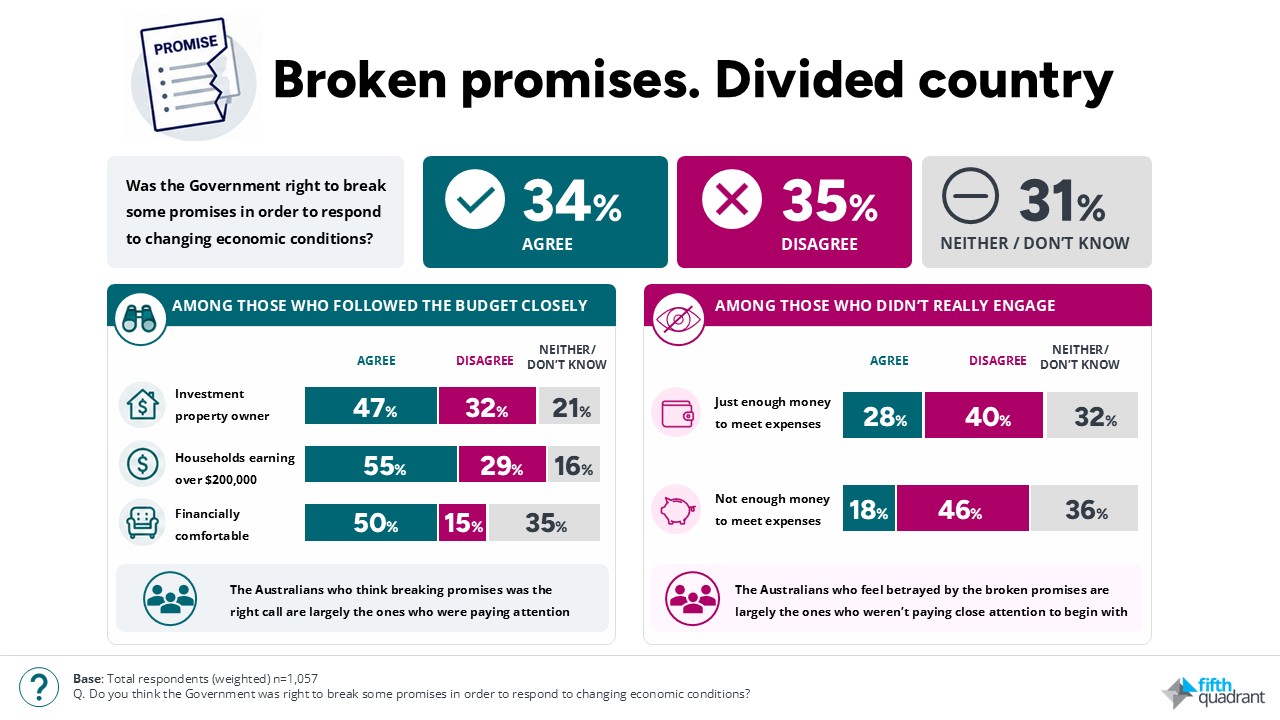
The Budget was built on a series of broken election promises, and much of the political and media discussion has treated this as a defining test for the Government. The public response is more divided than the headlines suggest. Asked whether the Government was right to break some promises in response to changing economic conditions, Australians split almost evenly. 34% agree, 35% disagree, while the remaining third sit in the middle or have no view.
What matters more is who lines up on each side. Among Australians who followed the Budget closely, support for breaking the promises runs relatively strong, particularly among higher income and financially comfortable households. Among Australians who were less engaged, especially those struggling financially, the reaction shifts sharply negative.The Australians most critical of the broken promises are largely the ones who were not paying close attention to the Budget itself. The Australians most supportive of them are largely the ones who were.
How the Budget landed
In summary there’s no single national verdict on this Budget. Different audiences are responding to it in very different ways, and the numbers shift sharply depending on which group you look at. Some tuned in, most did not and the headline figures reflect that ambiguity.
For a deeper look at how the Budget landed across the country, see our four companion pieces. Each examines one group whose response tells a particularly distinctive story. Gen Z. Australians Doing It Tough. Investment Property Owners. Baby Boomers. Together they reveal a country reacting to the same Budget from very different economic and emotional starting points.
At Fifth Quadrant, we help organisations move beyond headlines and assumptions to understand what Australians are really thinking, feeling and doing. If you’re looking for deeper insight into consumer sentiment, policy impact or emerging market trends, get in touch with our team to learn how our research can support better decision-making.
Source. Fifth Quadrant Consumer Sentiment Tracker: Nationally representative online survey of n=1,057 Australians aged 18 to 75, fielded post-Budget. Weighted to age × state by gender.
Posted in Financial Services, Consumer & Retail, QL, Uncategorized