

Investor home lending falls further in the September quarter
Author: James Organ | Posted On: 13 Nov 2026
Why is investor home lending falling in Australia? Higher interest rates and changes to negative gearing and capital gains tax are weighing on housing investment, with the pullback deepening sharply in the September quarter 2026.
The pullback in housing investment that followed the May Budget, and this year’s run of interest rate rises, deepened in the September quarter 2026. Figures released by the Australian Bureau of Statistics on 11 November show the value of new loan commitments for dwellings fell 15.5% in the quarter to $81.2 billion, seasonally adjusted. The number of new loans fell 15.0%.
Investors drove the fall
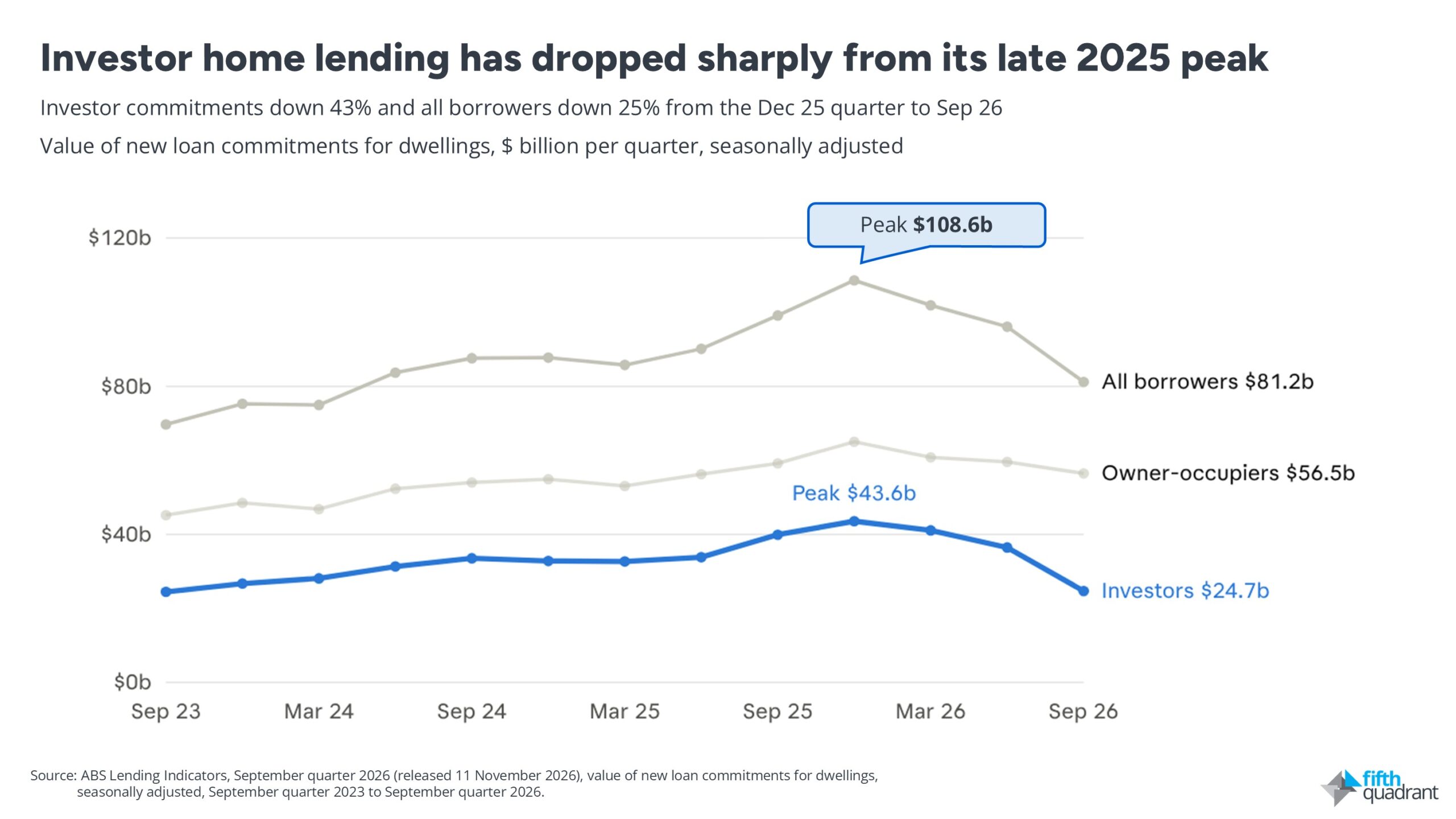
The value of new investor loan commitments fell 32.3% in the quarter to $24.7 billion, and was 38.1% lower than a year earlier. The number of investor loans fell 30.6%.
Owner-occupiers pulled back far less. The value of their new commitments fell 5.3% to $56.5 billion, which is 4.6% below the September quarter 2025. First home buyer commitments fell 8.0% in the quarter to $16.2 billion, and were 3.7% lower than a year earlier.
Across all borrowers, the value of new housing commitments was 18.1% lower than in the September quarter 2025.
A trend that has been building through 2026
Housing commitments peaked in the December quarter 2025 and have fallen in each quarter since. On ABS figures, investor commitments eased 5.7% in the March quarter as rate rises resumed, fell 11.2% in the June quarter, which included the 12 May Budget, and fell 32.3% in the September quarter, the first full quarter after it. Investor lending is now back around its level of three years ago, while owner-occupier lending has held up much better.
Two pressures working together
The first is interest rates. With inflation still too high, the Reserve Bank of Australia has raised the cash rate five times this year, from 3.60% to 4.85%, most recently on 3 November. In its latest decision, the Board said “inflation remains elevated and recent data indicate that it is broadly based.” For almost all of the September quarter the cash rate was 4.35%, so these figures largely predate the September increase and do not yet reflect the November one.
The second is tax. The 12 May Budget announced that, from 1 July 2027, negative gearing will be limited to new builds, and the 50% capital gains tax discount will generally be replaced with inflation indexation and a minimum 30% tax on real gains accruing after that date.
Properties held at Budget night are grandfathered for negative gearing. However, investors buying established properties after Budget night will only be able to offset rental losses against other residential property income from 1 July 2027, rather than against wages or other non-property income. Unused losses can be carried forward. These changes make established investment properties less attractive to some investors, which is consistent with where the lending decline has been concentrated.
The Reserve Bank links the two directly. Its November Statement on Monetary Policy said “housing prices and new lending have declined by more than expected”, pointing to the combined effects of monetary policy tightening and tax changes. Business borrowing has not followed, with the Bank noting that business credit growth remains very strong.
What it means for businesses
For builders, building suppliers, brokers, conveyancers and others tied to property transactions, fewer new loans usually means fewer settlements and less work in the months ahead. Businesses selling to households may also feel it as higher repayments squeeze discretionary spending.
Fifth Quadrant’s SME Sentiment Tracker suggests small and medium businesses are already bracing. In the October wave, 57% named the economic outlook and cost pressures among their biggest challenges for the next three months, up from 50% in September. The share citing changing customer behaviour rose from 31% to 40%. Asked about revenue compared with a year earlier, 20% of SMEs reported an increase and 31% a decrease.
Those readings were taken before the 3 November rate rise, so the November wave will give the first view of how businesses respond to it.
What to watch
With the September and November interest rate rises still flowing through and the Budget changes ahead, investor home lending could weaken further in the December quarter. The questions now are how far owner-occupier lending softens as higher repayments flow through, and whether investors shift toward new builds, which retain negative gearing benefits under the Budget changes. Both will shape demand for builders, lenders and property services well into 2027.
Fifth Quadrant’s financial services market research tracks how Australian businesses and consumers respond to changing economic conditions every month. Contact us to discuss what the latest insights mean for your customers and business strategy.
Sources: This analysis draws on the Australian Bureau of Statistics’ Lending Indicators, September quarter 2026; the Reserve Bank of Australia’s November 2026 Statement on Monetary Policy, monetary policy decisions of 3 November and 29 September 2026, and cash rate history; the Australian Government’s 2026–27 Budget documents covering tax reform and negative gearing and capital gains tax; and Fifth Quadrant’s SME Sentiment Tracker, Wave 92, October 2026 (minimum n=400 SMEs with up to 500 employees, weighted by industry, state and business size).
Posted in Financial Services, B2B, Consumer & Retail