

Super payments have doubled since Payday Super began
Author: James Organ | Posted On: 12 Nov 2026
What has changed since Payday Super began, and what does it mean for Australian small businesses? Since Payday Super began on 1 July 2026, employers have had to pay super into a worker’s fund within seven business days of each payday rather than once a quarter. Early figures from the Association of Superannuation Funds of Australia (ASFA) show the number of super payments more than doubled in the first two months. For small businesses, the change is less about the headline volumes and more about how often money leaves the account.
Payment volumes have more than doubled
Around 64 million super payments were processed in July and around 54 million in August, according to ASFA’s analysis of contribution messages. That compares with an average of around 25 million a month in 2025-26.
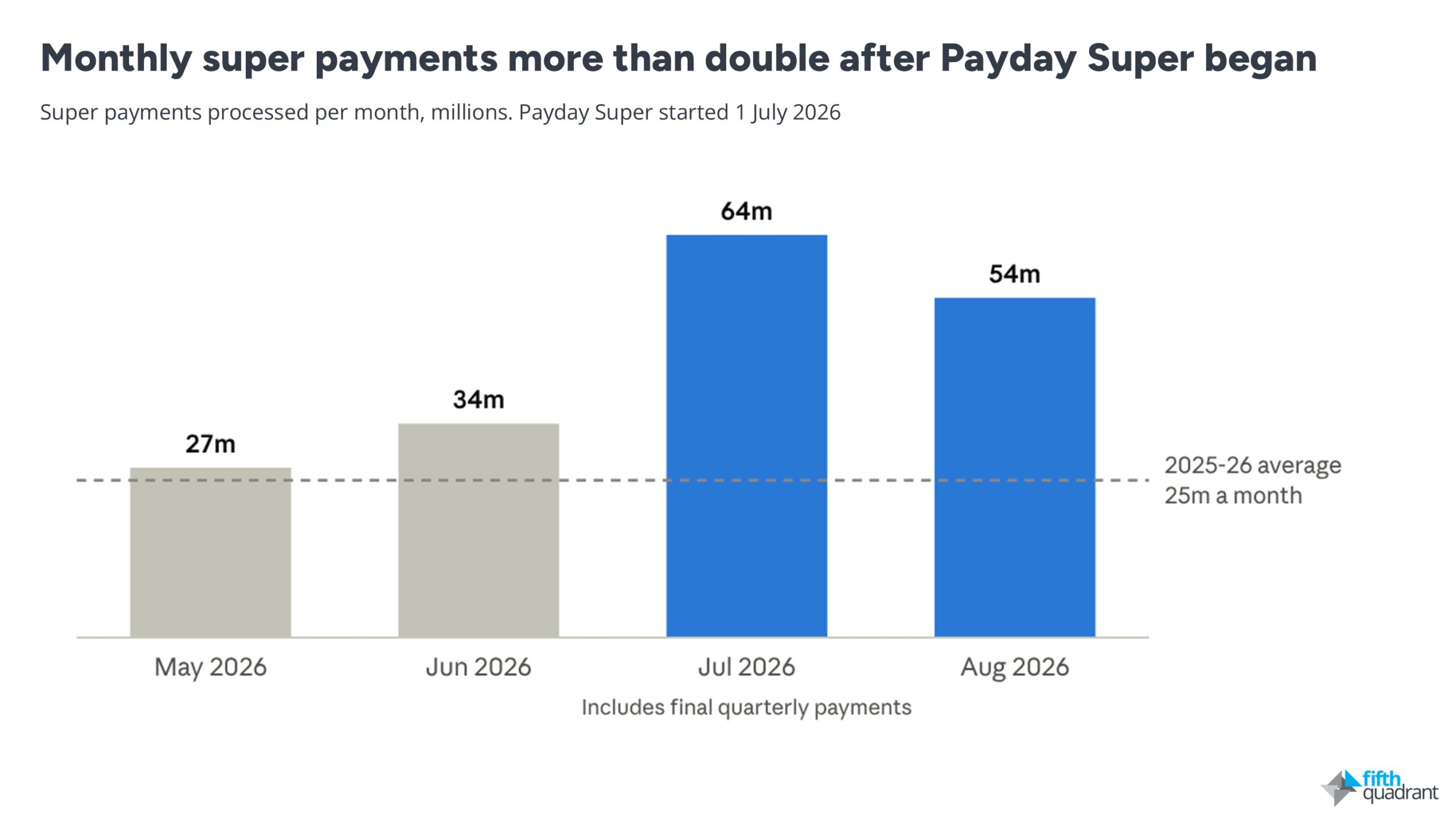
Source ASFA analysis of contribution messages, as reported by SMS Magazine and Financial Standard, 12 October 2026. 2025-26 average is ASFA’s approximate figure.
July was boosted because many employers made their last quarterly payment under the old rules in the same month as their first payday contributions. ASFA expects August’s level to be closer to the new normal.
Small business workers have seen the biggest change
ASFA’s preliminary estimate is that around 7 million workers who were paid super once a quarter now receive it with their wages, mostly weekly or fortnightly. A further 2 to 3 million are likely to have moved from monthly to more frequent payments.
Small businesses were the most likely to pay quarterly, so their employees saw the largest shift. ASFA reported that one fund with many small business employers received 3.5 times as many employer contributions after 1 July. ASFA also estimates that a 25 year old on average wages will retire with around $5,000 more from more frequent payments alone, because money paid sooner is invested sooner.
What has changed for employers
The Superannuation Guarantee rate of 12% and the list of employees who must be paid super are unchanged. What has changed is the timing and the detail. Super is now calculated on qualifying earnings, reported through Single Touch Payroll, and must reach the fund within seven business days of payday. Funds in turn have three business days to allocate or return a contribution, down from 20.
The ATO’s free Small Business Superannuation Clearing House closed on 1 July 2026, so employers who relied on it have had to find another way to pay. Penalties have also been reset. The super guarantee charge is now assessed by the ATO and is tax deductible, with penalties of 25% or 50% of the unpaid charge rather than up to 200%.
For the first year, to 30 June 2027, the ATO says its focus is helping employers make the transition. It will look at behaviour, not just mistakes, and will group employers into low, medium and high risk. Employers who pay on time or fix problems promptly are low risk and will not be reviewed. Those who leave unpaid amounts uncorrected for more than 28 days after the end of the quarter are its top priority.
Cash flow is the pressure point for smaller employers
Payday Super does not raise the cost of employing people, but it removes the gap between paying wages and paying super. A business that once held up to three months of super in its account before the quarterly due date now pays it out within days. For businesses that used that money as working capital, the adjustment is real.
It comes as wage bills are still rising. In the September 2026 wave of Fifth Quadrant’s SME Sentiment Tracker, 25% of SMEs expected the wages they pay to increase over the next three months and 9% expected them to fall. Because super is paid on those earnings, every increase in wages now flows through to super payments within the same pay cycle.
What to watch
The first months point to the reform working as intended, with far more payments made and workers seeing super land with their pay. The figures are early, though. July was inflated by the overlap of old and new rules, and ASFA expects August’s level of around 54 million to be closer to the ongoing norm.
APRA’s figures for the year to June 2026 already showed employer contributions of $164.4 billion, up 9.5%, but that period ends before Payday Super began. The September quarter release will be the first official read on contributions under the new rules. The other signal to watch is how many employers fall into the ATO’s medium and high risk groups as the first full quarters are assessed.
Fifth Quadrant tracks the conditions facing Australian SMEs every month through its SME Sentiment Tracker. Contact us to discuss what the results mean for your business or your customers.
Sources: Fifth Quadrant SME Sentiment Tracker, Wave 91, September 2026 (minimum n=400 SMEs with up to 500 employees, weighted by industry, state and business size), Financial Standard, Super payments doubled since July 1, ASFA, 12 October 2026, SMS Magazine, Payday Super impact noticeable, 12 October 2026, SuperGuide, Super news for October 2026, ASFA, Payday Super early lessons from across the sector, 19 August 2026, ATO, About Payday Super, ATO, Getting it right, compliance in the first year of Payday Super, APRA, Quarterly superannuation statistics, June 2026 (released 31 August 2026).
Posted in Financial Services, B2B, Consumer & Retail, Social & Government