

Stuck in hospital, waiting for aged care
Author: James Organ | Posted On: 14 Nov 2026
Why are thousands of older Australians still stuck in hospital when they are medically ready to leave? A growing shortage of aged care places and home support is delaying hospital discharges across Australia, putting pressure on public hospital capacity.
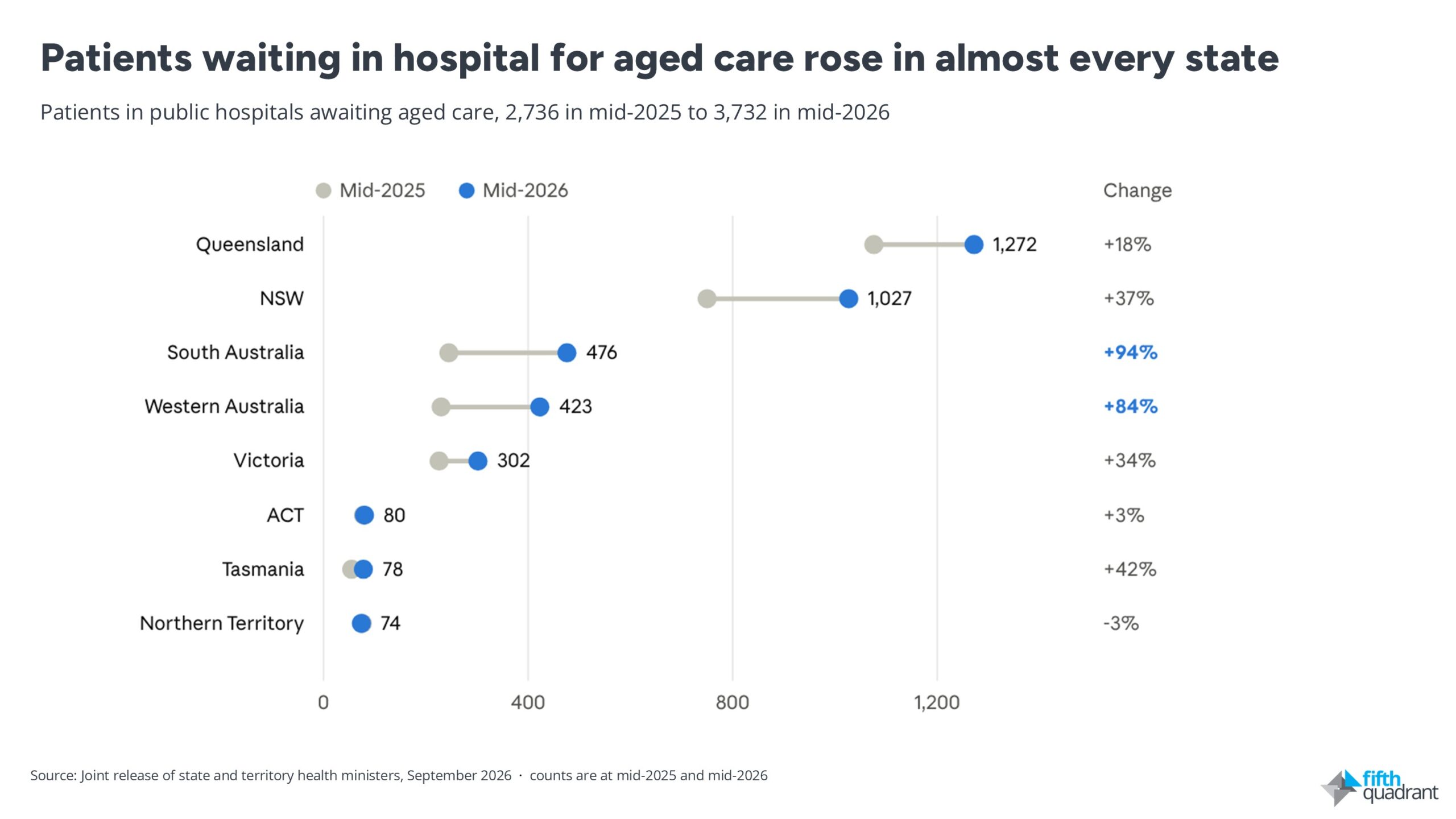
The latest comparable figures released by state and territory health ministers show 3,732 patients stranded in public hospital beds while waiting for Commonwealth-funded aged care. That is up from 2,736 a year earlier, an increase of roughly 36%.
More recent figures suggest the pressure has continued. South Australia alone now has around 500 older people waiting in hospital, compared with 476 in the mid-2026 national count.
Each of those beds is unavailable for someone coming through the emergency department or waiting for surgery. It is a hospital capacity problem as much as an aged care one.
Where the pressure is greatest
Queensland has the largest number of patients waiting, at 1,272, followed by NSW with 1,027. South Australia recorded 476 patients and Western Australia 423.
The fastest growth has been in South Australia and Western Australia, where the numbers increased by 94% and 84% respectively in twelve months. The ACT and Northern Territory were the only jurisdictions where numbers remained roughly steady.
The situation has continued to worsen in South Australia. By November, around 500 older patients were waiting in public hospitals for aged care, compared with approximately 60 four years earlier.
The September national figures remain the latest comparable breakdown across every state and territory. The more recent South Australian count indicates additional pressure but cannot be used to calculate an updated national total.
Why the queue keeps growing
The problem is not only a shortage of residential beds. Care at home is also struggling to keep up, which means fewer people can be discharged with support in place.
At 30 June 2026, 106,977 people had been approved for ongoing Support at Home services but were still waiting for a funded place. That was up from 100,191 three months earlier, an increase of 6.8%.
The latest Support at Home Program Data Report, released on 27 October, shows the Government released 131,017 ongoing places during the June quarter, compared with 79,145 in the March quarter.
The number of new ongoing classifications approved also increased, from 60,709 to 70,505. Yet the number of people beginning ongoing services fell from 35,734 to 26,581, a decline of 25.6%.
Supply is expanding, but getting people into care remains a challenge.
The latest Aged Care Act Wait Times Report, released on 11 November, provides further evidence of the delays.
For people who began ongoing Support at Home services between July and September 2026, the median time from initial application to starting care was 309 days, or just over ten months.
Across all the residential and home-based aged care services covered by the report, the median was 267 days. For ongoing residential aged care, it was 146 days.
These figures measure the full time from application to starting services, including assessment and allocation. They are not the same as the waiting period for funding after approval.
Even with that distinction, the figures show how long the overall process can take.
What changed on 1 October
From 1 October, personal care under Support at Home became fully government-funded for eligible participants. People receiving approved help with showering, dressing, continence support, eating or taking medication no longer pay a contribution for those services. Other services such as cleaning, gardening, meals and transport still attract a contribution.
This lowers the cost of staying at home for many older Australians. It does not, on its own, shorten the queue.
The latest figures underline that distinction. More than 106,000 people were still waiting for an ongoing Support at Home place at the end of June, and the September-quarter report shows that getting from an initial application to receiving care can take many months.
For people leaving hospital, the problem is not simply affordability. It is whether suitable care can be arranged when they need it.
NSW funds a stopgap
On 14 October the NSW Government announced a $28 million interim aged care pilot. It aims to help more than 300 hospital patients a year return home while they wait for Commonwealth Support at Home services. The pilot sits within a $35.7 million Aged Care Response Package that also expands specialist geriatric services.
The gap it is trying to bridge is far larger. The NSW Government’s release cites an estimate that NSW needs 2,600 additional residential aged care beds each year.
It also reports approximately 1,100 older patients stranded in NSW hospitals and projects that figure could pass 7,000 by 2036. Health Minister Ryan Park said state action needs to “complement, not replace” the Commonwealth’s responsibility for aged care.
The wider pressure on hospitals is also prompting investment in alternatives to inpatient treatment.
On 15 November, the NSW Government announced a proposed $259 million NSW Health @ Home service, expected to support up to 76,000 patients a year when fully implemented. The Government estimates it could free capacity equivalent to 700 hospital beds.
This is a broader hospital-at-home initiative, not a direct substitute for residential aged care or ongoing Support at Home funding. It nevertheless reflects the growing importance of delivering suitable care outside hospital walls.
What it means
- Hospitals. Every stranded patient is a bed that cannot be used for emergency or elective care. With winter behind us and the backlog continuing in parts of the country, this is no longer just a seasonal capacity problem.
- Aged care providers. Demand for transition care, step-down beds and hospital-in-the-home services remains strong. Providers that can accept patients directly from hospital have a clear role to play with state health systems. The growing difference between approved services and actual care commencements also deserves attention.
- Health insurers and private hospitals. Delays in the public system can flow through to private wards and the cost of longer stays. It is worth tracking how often discharge delays affect your members and patients.
- Families. Many people are making decisions about care for a parent while that parent is still in hospital. With more than 106,000 people waiting for ongoing home care funding and lengthy application-to-care periods, clear information on wait times, costs and alternatives matters more than ever.
The latest figures show two connected problems. Thousands of older Australians remain in hospital waiting for aged care, while more than 100,000 are waiting for funded home support.
The additional funding and new state initiatives may relieve some pressure, but it is too early to know how much they will reduce discharge delays.
What the national figures cannot tell us is how families, clinicians and providers are experiencing these waits, or which interventions are making the greatest difference. That is where the next layer of evidence needs to come from.
Fifth Quadrant’s healthcare market research helps providers, insurers and government understand trends across Australia’s health and aged care sectors. Get in touch to discuss what these insights mean for your organisation.
Sources: The updated analysis draws on the September 2026 joint statement by state and territory health ministers, the Support at Home Program Data Report for April to June 2026, My Aged Care’s published waiting list figures, the 11 November 2026 Aged Care Act Wait Times Report, Ageing Australia’s November statement on South Australia, the NSW interim aged care announcement and the NSW Health @ Home announcement.
Posted in Healthcare, B2B, CJM, Consumer & Retail, Social & Government