

Fleet AI adoption: The surprising agile advantage
Author: Ben Selwyn | Posted On: 08 Jul 2026
Why are Australia’s mid-sized corporate fleets adopting AI faster than the country’s largest fleet operators?
AI adoption in fleet management is accelerating across Australia, but not in the way many expect. The 2026 Australian Corporate Fleet Insights Study, which Fifth Quadrant runs in partnership with AfMA, identified that 63% of fleets with 20 to 49 vehicles are using or trialling AI tools to automate admin and compliance tasks. Among the largest operators, those with 250 or more vehicles, the figure is 42%.
Most fleet technology strategies assume that innovation flows downhill. The biggest fleets have the budgets, the data teams and the procurement sophistication, so they adopt first and the market follows. This data shows the opposite.
The adoption curve is upside down
Across almost every AI application we measured, smaller and mid-tier corporate fleets are ahead of the giants. Mid-sized fleets (50-249 vehicles) lead on AI-driven operational optimisation (69%) and generative AI for fleet tasks (63%). Smaller corporate fleets lead on AI-powered predictive maintenance and driver behaviour coaching, well clear of the 250+ cohort.
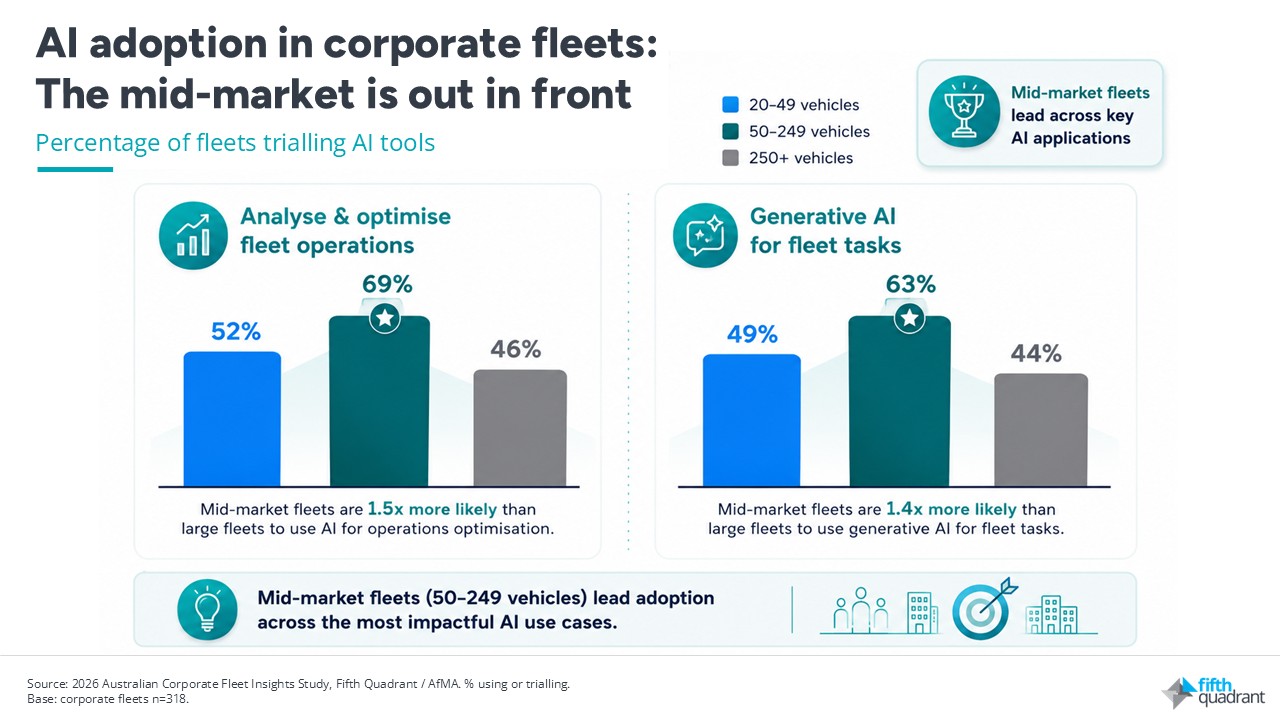
The pattern holds across all seven AI capabilities we measured, and it mirrors what we see in analytics investment, where mid-tier and Government fleets are the primary source of demand for the year ahead.
Why scale is slowing the giants
The barriers tell the story. When we asked fleets about their data and analytics challenges, the largest operators pointed overwhelmingly to people, with half citing a lack of in-house expertise or skilled personnel to analyse and interpret data. The talent constraint extends well beyond fleet, with the National AI Centre reporting that skills have overtaken technology as the main constraint on AI adoption across Australian businesses.
Mid-sized fleets point instead to integration, with 48% citing issues connecting new tools to existing systems, and larger operators name FMO data integration specifically.
Ultimately, the biggest fleets remain willing adopters. Legacy platforms, integration requirements and governance processes simply make every trial a larger undertaking. A 30-vehicle fleet can adopt an AI compliance tool in a week, while a 3,000-vehicle operator faces a much longer path.
The 10-19 vehicle opportunity
The same logic extends into the small fleet market, where the 10-19 vehicle tier stands out. Nearly half of these operators (47%) are already using or trialling AI for admin and compliance automation, and they are two to three times more likely than micro-operators to be analytically capable across almost every measure we track.
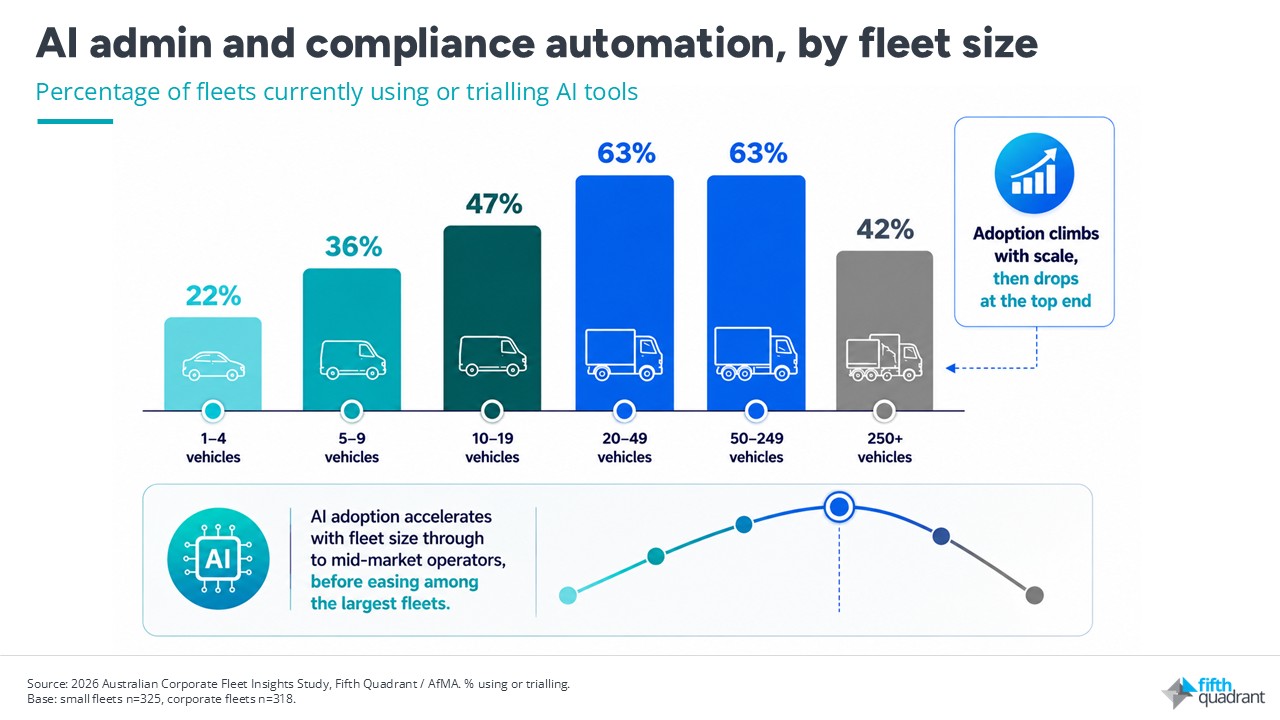
These businesses are big enough to understand the value and agile enough to move fast. They carry real operational complexity, without the committees that slow the top end down, and they are backing intent with budget, with nearly half of the 5-19 vehicle cohort planning to increase spend on data and analytics tools over the next 12 months.
The unclaimed opportunity: predictive maintenance
Predictive maintenance is the odd one out. It is the least developed analytics use case in the mid-market and across small fleets, despite speaking directly to the sector’s leading priority of reducing running costs.
The gap appears to be one of positioning rather than appetite. Fleets are not asking for machine learning on sensor data; they are asking for fewer breakdowns, lower repair bills and less unplanned downtime. Yet most pitches lead with the technology instead of the outcome. For providers, the play is to quantify the saving per vehicle per year, prove it on a subset of the fleet, and price against the maintenance budget rather than the IT budget.
What this means for fleet technology providers
The standard playbook, building for enterprise and selling down, is misaligned with how this market is actually adopting. It is also misaligned with where the accounts are: Australia has around 12,600 corporate fleets in the 20-49 vehicle tier and 9,700 at 50-249, against roughly 1,200 operators with 250 or more vehicles. The segment leading adoption is also the biggest by count.
Three adjustments follow from the data. Providers need tier-specific propositions, because the mid-market wants integration-light tools that work out of the box, while the big end needs services and talent as much as software. Sales targeting should weight the 20-249 vehicle segment, where adoption appetite and speed are highest. And FMOs sit in the middle of all this, because the integration operators keep asking for runs through FMO data, making partnership as important as product.
At Fifth Quadrant, our fleet research program with AfMA has tracked this market since 2018.
The 2026 Australian Corporate Fleet Insights Report and 2026 Australian Small Fleet Insights Report are now available. Click here to request a copy of the reports, and a member of the Fifth Quadrant team will contact you to discuss your requirements or sign up for our monthly insights.
This article draws on findings from the 2026 Australian Corporate Fleet Insights Study, conducted by Fifth Quadrant in partnership with the Australasian Fleet Management Association (AfMA), with supporting context from the Australian Government’s National AI Centre AI Adoption Tracker.
Posted in Auto & Mobility, QN