

What August’s approvals tell us about the 2029 housing target
Author: James Organ | Posted On: 19 Oct 2026
What do Australian housing approvals August 2026 reveal about the growing gap between houses and apartments, and what does this mean for the National Housing Accord’s 1.2 million-home target? The latest building approvals data highlights a widening divide in Australia’s residential construction market, with important implications for developers, builders, lenders and the broader built environment.
The headline hides the story
August’s building approvals look like a modest step back. Australian Bureau of Statistics (ABS) data shows total approvals fell 6.1% to 16,953 dwellings. Underneath that number, two very different markets are moving in opposite directions.
Private house approvals rose 3.7% to 10,885, the highest since August 2021. Approvals for private sector dwellings excluding houses, including apartments and townhouses, fell 21.2% to 5,674. Meeting the 2029 housing target needs both segments working, and right now only one of them is showing sustained momentum.
The 2029 target comes from the National Housing Accord, which commits all levels of government to supporting the delivery of 1.2 million new homes between July 2024 and June 2029. That works out at around 240,000 homes a year. The National Housing Supply and Affordability Council’s August 2026 Quarterly Report now expects the target to be reached in the December quarter of 2030, about 18 months late. Approvals are an early signal of where completions are heading, which is why a shift in their mix is worth watching.
Where the split shows up
ABS Building Approvals, Australia, August 2026, released 30 September 2026. September 2024 to August 2026.
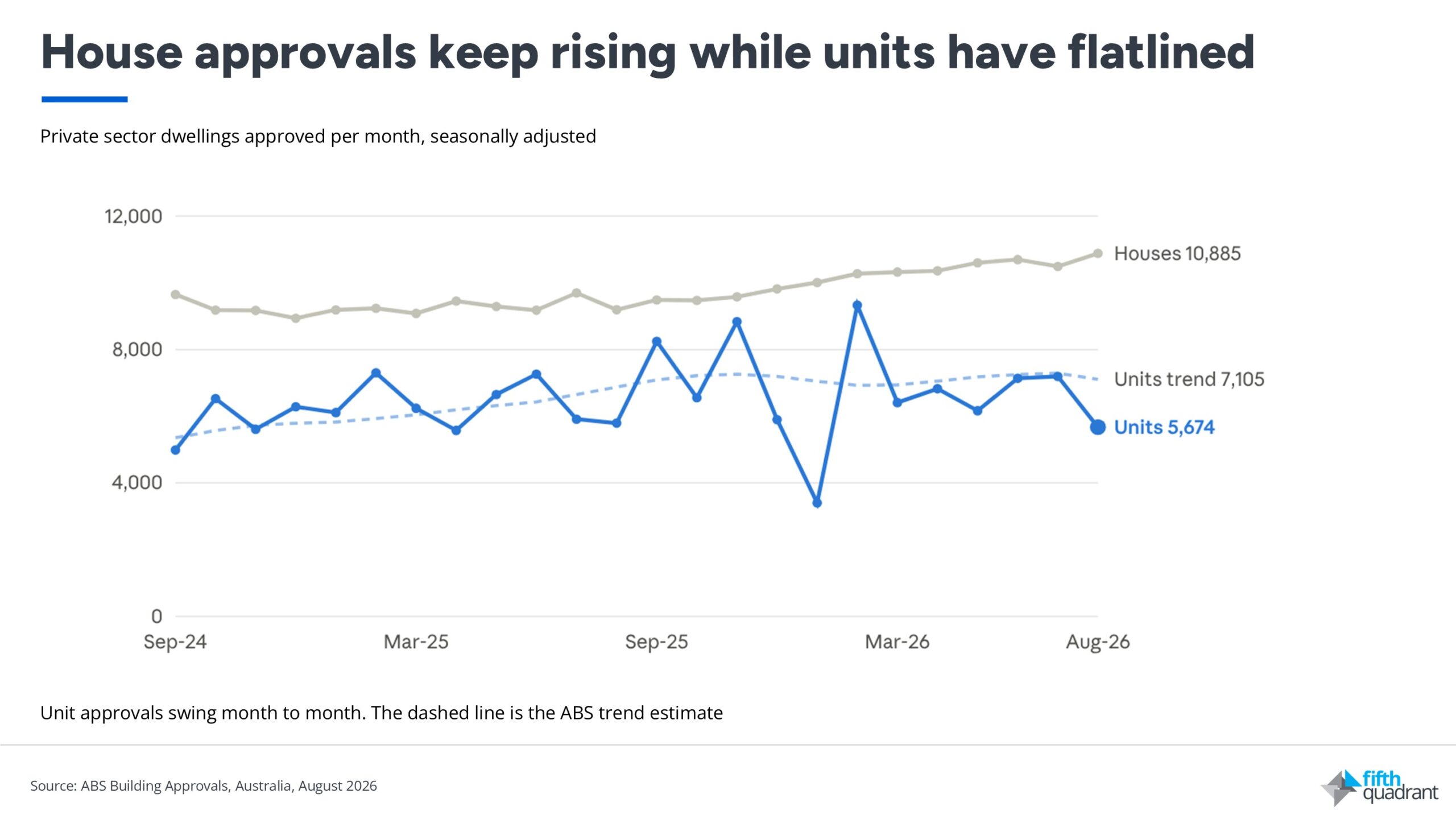
One month of data can be noisy, and approvals for apartments and other attached dwellings are lumpy because a single large project can swing the total. In trend terms, private sector dwellings excluding houses eased a more modest 2.6% in August and were still 3.3% higher than a year ago. House approvals tell a steadier story, up 18.4% on August 2025 in seasonally adjusted terms.
So August is a warning sign rather than proof of a collapse. But it lands on top of a year in which houses have done much of the lifting.
Activity is uneven rather than absent. Adelaide approved around 1,400 residential and student apartments across five projects in late September, representing more than 1,600 beds. Strong results in one city are not enough to offset a national decline of this size, though.
For the built environment industry, the distinction matters. Australia does not simply need more housing approvals. It needs a pipeline of viable projects that can move through financing, procurement and construction to completion, particularly in higher-density markets where delivery is more complex.
Why apartments are stalling
Four pressures are landing on apartment projects at the same time.
- Finance. Investors are a key source of demand for off-the-plan apartments. According to the ABS Lending Indicators, the value of new investor housing loan commitments fell 10.2% in the June quarter, while the number of commitments declined 8.6%. Softer investor lending creates another hurdle for developments that depend on presales to secure construction finance.
- Prices. Westpac’s September 2026 Housing Pulse forecasts a 7.3% peak-to-trough fall in dwelling prices. Housing turnover remains weak, with Westpac pointing to a broader correction in prices and market activity. For apartment developers, weaker prices can narrow the margin between expected sales revenue and the cost of delivery.
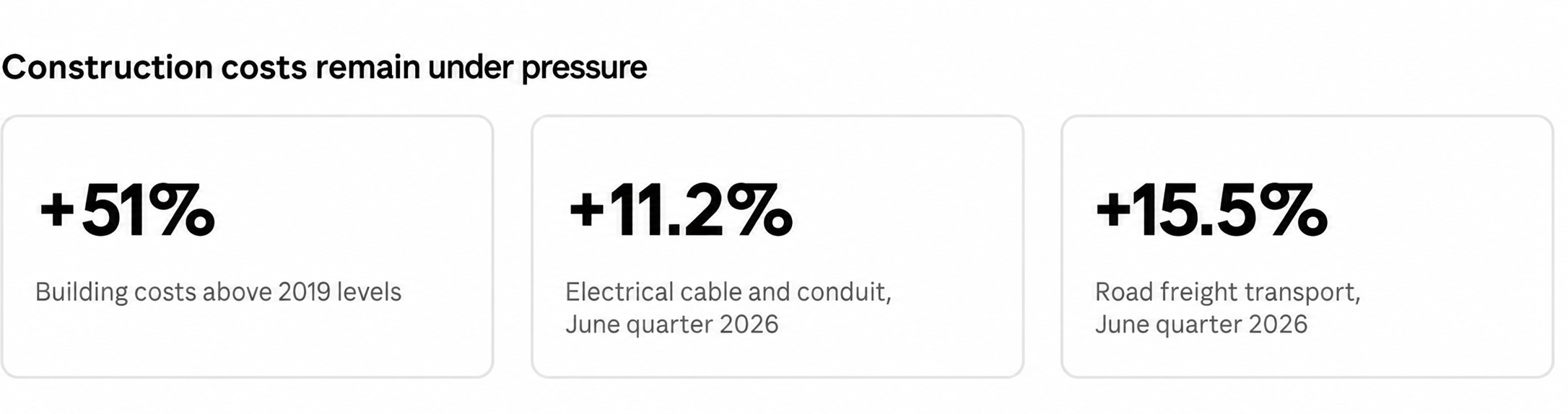
- Costs. Building costs remain around 51% above pre-pandemic levels, according to the National Housing Supply and Affordability Council. Further increases in material and construction costs are putting pressure on project feasibility, particularly where developments require lengthy construction programs and substantial upfront capital.
- Labour. Skilled labour shortages remain a constraint on housing delivery. September 2026 migration reforms prioritise construction occupations while the government forecasts net overseas migration of 245,000 in 2026–27. The net effect on the construction trades pipeline is still unclear.
Detached homes face the same cost and labour pressures. They rely less on large-scale investor presales and are generally quicker to get started, which goes some way to explaining why the two segments are pulling apart.
The challenge for apartment development is not simply whether there is demand for more housing. It is whether projects can achieve acceptable returns after accounting for financing conditions, construction costs, presale requirements and delivery risk.
Who is filling the gap
The builders still standing are changing. In FY2026, 3,472 construction companies entered insolvency, representing about a quarter of all company insolvency appointments nationally. The sector remains under significant financial pressure, while well-capitalised Japanese groups are expanding their presence in Australia’s residential construction market.
- Sumitomo Forestry, which owns Metricon, Henley and other Australian building businesses, topped the HIA Housing 100 for 2025–26 with 8,038 commencements.
- Sekisui Chemical agreed to pay approximately $335 million for a 51% stake in Brisbane-based Ausbuild, pairing Ausbuild’s development pipeline with the Japanese group’s manufacturing and housing expertise. The transaction was announced in September 2026.
Offsite manufacturing is also moving from pilots towards industrial-scale production. Built and Wesfarmers’ Built Living venture is developing a component manufacturing facility at Neerabup in WA, supported by $240 million in combined federal investment, private equity and state government funding. It is designed to produce components for more than 2,000 apartments a year, with first manufacturing output targeted for early 2028, subject to approvals.
In Sydney, Freecity’s 20-storey modular student accommodation tower at Macquarie Park reached level 12 in September, using imported modules with internal finishes and facade elements already installed.
Neither trend is likely to close the apartment shortfall before 2028. Both point to where new delivery capacity is likely to come from after that.
They also signal a potential shift in the industry’s competitive structure. Capital strength, access to manufacturing technology and the ability to manage construction risk at scale may become increasingly important differentiators.
What it means for the industry
- Developers. Feasibility on high-density sites is being squeezed from three directions at once, through softer prices, slower investor finance and higher build costs. Projects that stacked up on 2024 assumptions are worth re-testing.
- Lenders and insurers. Apartment pipelines are worth stress-testing against further weakness in attached-dwelling approvals and presales, rather than relying on headline housing data.
- Policymakers. A target assessed through total approvals can look closer to being on track than the underlying delivery pipeline suggests. Reporting houses and higher-density dwellings separately gives a clearer read on whether density-led supply is being delivered. Ultimately, completions rather than approvals determine progress towards the Accord target.
- Builders and suppliers. Better-capitalised and factory-backed competitors are entering the market. Smaller builders and trade suppliers need a clear view of where they fit as that happens.
The 2029 target is increasingly a question of apartment and higher-density housing delivery rather than housing supply in general. That is where the attention, and the evidence base, needs to go next.
Understanding these shifts requires more than tracking approval volumes. It means examining how market conditions influence development feasibility, investment decisions, construction capacity and the willingness of industry participants to commit to new projects.
Fifth Quadrant tracks sentiment and decision-making across Australia’s built environment. Through market research and industry intelligence, we help businesses understand emerging risks, changing customer priorities and the forces shaping housing and construction activity. Get in touch to talk about what these shifts mean for your business.
Sources: This article draws on the Australian Bureau of Statistics’ Building Approvals, Australia, August 2026 and Lending Indicators, June Quarter 2026; the National Housing Supply and Affordability Council’s August 2026 Quarterly Report; Westpac’s September 2026 Housing Pulse; and the HIA Housing 100. Additional reporting and announcements from InDaily, Arnold Bloch Leibler, Built, Inside Construction and the Australian Government provide context on apartment development, industry consolidation, prefabricated construction and skilled migration. Statistics and forecasts reflect information available as at October 2026.
Posted in Built Environment, B2B, Consumer & Retail, Social & Government, Uncategorized