
The household energy squeeze: Are consumers being rewarded for powering the transition?
Author: Hannah Hewes | Posted On: 02 Jul 2026
Are Australian households being fairly rewarded for helping power the energy transition?
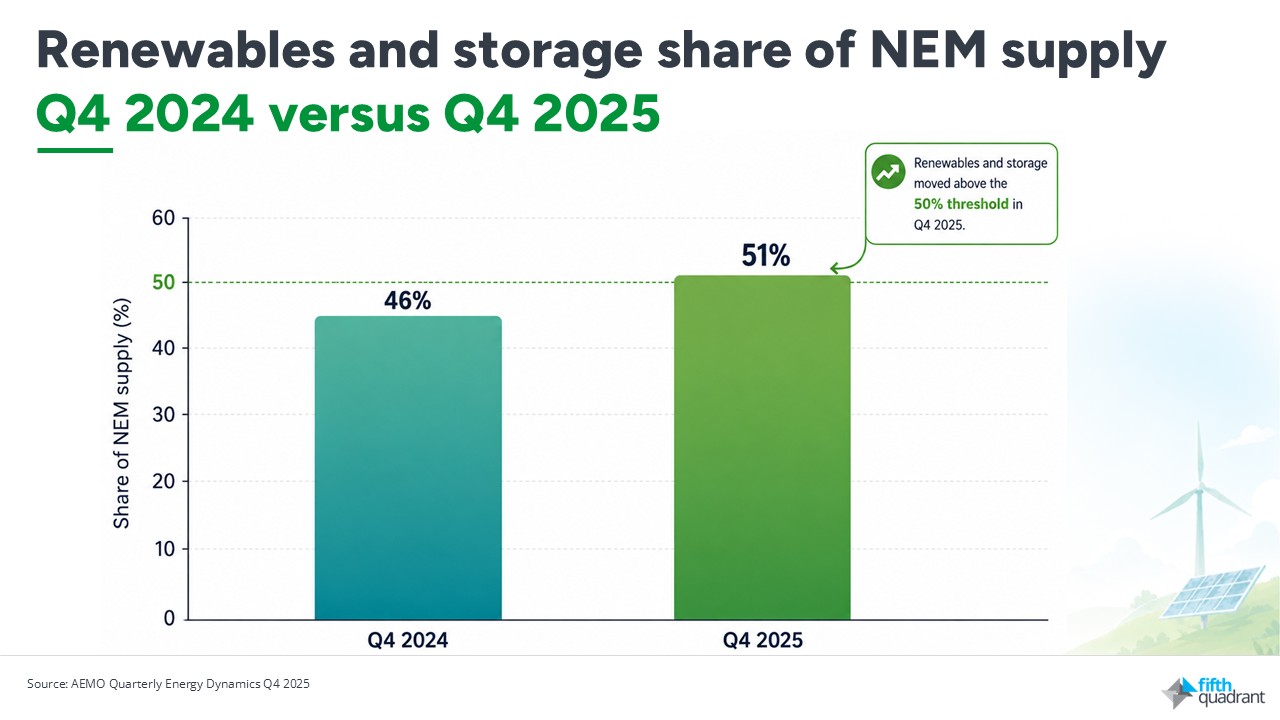
In our previous blog, “What 50% renewables means for Australia’s electricity system” we explored how Australia’s electricity system crossed a critical threshold, with renewables and storage supplying more than half of electricity across the National Electricity Market for the first time in the final quarter of 2025.
That milestone showed how far the supply side of the energy transition has come. Renewables are no longer a marginal contributor to the grid. They are increasingly shaping how electricity is generated, priced and managed.
But the next phase of Australia’s energy transition will also be shaped by millions of household decisions: whether to electrify heating and cooling, install a battery, upgrade an inverter, join a virtual power plant or use electricity at different times of day.
This is where the transition becomes more personal, and more complicated.
From renewable generation to household optimisation
AEMO’s latest Quarterly Energy Dynamics report shows that renewables and storage supplied 51.0% of NEM electricity in Q4 2025, up from 46% a year earlier.
However, higher renewable supply does not automatically mean households receive a fairer or simpler energy outcome. Many are now facing a more complex set of choices than ever before.
For years, rooftop solar was sold on a relatively simple promise: generate power during the day, use what you can and export the rest back to the grid. Feed-in tariffs helped households recover the cost of their investment and made solar feel like a straightforward financial decision.
That equation is changing.
The falling value of solar exports
As rooftop solar has scaled, daytime exports have become less valuable to the grid. The shift is clear when current feed-in tariffs are compared with those available five years ago.
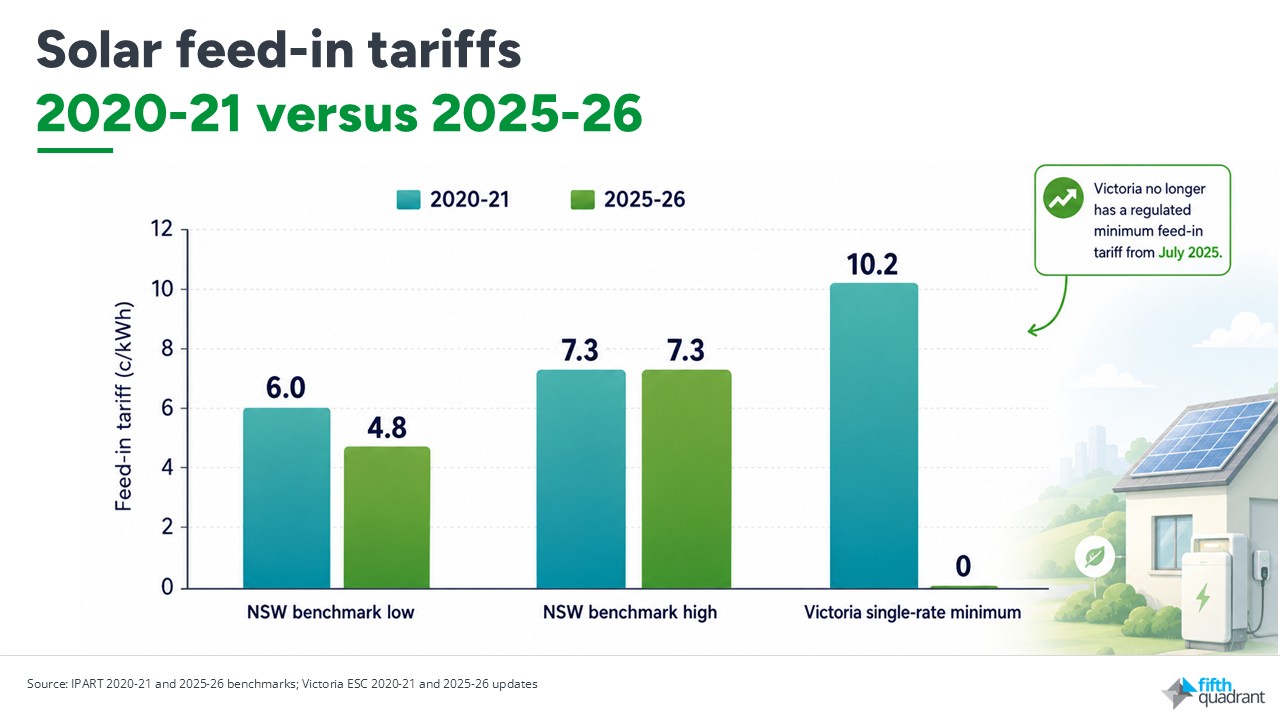
In NSW, IPART’s benchmark range for solar feed-in tariffs was 6.0 to 7.3 cents per kWh in 2020-21. For 2025-26, the flat-rate benchmark is 4.8 to 7.3 cents per kWh. While the top of the range is unchanged, the lower end has fallen, and IPART has noted that as more customers export excess solar during the day, the value of that electricity is likely to remain low.
Victoria shows the shift more sharply. In 2020-21, the regulated minimum single-rate feed-in tariff was 10.2 cents per kWh, with time-varying rates between 9.1 and 12.5 cents per kWh. From 1 July 2025, the Essential Services Commission no longer sets a minimum feed-in tariff, and retailers can set their own rates as long as they do not fall below zero.
This matters because solar households are increasingly being told that the real value is no longer in exporting excess electricity, but in using more of their own solar, storing it in batteries and avoiding expensive grid imports during peak periods.
That may be rational for the energy system, but it changes the household economics. Consumers who invested in rooftop solar expecting export credits to support payback are now being pushed toward another investment cycle. For some, that means batteries. For others, it may mean smart inverters, new tariffs, automation platforms or replacing equipment that is only a few years old.
The risk is that households carry more of the cost and complexity of the transition while receiving less value for the energy they export.
Batteries are becoming the next stage of rooftop solar
The federal Cheaper Home Batteries Program is accelerating the shift toward storage, offering a discount of around 30% on eligible small-scale battery systems connected to new or existing rooftop solar.
The Clean Energy Council reported that 183,245 batteries were sold in Australia in the second half of 2025 alone, more than the previous four years combined.
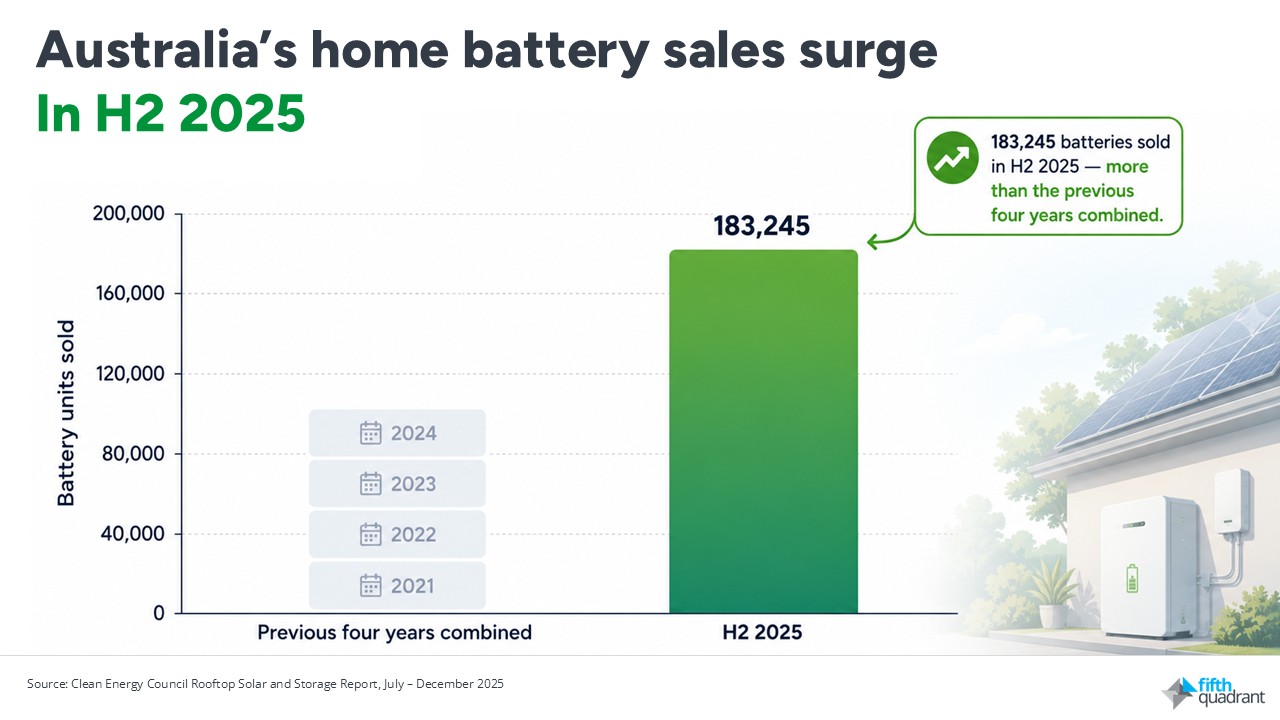
This shows households are moving from solar generation to energy optimisation. The goal is no longer simply to produce electricity. It is to control when electricity is used, stored and exported.
Companies such as Amber are changing this market. Amber’s SmartShift technology combines dynamic wholesale pricing with battery automation, helping customers charge or export at more valuable times. This type of model gives households the potential to capture more value than they would under a standard flat feed-in tariff.
But it also highlights the growing complexity of household energy. Dynamic pricing, wholesale market exposure, automation settings, battery compatibility and inverter requirements are not simple decisions for most consumers.
Air-conditioner rebates are positive, but not the whole answer
State government air-conditioner rebates are another important part of the picture. NSW provides upfront discounts for efficient reverse-cycle air conditioners, while Victoria’s Energy Upgrades program promotes heating and cooling discounts that can reduce upfront costs and annual energy bills.
These programs are positive. Efficient reverse-cycle air conditioning can reduce emissions, improve comfort and lower running costs, especially where it replaces inefficient appliances or gas heating.
However, the system-level benefits depend on when and how electricity is used. An efficient air conditioner running during a solar-rich part of the day can help absorb low-cost renewable energy. The same appliance running during the evening peak can add pressure to the grid.
That means appliance rebates, batteries and solar tariffs cannot be viewed separately. They are all part of the same household optimisation challenge.
The real question is fairness
Australia’s energy transition is moving from generation to coordination. We are no longer only asking whether enough renewable energy can be built. We are asking whether households, retailers, networks and policymakers can work together so flexible demand is properly rewarded.
If households are expected to install efficient appliances, batteries and smart technology, they need clearer incentives and simpler pathways. If solar exports are worth less during the day, households need practical ways to use or store more of that energy. If batteries can support the grid, households need to understand how they are being paid for that flexibility and what risks they are taking on.
For organisations navigating this next phase of Australia’s energy transition, Fifth Quadrant’s energy transition market research can help identify how households and businesses understand, adopt and value new energy technologies, tariffs and incentives. We support evidence-based decisions across electrification, solar, batteries, retail energy, policy and customer behaviour. Contact us to discuss how research can help your organisation make smarter decisions in a more complex energy market.
This article draws on AEMO’s Q4 2025 Quarterly Energy Dynamics report, which found renewables and storage supplied 51.0% of NEM electricity in Q4 2025; IPART’s 2025-26 NSW solar feed-in tariff benchmark of 4.8 to 7.3 cents per kWh; the Victorian Essential Services Commission’s update that it no longer sets minimum feed-in tariffs from 1 July 2025; the Clean Energy Council’s July to December 2025 Rooftop Solar and Storage Report, which reported 183,245 batteries sold in the second half of 2025; the Australian Government’s Cheaper Home Batteries Program; NSW and Victorian air-conditioner rebate information; and Amber’s SmartShift information on dynamic wholesale pricing and battery optimisation.
Posted in Energy Transition, Consumer & Retail, Social & Government, TL