

When life gets harder, the world gets smaller
Author: James Organ | Posted On: 30 Sep 2026
What is the finite pool of worry, and could it explain why Australians’ personal circumstances shape the issues they care about most?
You might assume Australians who are unhappy with their lives would also be the most worried about the world around them.
Our Consumer Tracker shows the opposite. In September 2026, 77% of Australians who described themselves as happy were concerned about scams and cyber threats, compared with 60% of those who were unhappy.
And it isn’t just cybercrime. Happy Australians were more concerned than unhappy Australians about every major issue we track, including climate change, domestic violence and inequality.
At first glance, that seems counterintuitive. Why would people who feel better about their own lives be more worried about everything else?
The answer may be surprisingly simple: when people are struggling with what is directly in front of them, there is less attention left for everything beyond it.
Pressure changes what gets our attention
Australians have been dealing with sustained pressure on household finances for several years.
In August 2024 our Consumer Tracker found 37% were struggling to meet household expenses, including around one in ten who could not meet all their bills. At the time, 62% expected the cost of living to get worse over the following 12 months.
By September 2026, satisfaction with several parts of life had weakened further. Dissatisfaction with mental health had risen from 21% to 25%, dissatisfaction with work/life balance from 16% to 20%, and dissatisfaction with career from 19% to 24%.
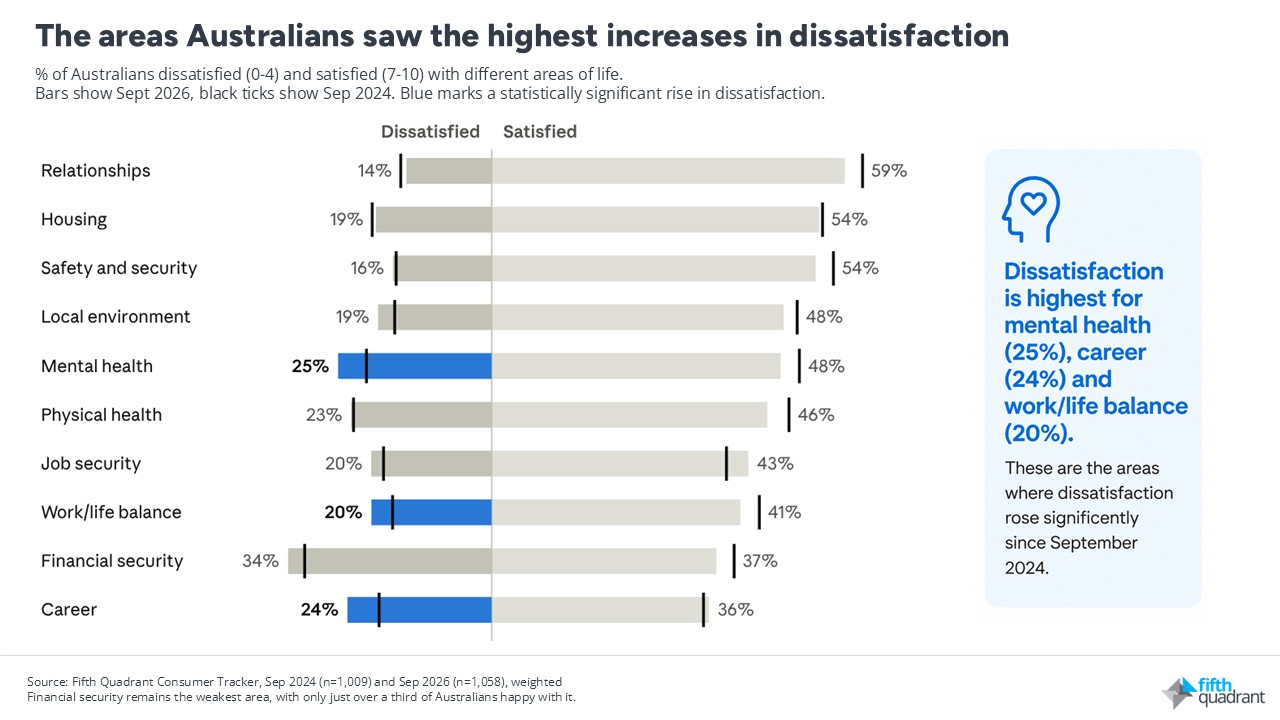
Financial security remained the weakest area of personal wellbeing, with only a little over a third of Australians satisfied with their position.
Against that backdrop, something else happened: concern about several broader social issues softened.
That does not necessarily mean Australians suddenly care less.
It may mean they have more immediate things to worry about.
The people doing better personally are looking further outward
Our Consumer Tracker asks Australians to rate how happy they feel at the moment on a scale from 0 to 10.
In September 2026, people scoring 7 or higher were more concerned than those scoring 4 or lower on all eight of the major issues we measured.
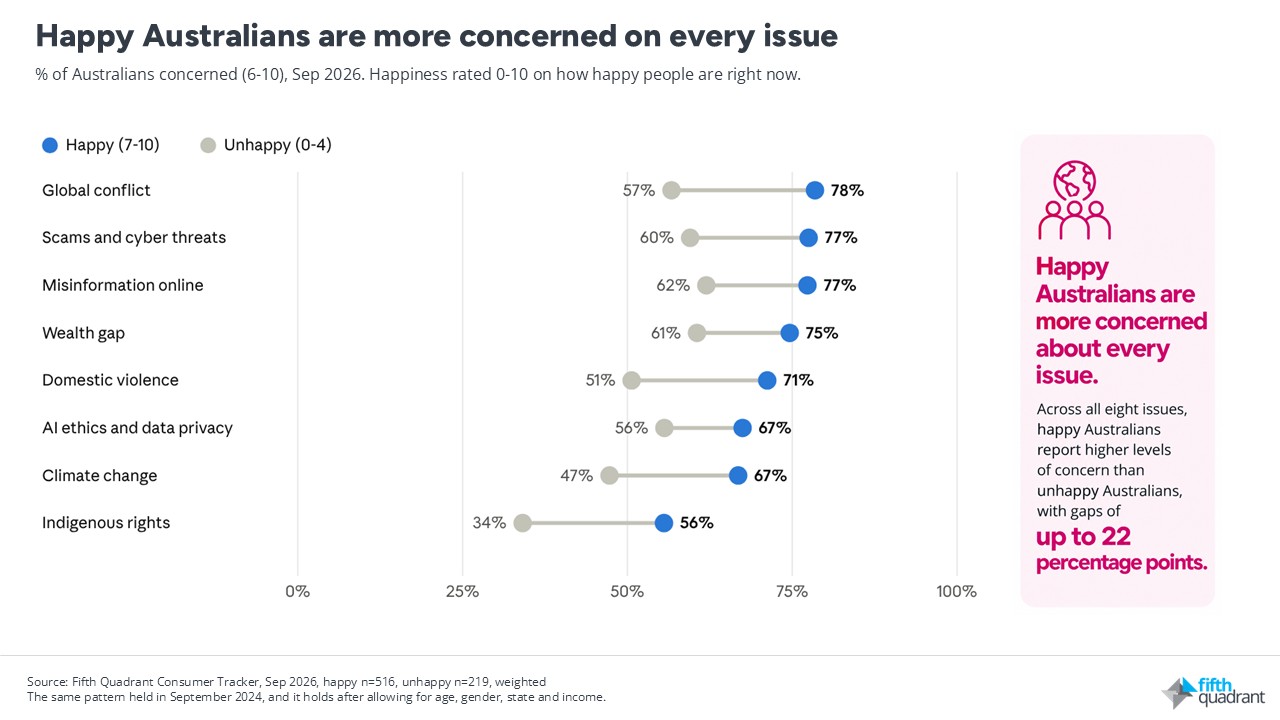
The same relationship appeared in our September 2024 results. It also remained after accounting for differences in age, gender, state and income.
So this is not simply a story about happy Australians being younger, older or wealthier.
There appears to be a broader relationship between how secure people feel in their own lives and how much attention they give to issues outside them.
We only have so much worry to go around
There is a useful idea in psychology known as the finite pool of worry.
Put simply, the hypothesis suggests that people have limited emotional and cognitive resources to devote to different threats. When one problem becomes immediate and personal, other concerns may receive less attention.
Research has produced mixed evidence for a literal finite pool of worry, but there is stronger evidence that attention itself is limited. Studies examining competing threats have found that increased attention to one problem can coincide with reduced attention to another, even when levels of worry do not necessarily fall in the same way.
That makes intuitive sense.
If you are worried about making the next mortgage payment, whether your job is safe or how much the weekly grocery shop is going to cost, those problems demand attention now.
Climate change, cybercrime or broader social inequality may still matter to you. They are simply competing with problems sitting much closer to home.
Research on scarcity from Princeton University points in the same direction, finding that financial concerns can consume cognitive resources, leaving less mental capacity available for other tasks.
Our data suggests that a similar narrowing of attention may be reflected in Australians’ attitudes.
Money changes the order of the worry list
The clearest example is climate change and inequality.
Among Australians who feel financially insecure, concern about the wealth gap sits 18 percentage points above concern about climate change.
Among financially secure Australians, the difference between the two issues is only five points.
We saw the same pattern in 2024.
That distinction matters.
For someone under financial pressure, inequality is not necessarily an abstract social issue. It can be experienced through rent, mortgage repayments, groceries, energy bills and the feeling that getting ahead is becoming harder.
Climate change may still be important, but inequality is being felt now.
For someone who feels secure financially, there is more room for both concerns to sit alongside each other.
Concern scores are not the same thing as values
This is where discerning interpretation matters.
A headline movement in the data rarely tells the whole story. A fall in concern about climate change, cyber security or domestic violence could easily be read as evidence that these issues matter less to Australians, or that people’s underlying values are changing. But looking at the results in isolation risks drawing the wrong conclusion.
The more revealing insight comes from understanding what sits behind the numbers. By examining concern alongside happiness, financial security and other measures of personal wellbeing, we can see a different dynamic at work: people under greater personal pressure may have less capacity to focus on issues beyond their immediate circumstances.
That distinction matters. Good research does more than report what has changed. It looks beyond the topline result to uncover the relationships in the data that help explain why it has changed, and what that really means for organisations making decisions based on those findings.
Why this matters for organisations
For businesses, governments and researchers, this changes how shifts in public opinion should be read.
Attitudes do not exist in isolation.
A period of financial stress, deteriorating wellbeing or economic uncertainty can change the relative importance people give to everything from sustainability and technology to social issues and public policy.
That means movements in headline concern scores should not automatically be interpreted as movements in underlying beliefs.
Understanding how people feel about their own lives helps explain why some issues rise up the agenda while others temporarily recede.
The bigger lesson from our tracker is simple:
When life becomes harder, people’s field of view gets smaller.
Australians who feel good about their own lives are not necessarily more anxious about the world. They may simply have more room to think about it.
The right decisions depend on understanding not just what people think, but why. At Fifth Quadrant, we look beyond the topline numbers to uncover the attitudes, pressures and behaviours shaping your customers and your market. If you need research that turns data into clear, actionable insight, contact us to discuss how we can help with your next market research project.
Sources: The Fifth Quadrant Consumer Tracker is a nationally representative survey of Australians aged 18 to 75. This analysis compares the September 2024 wave (n=1,009) with the September 2026 wave (n=1,058). Results are weighted by age, gender and state.
All measures use a 0 to 10 scale. Scores of 7 to 10 count as happy or satisfied and 0 to 4 as unhappy or dissatisfied. On issues, 6 to 10 counts as concerned and 0 to 4 as not concerned. Reported changes are significant at the 95% level, and relationships were tested while controlling for age, gender, state and income. The finite pool of worry hypothesis is associated with Elke Weber’s research on risk perception and climate change. Research by Anandi Mani, Sendhil Mullainathan, Eldar Shafir and Jiaying Zhao, published in Science, found that poverty-related financial concerns can consume mental resources and reduce cognitive capacity available for other tasks.
Posted in Consumer & Retail, B2B, Social & Government, Uncategorized