
Fleet safety: The hidden gap behind rising intentions
Author: Ben Selwyn | Posted On: 13 Jul 2026
Why are fleet safety policies and systems failing to keep pace with safety priorities across Australian fleets?
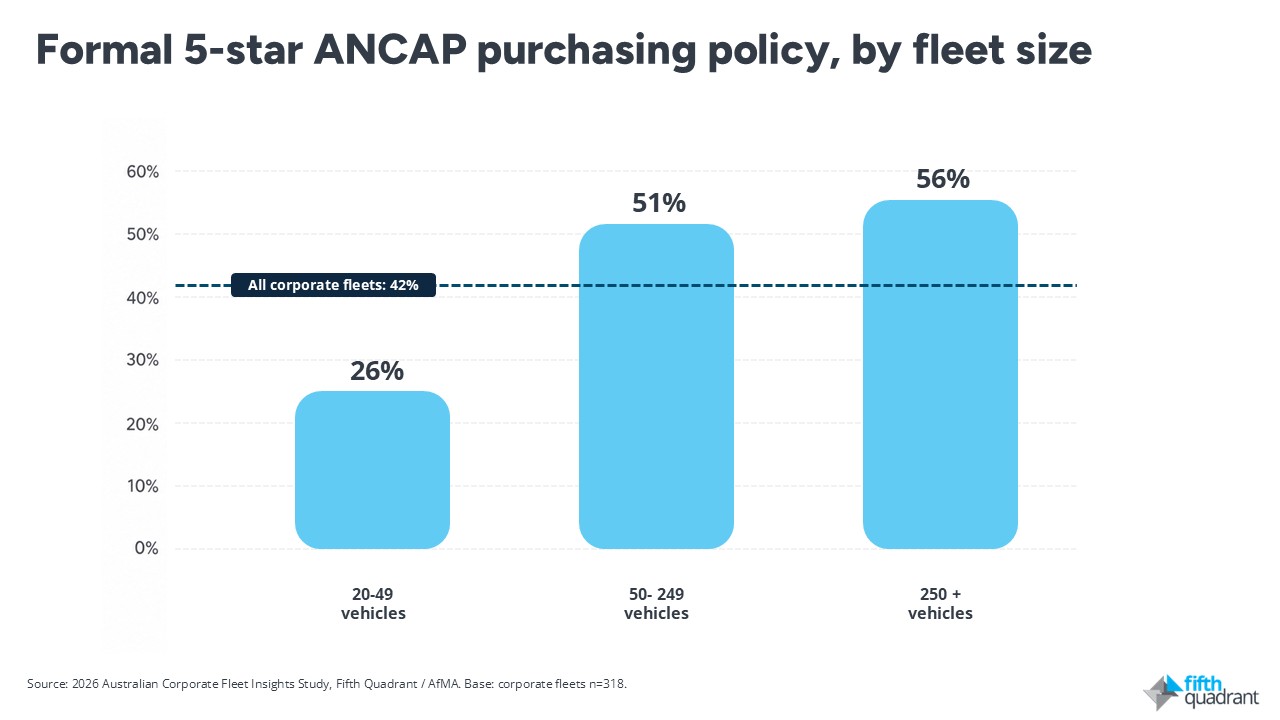
Fleet safety in Australia has become a top-tier priority for Australian operators. The 2026 Australian Corporate Fleet Insights Study, which Fifth Quadrant delivers in partnership with AfMA, found 69% of corporate fleet operators rating vehicle safety a high or top priority, with driver safety close behind at 68%. Yet only 42% of those same fleets hold a formal 5-star ANCAP purchasing policy. Safety is rising up the agenda, but for most operators the policies and systems have not yet caught up.
Priority without policy
The policy gap scales with fleet size. Among the largest corporate operators (250+ vehicles), 56% hold a formal 5-star ANCAP purchasing policy. At the 20-49 vehicle tier, that falls to 26%. Across the small fleet market (1-19 vehicles), just 25% have a purchasing policy, and 38% of operators hold no ANCAP position at all.
Knowledge gaps compound the problem. Only 36% of corporate fleets, and 20% of small fleets, are aware that ANCAP ratings expire after six years. An operator can believe they are running a 5-star fleet while holding ratings that lapsed years ago.
The grey fleet blind spot
While attention focuses on company vehicles, the risk is growing fastest outside them. Grey fleet use, employees driving their own vehicles for work, increased over the past year in more than four in ten corporate fleets, and most sharply in Retail & Hospitality where nearly two thirds report growth. Small fleets show the same pattern.
This matters because under work health and safety law, a vehicle used for work purposes is a workplace regardless of who owns it. Yet grey fleet vehicles sit outside purchasing policies, telematics coverage and maintenance schedules, and the research shows no clear signal that fleet managers are actively responding to the widening visibility and liability gap.
Safety tools scale with fleet size
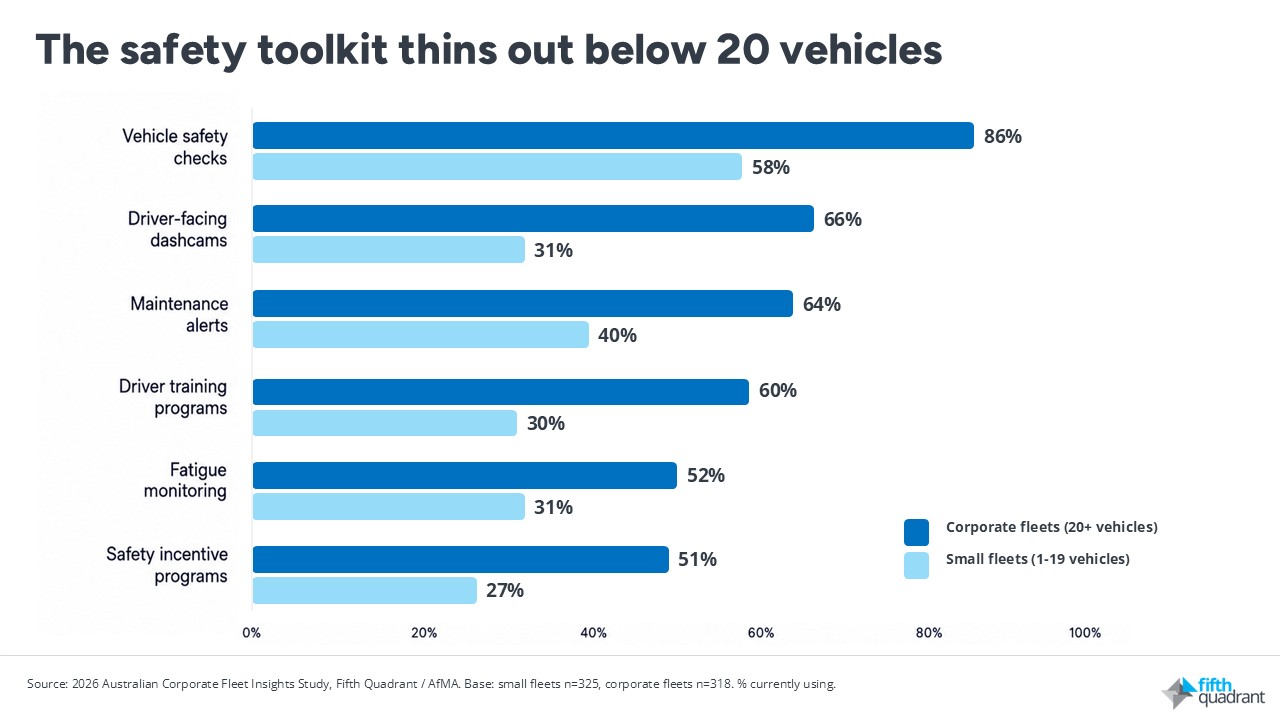
The safety toolkit follows the same size gradient as policy. Driver training programs are used by 60% of corporate fleets but only 30% of small fleets. Dashcams, fatigue monitoring and safety incentive programs all step down sharply below 20 vehicles. The composition of the toolkit matters as much as its breadth. Smaller operators concentrate instead on maintenance and fatigue monitoring, despite driver behaviour being where road safety research consistently locates the greatest risk.
What this means for the industry
For fleet suppliers, safety has become a selection issue. Operators are telling us that providers without a credible safety offer are misaligned with their expectations, and safety credentials increasingly function as a tie-breaker in otherwise price-led decisions. For insurers, the data shows where risk concentrates. The smaller the fleet, the wider the gap between safety sentiment and safety systems, and the greater the grey fleet exposure.
For ANCAP, government and industry bodies, this is an education opportunity. The smaller end of the market shows genuine interest in safety policy, and awareness is the main constraint on take-up. One in five corporate fleets would welcome an ANCAP rating for light trucks, and ANCAP’s own direction is converging on that gap, with tougher testing protocols introduced from January 2026 and plans to extend assessment to larger US-style pickups and light trucks.
There is also a positioning question for vehicle brands. A 5-star ANCAP rating is rated very or extremely important by 68% of corporate fleets when selecting a vehicle, ahead of brand image and dealer network. For many fleets, safety now carries more weight in the purchase decision than the attributes marketing budgets are typically built around.
Safety intentions have never been higher in the Australian fleet market, but the policies and systems to deliver them have not kept pace, particularly at the smaller end. For suppliers and industry bodies, that gap is a commercial and education opportunity.
At Fifth Quadrant, our fleet research program with AfMA has tracked this market since 2018.
The 2026 Australian Corporate Fleet Insights Report and 2026 Australian Small Fleet Insights Report are now available. Click here to request a copy of the reports, and a member of the Fifth Quadrant team will contact you to discuss your requirements or sign up for our monthly insights.
Sources referenced in this article include the 2026 Australian Corporate Fleet Insights Study, delivered by Fifth Quadrant in partnership with AfMA; ANCAP vehicle safety ratings and 2026 testing protocols; Australian work health and safety guidance relating to vehicles used for work; and road safety research on driver behaviour.
Posted in Auto & Mobility, B2B