
Most Australian AI has no safety net
Author: Dr Steve Nuttall | Posted On: 06 Jul 2026
How prepared is your organisation to use AI responsibly?
Since 2021, Fifth Quadrant’s Responsible AI Index has been measuring how well Australian organisations are turning responsible AI from principle into practice. It provides a national benchmark, and is aligned with the Australian Government’s Guidance for AI Adoption. For the 2025 edition, sponsored by the National AI Centre, we built the Responsible AI Self-Assessment Tool, an online version of the Index so that any organisation could assess itself and receive a tailored report. Nearly 250 organisations completed it, a strong signal of how seriously Australian businesses now take responsible AI. Here we set out the results, which reveal a gap between how seriously organisations take responsible AI and how little many have done to control it once a system is live.
How do organisations score overall?
On average, those organisations scored 44 out of 100. Scored the same way, the 2025 Responsible AI Index produced an almost identical 43. Two samples sitting within a point of each other suggests 44 is a fair reading of the national picture.
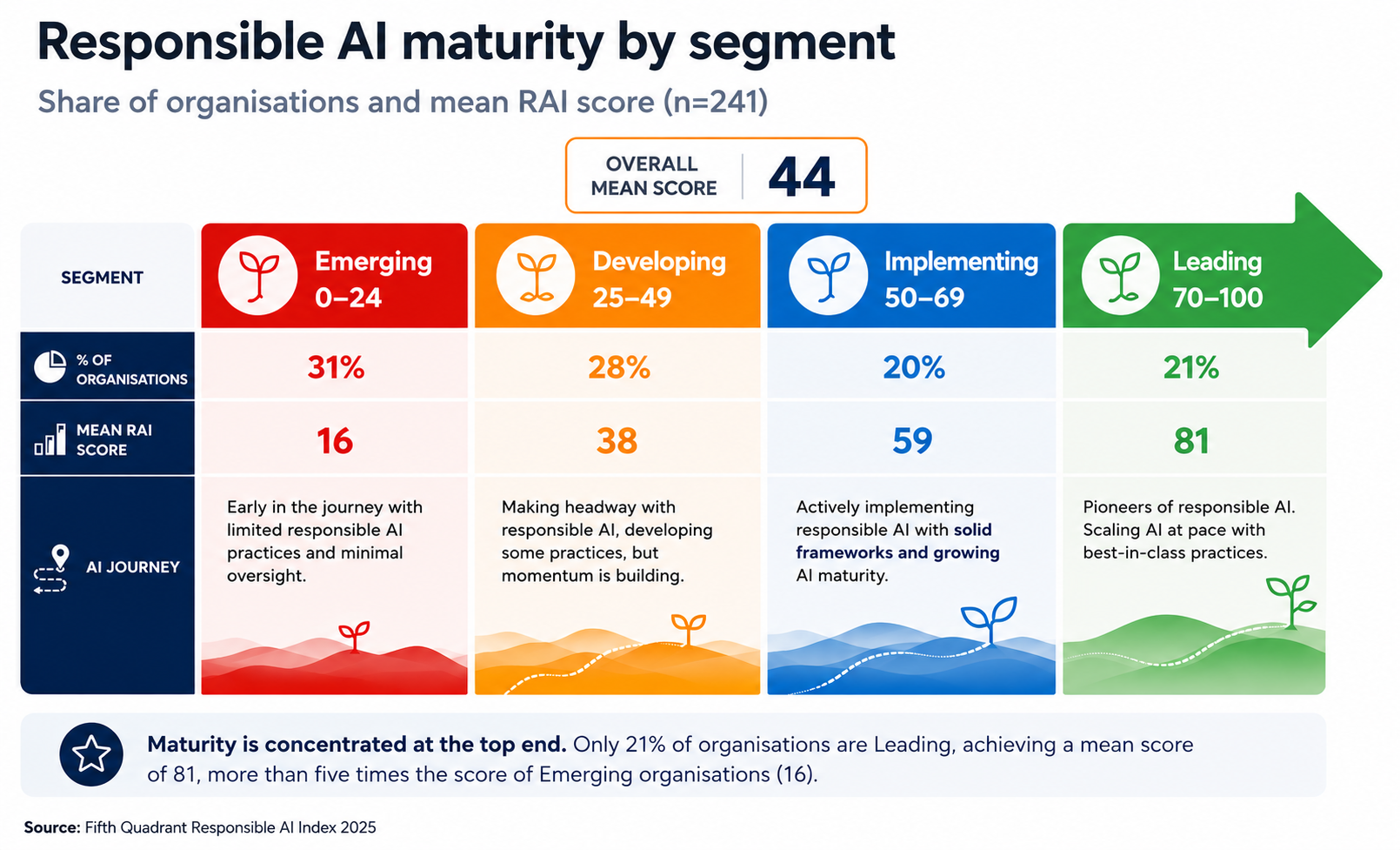
As shown in figure 1, organisations fall into four maturity segments based on their score. Just under a third (31%) sit in the Emerging segment, averaging 16 out of 100. At the other end, 21% reach the Leading segment, averaging 81. The most mature organisations are therefore operating at roughly five times the level of the least mature, which tells us responsible AI capability in Australia is concentrated in a minority of organisations that have moved well beyond policy statements into daily practice.
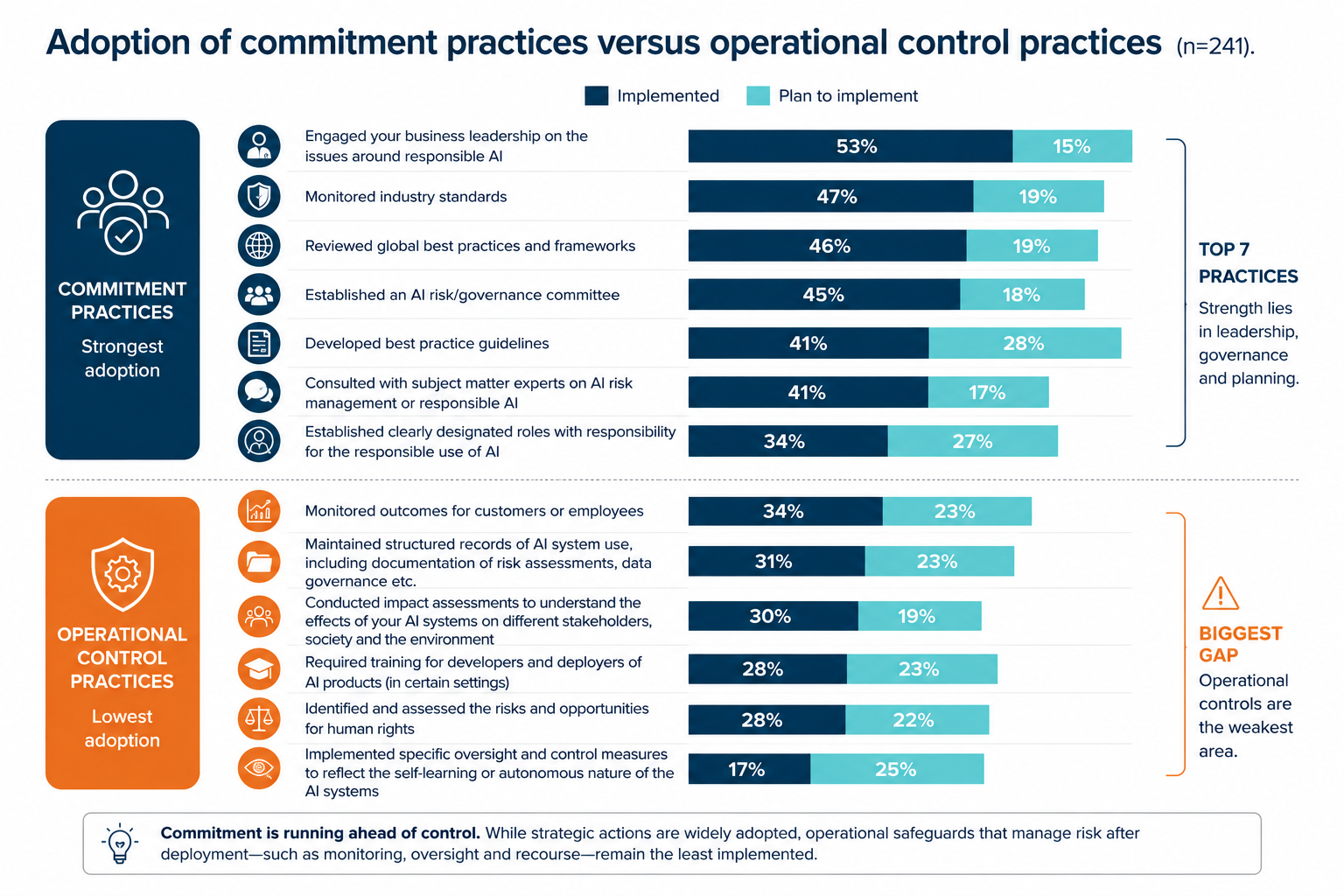
Behind that headline score sits a clear and uncomfortable pattern. The practices organisations have adopted most widely are the visible, strategic ones, such as engaging leadership and forming a governance committee. The practices they have adopted least are the operational safeguards that catch an AI system when it drifts or causes harm. Commitment is running ahead of control, and that gap could expose any organisation relying on AI in production.
Which practices have organisations adopted?
Figure 2 looks at which individual practices organisations have actually implemented, of which the strongest are governance and leadership actions. The single most common practice across the whole assessment is engaging business leadership on responsible AI, adopted by 53% of organisations. Monitoring industry standards (47%), reviewing global best practice (46%) and establishing an AI risk or governance committee (45%) follow close behind. Just over half (57%) have a responsible AI strategy tied to their wider business strategy. These are the foundations of responsible AI governance, and Australian organisations are laying them.
Where do the controls fall short?
The operational controls, the safety net that catches a system after it goes live, tell a different story, and most organisations do not have one. Only 17% have put in place oversight measures that reflect the self-learning or autonomous nature of their AI systems. This is the least adopted accountability practice in the assessment. Just 20% run robust processes to detect unintended consequences, model drift and emerging risks once a system is live. Recourse mechanisms for members of the public harmed by an AI system exist at only 21% of organisations. Each of these safeguards operates after deployment, when an AI system is making real decisions. They are the mechanisms that surface a model quietly degrading, or flag a system producing biased or unsafe outputs before customers feel the effect. Their absence means most organisations have a committee and a strategy but no safety net, almost nothing in place to detect or correct an AI failure once it happens.
The intent to close this gap is visible in the same data. A third of organisations (34%) plan to introduce monitoring for model drift, a quarter (25%) plan to add oversight for autonomous systems, and a similar share plan to build recourse mechanisms. For many organisations the controls are planned but not yet operational, and the open question is how quickly that planning becomes live, audited practice.
Why is fairness the weakest area?
The same pattern shows up across the five dimensions that make up the index. Four of the five score 9 or 10 out of 20. Fairness is the lowest, at 7. The practices beneath it are among the least adopted anywhere in the data, with 36% using tools to help mitigate bias and 32% reviewing their training data and algorithms for bias. For organisations applying AI to hiring, lending or other consequential decisions, fairness is where the distance between intent and practice is widest, and it is the dimension most likely to draw regulatory attention as AI assurance expectations tighten.
Asked to rate their own ability to use AI responsibly, organisations average just 5.9 out of 10, and that low mark sits close to their measured maturity rather than flattering it. They are not overstating their progress, and an accurate read of where they stand is the starting point for closing the gap. What remains is the harder, less visible work of operational control: monitoring systems in production, building recourse for the people they affect, and testing for bias and drift over time. In October 2025 the National AI Centre replaced the Voluntary AI Safety Standard’s ten guardrails with the Guidance for AI Adoption, six essential practices that point organisations towards exactly this work. The new guidance is more prescriptive than the standard it evolves, with a sharper emphasis on assessing AI systems across their whole lifecycle and reviewing them once they are live, which is precisely the operational control the data shows is thin. For boards and executives, the real question is whether the controls behind the strategy actually function when a system misbehaves. National policy points the same way and puts the weight on how each organisation operationalises responsible AI in practice. For most, the safety net is not yet there, and building it is the work that turns a responsible AI commitment into a responsible AI system.
Want to find out more? Explore our work on responsible AI to see how we help organisations move from commitment to control, or read the 2025 Responsible AI Index for the full national picture.
This article draws on findings from the Fifth Quadrant Australian Responsible AI Index 2025, sponsored by the National AI Centre, and the Australian Government’s Guidance for AI Adoption. Together, these provide a national benchmark for responsible AI maturity and best practice across Australian organisations. Learn more at www.fifthquadrant.com.au/responsible-ai-index and www.ai.gov.au.
Posted in B2B, Social & Government, Technology & Telco, Uncategorized