

Health, money and happiness. What’s driving Australia’s wellbeing divide?
Author: James Organ | Posted On: 18 Aug 2026
New Fifth Quadrant tracking shows that wellbeing in Australia is under pressure, with Australians feeling less positive about their health, but age alone does not explain the shift. Health, financial security and happiness are closely intertwined, with different generations experiencing different forms of pressure.
Australians are feeling less positive about their health.
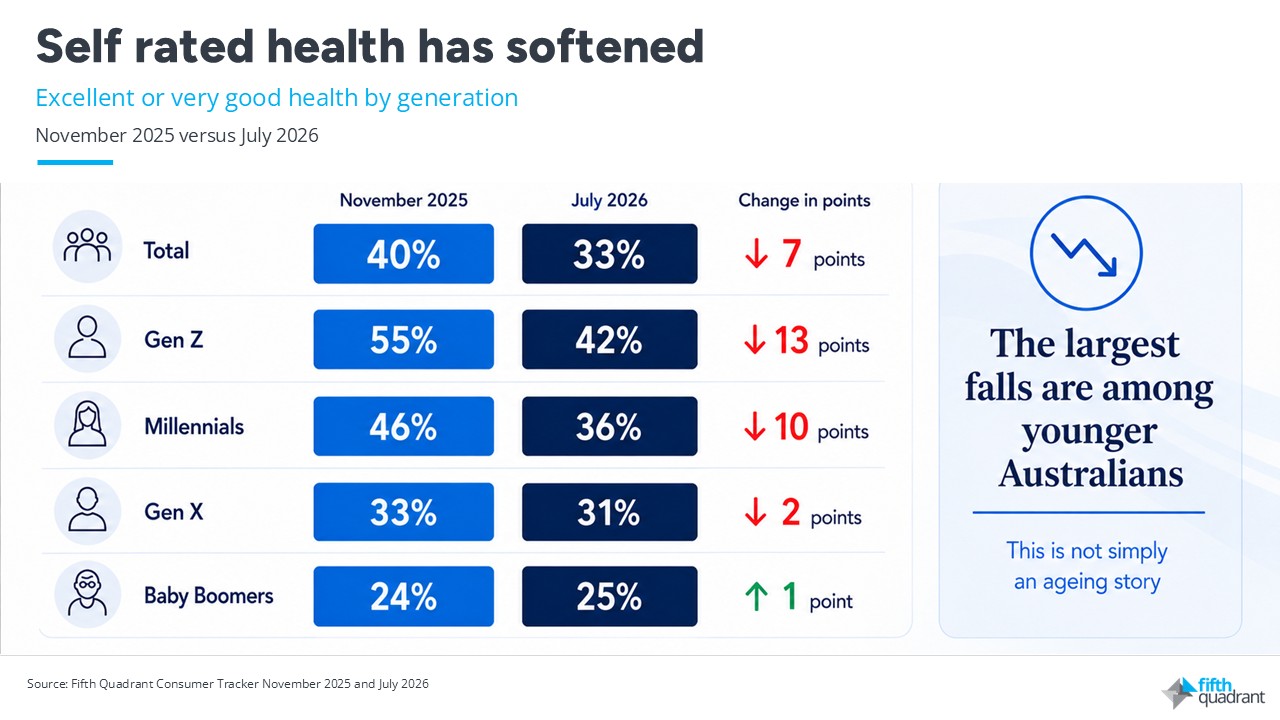
In November 2025, 40% rated their health as excellent or very good. By July 2026, that had fallen to 33%.
The shift has not been towards large numbers describing their health as poor. Instead, more Australians have moved towards the middle, rating their health as simply good.
Beneath the overall result is an even more interesting generational story.
Positive health ratings fell most sharply among younger Australians. The proportion of Gen Z rating their health excellent or very good dropped from 55% to 42%, while Millennials fell from 46% to 36%. Gen X was relatively stable at 33% to 31%, while Baby Boomers remained unchanged at around one quarter.
This is clearly not simply a story about declining health as Australians get older.
Millennials are feeling the broadest squeeze
Looking beyond self rated health provides a clearer picture of what is happening.
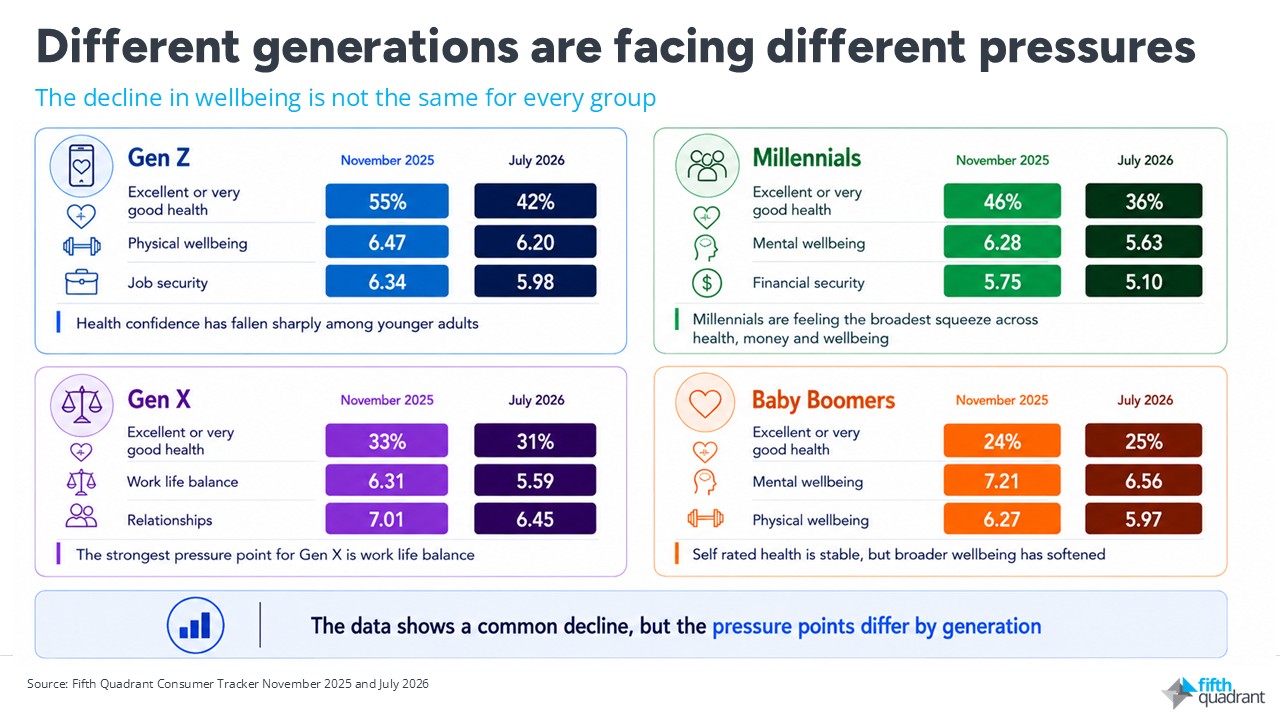
Millennials recorded declines across all of the major wellbeing dimensions tracked between November and July. Mental wellbeing fell from 6.28 to 5.63 out of 10, financial security from 5.75 to 5.10, happiness from 6.44 to 5.95 and physical wellbeing from 6.31 to 5.93.
Their financial position has also become more difficult. The proportion saying they have enough money to live comfortably fell from 23% to 15%, while those unable to meet their expenses increased from 8% to 15%.
For Millennials, health, money and happiness appear to be moving in the same direction.
Other generations show different pressure points. Gen Z recorded the largest decline in excellent or very good health and weaker physical wellbeing and job security. Gen X saw relatively little movement in self rated health, but a substantial decline in work life balance and weaker relationships. Baby Boomers remain comparatively positive on many measures, but mental and physical wellbeing have also softened.
Health matters more than age alone
The differences between generations are significant, but an even larger divide emerges when Australians are grouped according to their health status.
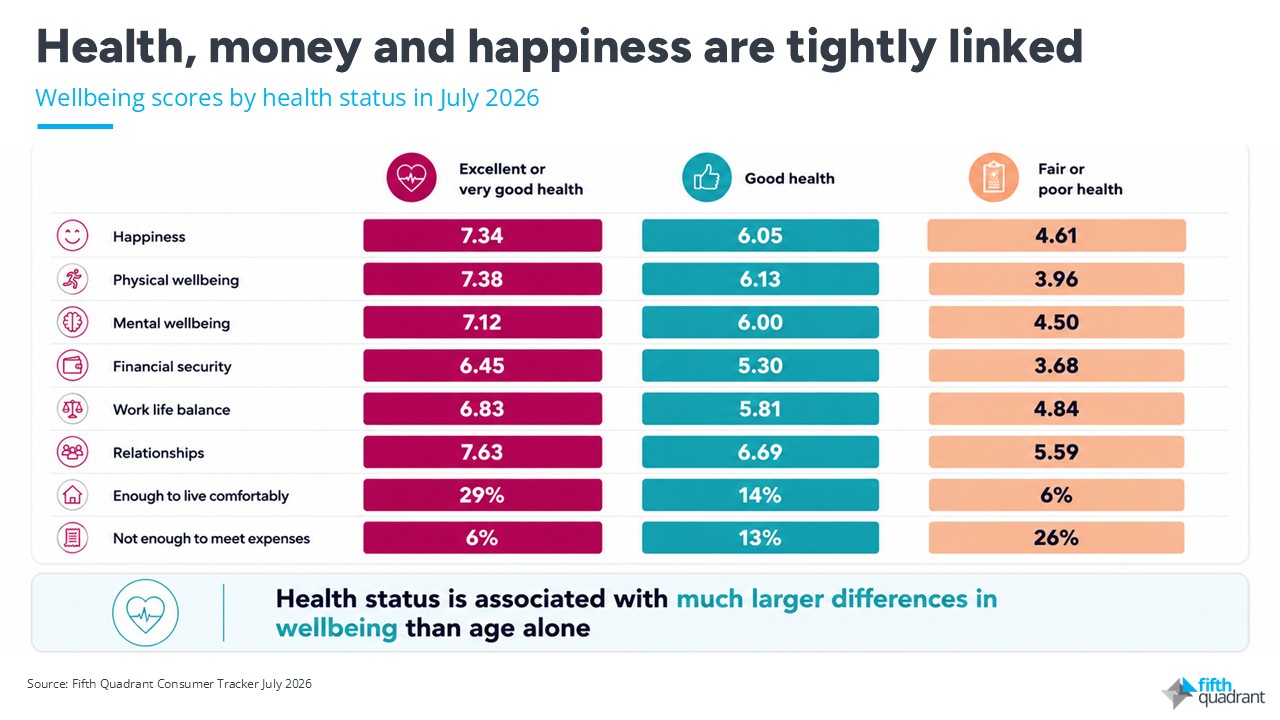
In July 2026, people who rated their health as excellent or very good reported average happiness of 7.34 out of 10. Among those in fair or poor health, happiness was just 4.61.
The pattern extends across almost every aspect of wellbeing.
Physical wellbeing falls from 7.38 to 3.96 between those in excellent or very good health and those in fair or poor health. Mental wellbeing falls from 7.12 to 4.50, financial security from 6.45 to 3.68, work life balance from 6.83 to 4.84 and relationship satisfaction from 7.63 to 5.59.
The financial divide is equally striking. Almost three in ten Australians in excellent or very good health say they have enough money to live comfortably. Among those in fair or poor health, only 6% say the same. Conversely, 26% of those in fair or poor health do not have enough to meet their expenses, compared with just 6% among those in excellent or very good health.
This does not mean health alone causes happiness or financial security. The relationship can work in multiple directions. Financial stress can affect wellbeing, while poor health can affect people’s ability to work, earn and participate fully in everyday life.
What the findings do show is that health status is associated with much larger differences in wellbeing than age alone.
The experience of healthcare also differs sharply
The connection between health and financial wellbeing becomes even more important when we look at people’s experience of the healthcare system. Australians in excellent or very good health are considerably more positive about the care they receive than those in fair or poor health.
Among those in excellent or very good health, 87% rate ease of accessing care positively, compared with 56% among those in fair or poor health. The equivalent figures are 86% versus 60% for quality of care and 85% versus 54% for trust in the healthcare system.
The largest gap is affordability. 82% of those in excellent or very good health rate affordability positively, compared with just 47% of those in fair or poor health.
This is particularly concerning because cost is already influencing healthcare decisions.
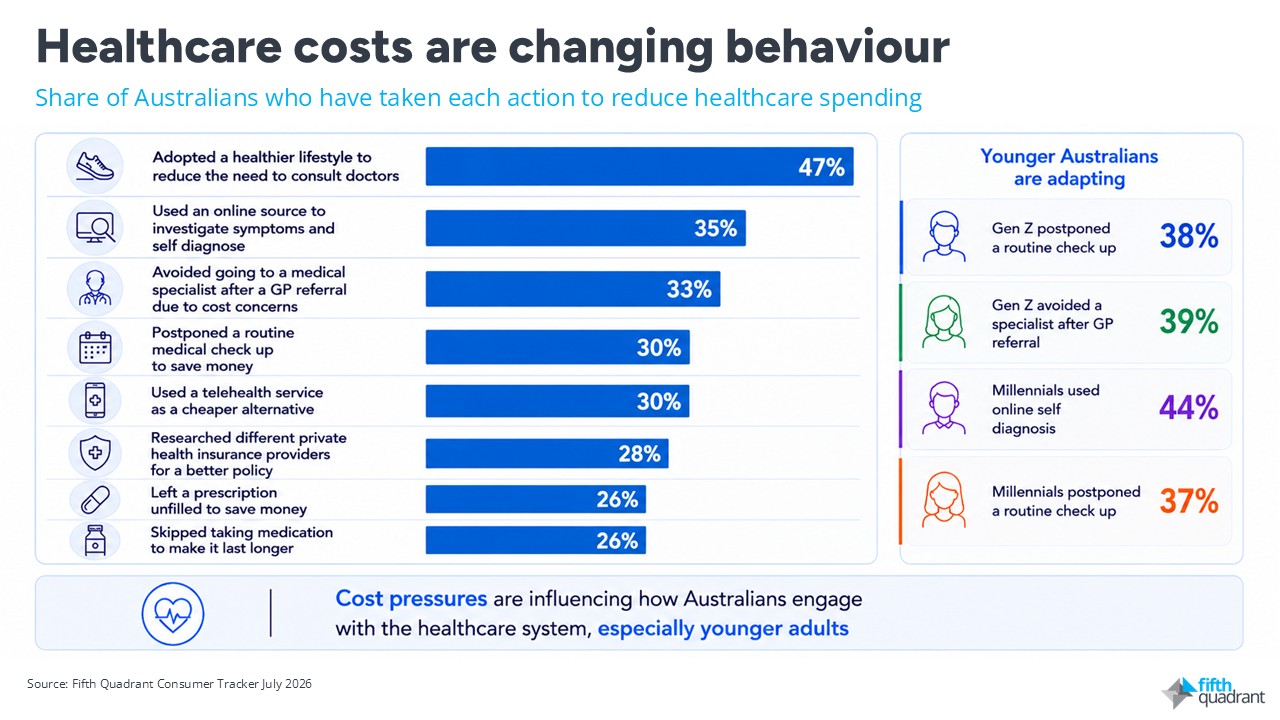
One third of Australians have avoided seeing a specialist after receiving a GP referral because of cost. Three in ten have postponed a routine check up, while around one quarter have left a prescription unfilled, stretched medication to make it last longer or skipped a diagnostic test.
More than one third have also used online sources to investigate symptoms and self diagnose rather than see a healthcare professional.
The concern is therefore not simply whether Australians believe the healthcare system provides good care. It is whether those who need care most can access and afford it.
Wellbeing is more interconnected than it looks
It is tempting to explain wellbeing primarily through demographics. Younger Australians face housing and career pressures, middle aged Australians often balance work and family responsibilities, while older Australians are more likely to experience chronic health conditions.
Our tracking suggests the reality is more complex.
Different generations are facing different pressures, with Millennials currently showing the broadest deterioration. But age alone does not explain the much larger differences in how Australians feel about their lives. Health, financial security and happiness appear closely connected.
For healthcare providers, insurers, employers and policymakers, the challenge is therefore broader than improving health outcomes in isolation. It is understanding the whole person and recognising that health, money and happiness rarely move independently of one another.
Need deeper insight into Australia’s healthcare market? Fifth Quadrant helps healthcare organisations understand patient needs, behaviours and experiences through tailored market research. From access and affordability to brand perception and service design, our research turns complex healthcare questions into clear, actionable insight.
Talk to us about your healthcare market research needs.
Source Fifth Quadrant Consumer Tracker, November 2025 and July 2026. Healthcare experience and healthcare cost reduction behaviours are from the July 2026 wave.
Posted in Healthcare, Consumer & Retail, Financial Services, TL, Uncategorized