

How generative AI is redefining search behaviour in Australia
Author: James Organ | Posted On: 24 Feb 2026
Generative AI is increasingly being used as a first-choice channel for information-intensive tasks. Findings from the latest Fifth Quadrant Consumer Sentiment Tracker indicate a measurable shift in search behaviour. Australians are turning to AI for explanation, comparison and decision support, while continuing to rely on search engines for habitual and low-complexity queries. This shift is supported by sustained growth in both understanding and adoption.
Understanding and adoption are accelerating
Nearly half of Australians now report a good understanding of generative AI, up materially from a year ago. Adoption has increased in parallel, with almost two-thirds now using at least one AI tool with conversational AI platforms the primary entry point.
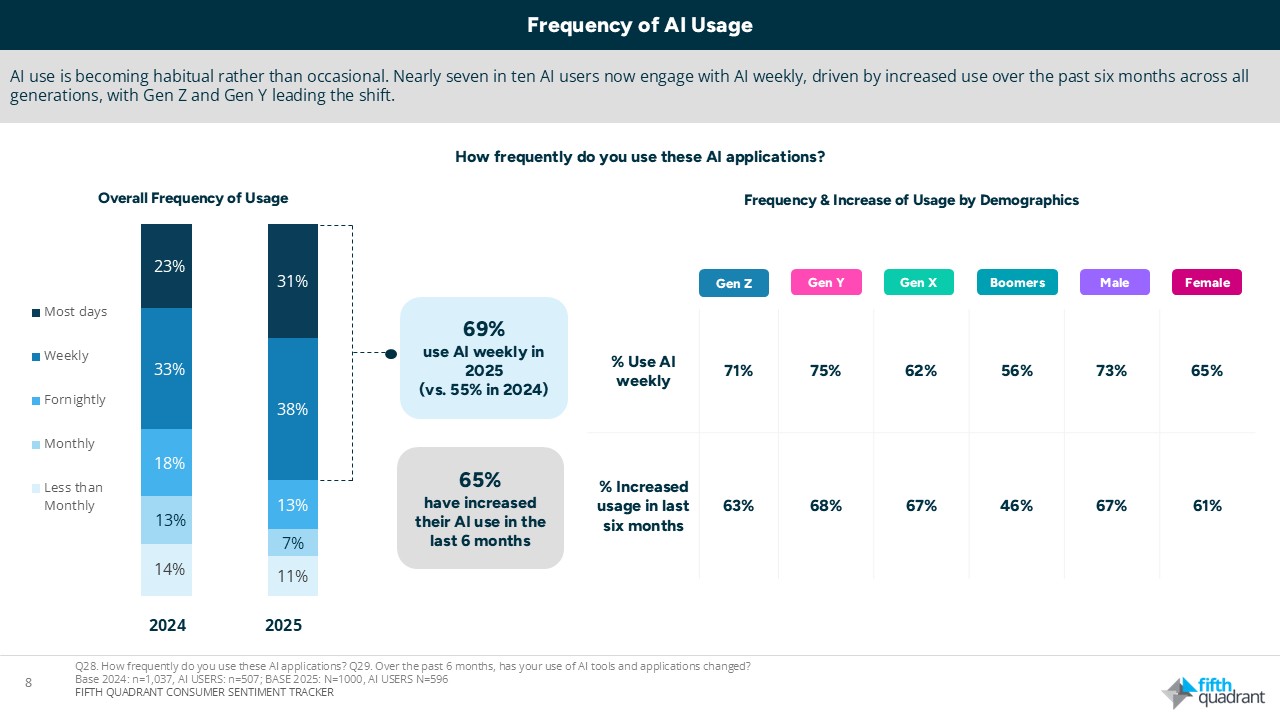
Among AI users:
• 69% use AI weekly, up from 55% in 2024
• 65% report increased usage over the past six months
• Growth is evident across all generations, led by Gen Z and Gen Y
This indicates movement from trial to habitual usage.
Channel preference is becoming task-specific
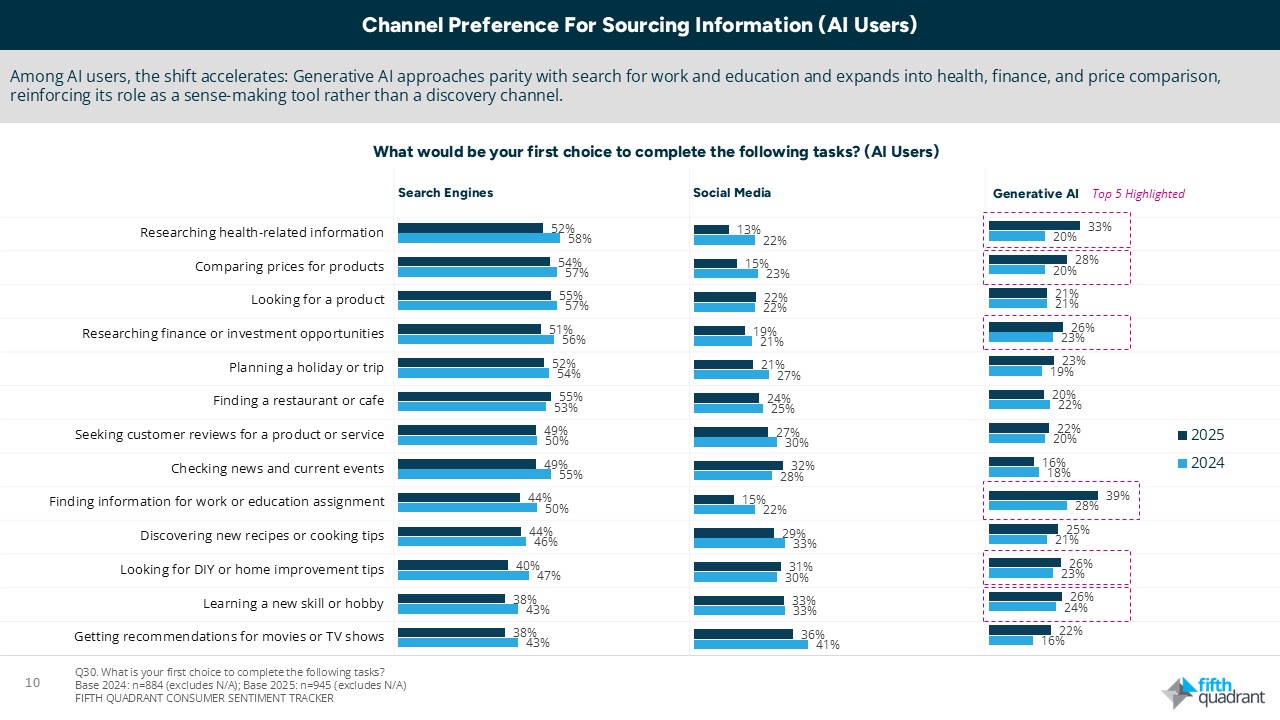
Channel selection is increasingly determined by task requirements. Search engines remain dominant for quick look-ups, transactional queries and routine product searches. These are tasks where speed and precision retrieval are prioritised. Social media continues to play a central role in inspiration, cultural discovery and lifestyle exploration. Generative AI, however, is gaining share in tasks requiring interpretation. It is increasingly selected as a first-choice channel for work and study tasks, health information, financial topics and price comparisons. These are domains characterised by complexity, uncertainty or competing options. In these contexts, users appear to value synthesis, clarification and structured comparison over simple link-based retrieval.
Among AI users, the shift is more pronounced
Naturally, behavioural change is much stronger among Australians who already use AI tools. Within this group, generative AI approaches parity with search for work and education tasks. It records some of the largest year-on-year increases in health, finance and price comparison activities, and is consistently preferred over social media for information-led tasks. Once adopted, AI tends to move across multiple task types rather than remaining confined to a single function such as drafting or summarising. The more comfortable users become, the more categories are explored.
What this means for organisations
As generative AI becomes embedded in how people interpret and compare information, organisations cannot rely solely on traditional search or social media to influence decisions.
Three shifts matter.
- Information quality now drives visibility. It is no longer just about ranking for keywords. Content must be clear, structured and consistent so AI systems can interpret and surface it accurately.
- Comparison is more transparent. When users ask AI to compare options, strengths and weaknesses appear side by side. Differentiation needs to be explicit and defensible across publicly available information.
- Influence may not show up in traffic data. Users may form preferences through AI-generated summaries without visiting a website. Measurement models need to adapt to this reality.
The next 12–18 months
Over the next 12–18 months, this shift is likely to accelerate.
AI functionality will become more deeply embedded into mainstream search environments, reducing the distinction between search and AI from a user perspective. Expectations of response quality will rise as users become accustomed to synthesised answers and structured comparisons. Competitive comparison will intensify, with strengths and weaknesses surfaced more transparently when users prompt AI to evaluate options.
Behaviour is likely to polarise by task complexity. Simple, transactional queries will remain search-led. More complex, evaluative and advisory tasks will increasingly default to AI-supported interaction.
Organisations that understand how AI systems ingest, interpret and surface information will be better positioned to maintain influence as search behaviour continues to evolve.
Implications: a rebalancing of roles across channels
As Generative AI becomes embedded in tasks influence will increasingly occur earlier in the decision process, often before a search query is entered, a brand website is visited, or an ad is clicked. This places greater emphasis on the quality and structure of information, not just visibility.
At the same time, channel roles are becoming more clearly differentiated:
- Search continues to serve habitual and transactional needs
- Social media remains important for inspiration and discovery
- Generative AI is increasingly selected when people are making sense of complex information
For organisations, the challenge is no longer choosing which channel matters most, but understanding how each channel contributes at different stages of decision-making as search behaviour continues to evolve.
As Generative AI continues to reshape how Australians search, compare and decide, organisations must rethink how their information is structured and surfaced. To understand how these shifts will impact your brand and strategy, contact Fifth Quadrant to discuss how our Consumer Sentiment Tracker insights can support your next move.
Posted in Uncategorized, B2B, Consumer & Retail, Technology & Telco