

New SME research shows the card surcharge is going, but the cost is not
Author: James Organ | Posted On: 25 Aug 2026
What will the 2026 Australian card surcharge ban mean for SMEs if the surcharge disappears but the cost of accepting card payments does not?
On 1 October 2026, the way Australian businesses recover the cost of card payments will fundamentally change.
From that date, businesses will no longer be able to surcharge customers paying through the eftpos, Mastercard or Visa networks. While American Express is not formally covered by the RBA’s regulation, it has voluntarily decided to introduce its own no-surcharge rule from the same date. RBA surcharge FAQs
For consumers, the change promises simpler and more transparent prices. For businesses, particularly those that use surcharging to recover payment costs, it creates a more complicated question. If the surcharge disappears, where does the cost go?
Surcharging is deeply embedded among Australian SMEs
Fifth Quadrant’s SME Sentiment Tracker shows that 56% of Australian SMEs currently apply a surcharge to card payments.
The practice becomes considerably more common as businesses grow. It is used by 48% of SMEs with fewer than five employees, rising to 65% of those with 5 to 19 staff, 78% of those with 20 to 99 staff and 85% of businesses employing 100 to 500 people.
There are also substantial differences by industry. Hospitality leads at 84%, followed by distribution at 73%. Health and education sits at 63%, retail at 59% and construction at 57%. Surcharging is less common in services at 48% and production at 44%, but even in these sectors it remains significant.
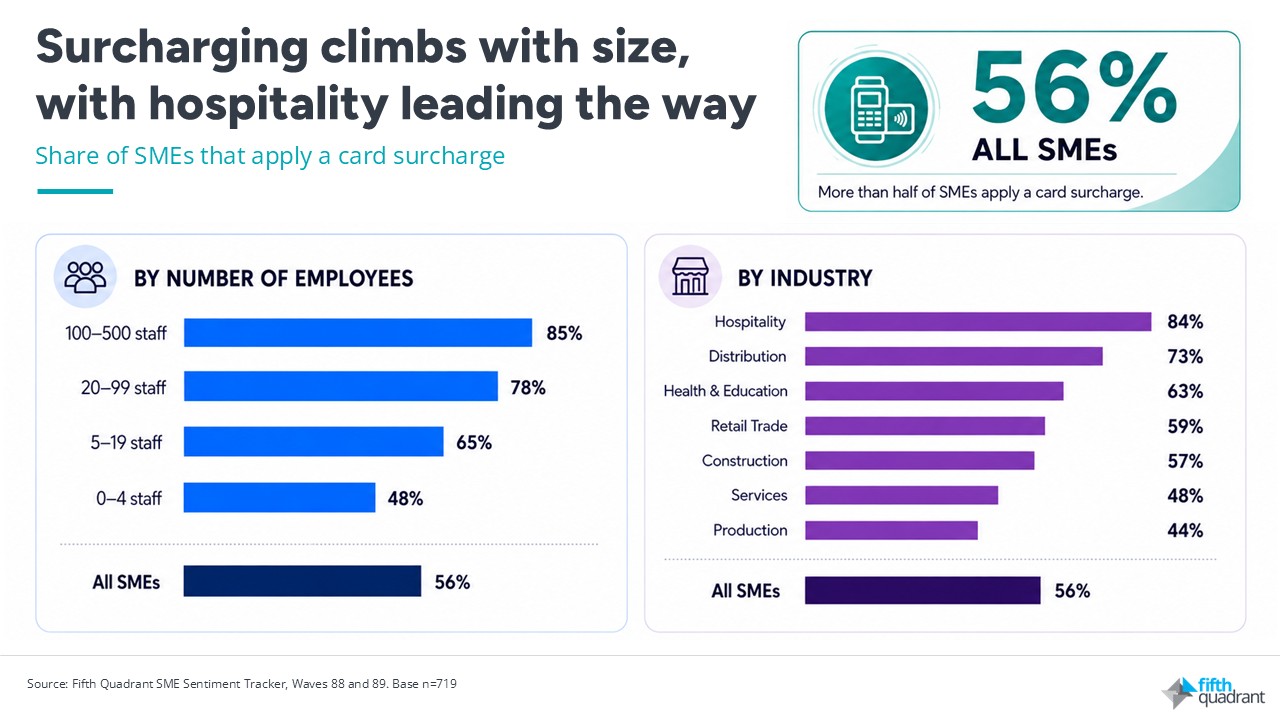
The October change is therefore not a marginal compliance issue. It requires a large share of Australian SMEs to reconsider how payment costs fit within their pricing, margins and customer experience.
Awareness of the card surcharge changes is high, but understanding is uneven
Three quarters of businesses that currently surcharge are aware of the coming change. However, only 41% say they understand it well. A further 35% are aware only at a broad level, while 24% have low awareness.
Awareness also varies across industries. It is lowest among surcharging businesses in health and education at 64%, followed by retail at 66%. Awareness reaches 72% in construction, 76% in services, 77% in hospitality, 80% in production and 88% in distribution.
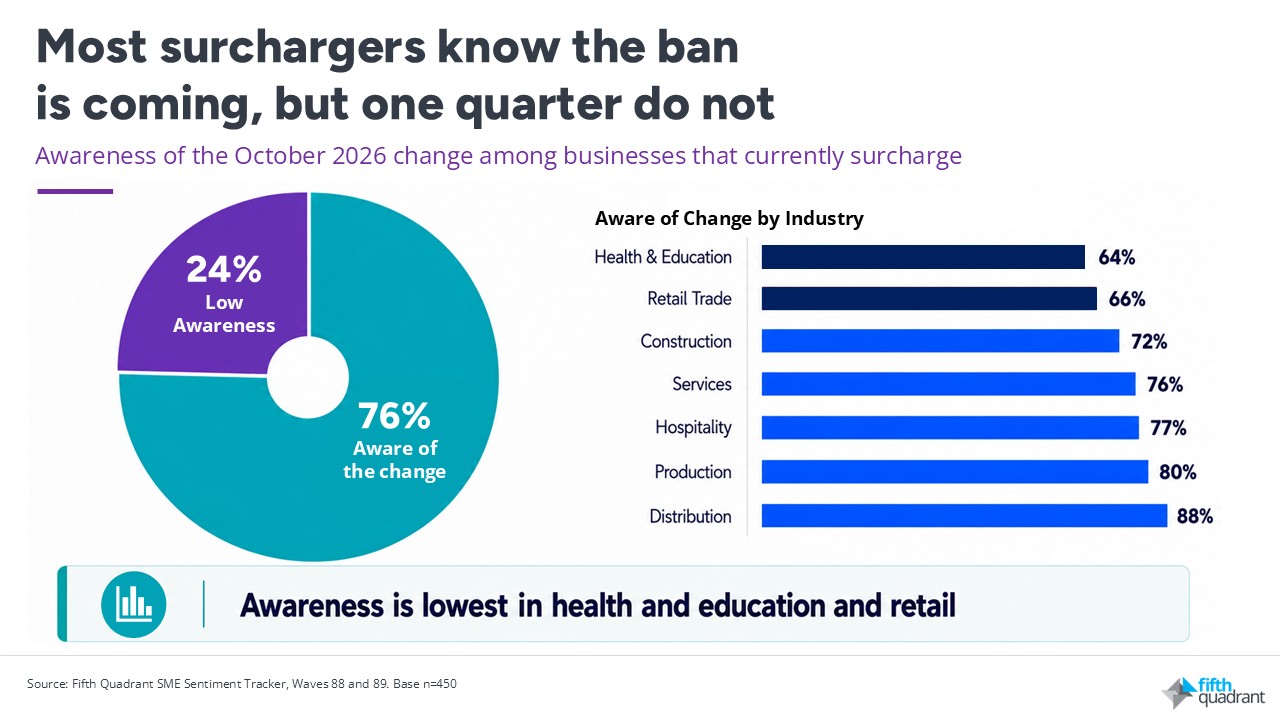
The risk is not simply that some businesses have missed the announcement. Many know something is changing but may not yet understand what it means for their pricing, payment systems or customer communications.
The new rules apply to card payment surcharges rather than weekend surcharges, public holiday surcharges or general booking and service fees. Businesses will also still be able to offer discounts for selected payment methods. These distinctions will be important as businesses review their options. The ACCC provides guidance on the scope of the changes.
More than one in three surcharging SMEs expect a negative impact
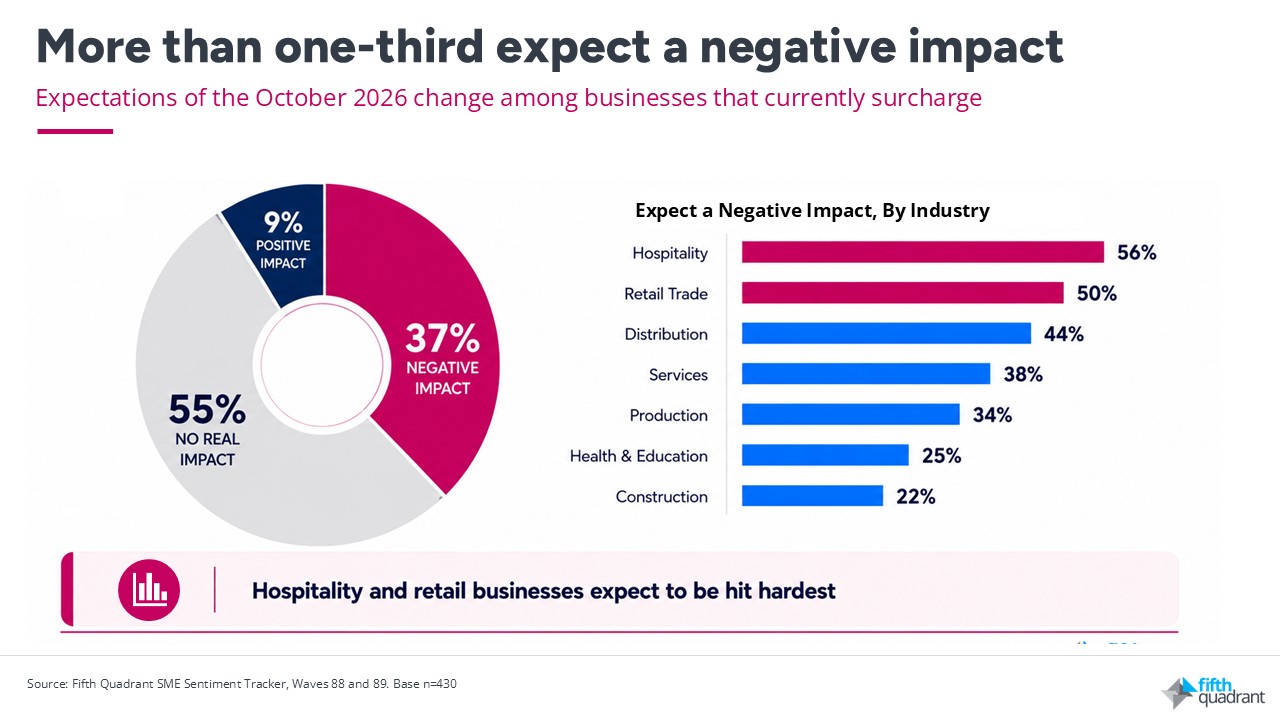
While 55% of current surchargers expect the removal of card surcharges to have no real impact on their business, a substantial 37% expect the effect to be negative. Only 9% anticipate a positive outcome.
This is not a marginal group. It represents more than one in three businesses that currently rely on surcharging to recover card payment costs. The pressure is even greater in customer-facing sectors, with 56% of hospitality businesses and 50% of retailers expecting a negative impact. The figure is also high among distributors at 44% and services businesses at 38%.
Hospitality and retail face a particularly difficult adjustment. Both have high rates of surcharging and operate in highly visible, price-sensitive environments. Their payment costs are spread across large numbers of transactions, often with relatively low individual values. Removing a small charge from every transaction can therefore create a significant accumulated cost.
For these businesses, the change is not simply an administrative adjustment. It directly affects pricing, margins and how the cost of accepting card payments is shared with customers.
Businesses are considering a mix of responses to the surcharge ban
Increasing general prices is the most common planned response, selected by 45% of current surchargers. A further 13% are considering minimum transaction values.
Many will also try to reduce their payment costs. Twenty seven per cent plan to encourage customers towards lower cost payment methods, while 26% intend to negotiate lower provider fees. Another 16% may reduce their acceptance of high cost methods and 10% are considering changing payment providers.
Others will attempt to absorb or offset the cost internally. Twenty seven per cent plan to absorb the impact without changing prices, while 10% expect to accept lower margins and 9% will pursue operational efficiencies.
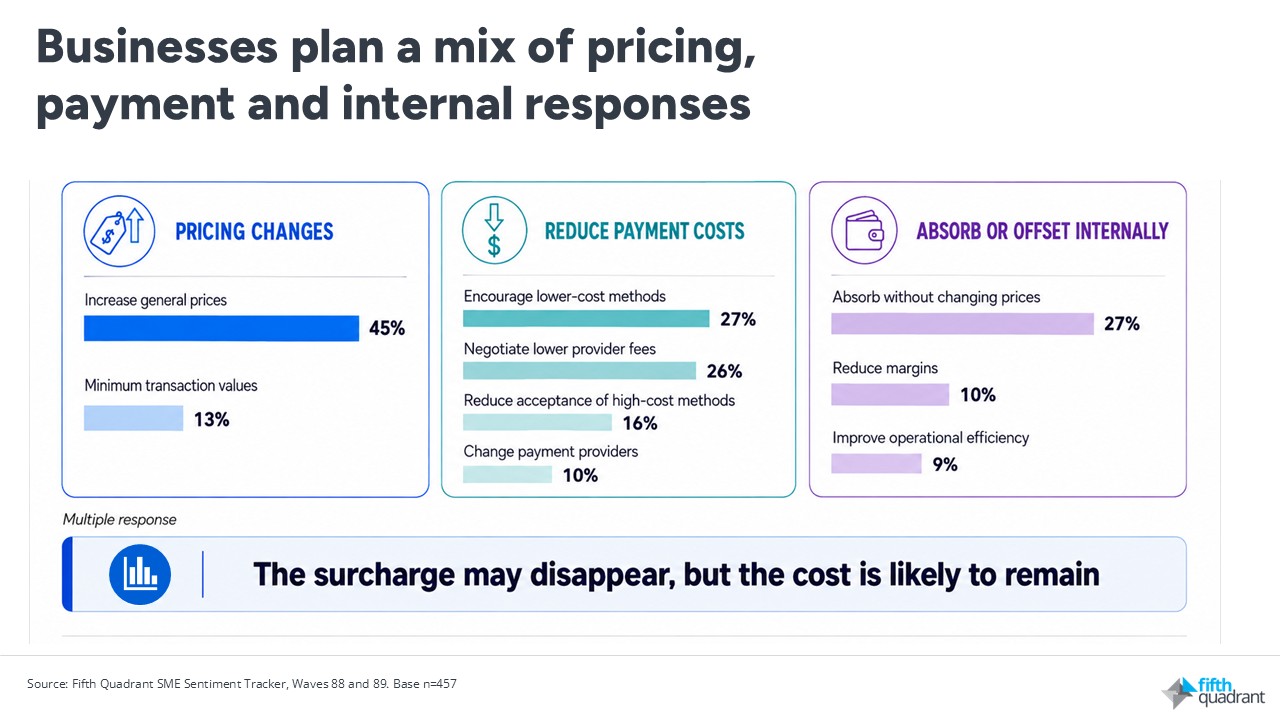
These responses are not mutually exclusive. A business may increase some prices, renegotiate provider fees and encourage customers towards lower cost payment methods at the same time.
The RBA’s wider reforms are intended to reduce card acceptance costs through lower interchange fees and greater fee transparency. However, businesses will continue to incur costs when accepting card payments. The RBA acknowledges that these costs may be reflected in overall business pricing rather than charged separately at the checkout.
That is the central tension in the reform. Consumers may no longer see a card surcharge, but the underlying cost of accepting the payment remains. It will be incorporated into prices, redirected through payment choices or absorbed within already pressured margins.
The surcharge may disappear. The cost is likely to remain.
Want to understand what these changes mean for your customers, market or growth strategy? Fifth Quadrant helps organisations turn complex business questions into clear, evidence-based decisions through tailored B2B market research.
Contact Fifth Quadrant to discuss your research needs, or subscribe to our regular insights to receive the latest findings from the monthly SME Sentiment Tracker, including updates on business confidence, challenges and priorities across Australian SMEs.
Source: Fifth Quadrant SME Sentiment Tracker, Waves 88 and 89. Survey of Australian SMEs with up to 500 employees.
Posted in Financial Services, B2B, Consumer & Retail, Technology & Telco, Uncategorized