
Auto Technology Has A Trust Problem
Author: James Organ | Posted On: 01 Sep 2026
Why is trust in automotive technology falling among Australian consumers?
Automotive technology trust in Australia is weakening as vehicle technology advances faster than consumer confidence. Australians are becoming more selective about the driver-assistance, connected car and autonomous vehicle technologies they are willing to trust.
The latest Fifth Quadrant Consumer Tracker shows a clear cooling in attitudes towards several vehicle technology features. Australians are not rejecting technology outright, but the data shows they are becoming more cautious about how it is used, what value it delivers and whether it can be trusted.
Trust in driver assistance and connected cars is falling
The sharpest shift is in driver-assistance technology. In 2025, 59% of Australians agreed they trusted the latest driver-assistance features, such as lane-keeping, adaptive cruise control and blind-spot monitoring, to make driving safer. In 2026, this has fallen to 47%.
Comfort with vehicle data collection has also weakened. In 2025, 57% of Australians said they were comfortable with car brands collecting driving data if it improved safety or lowered insurance costs. In 2026, this has fallen to 47%.
Excitement about connected car technology has declined as well. In 2025, 47% of Australians said they were excited about features such as automatic software updates, in-car AI assistants or over-the-air upgrades. In 2026, this has fallen to 37%.
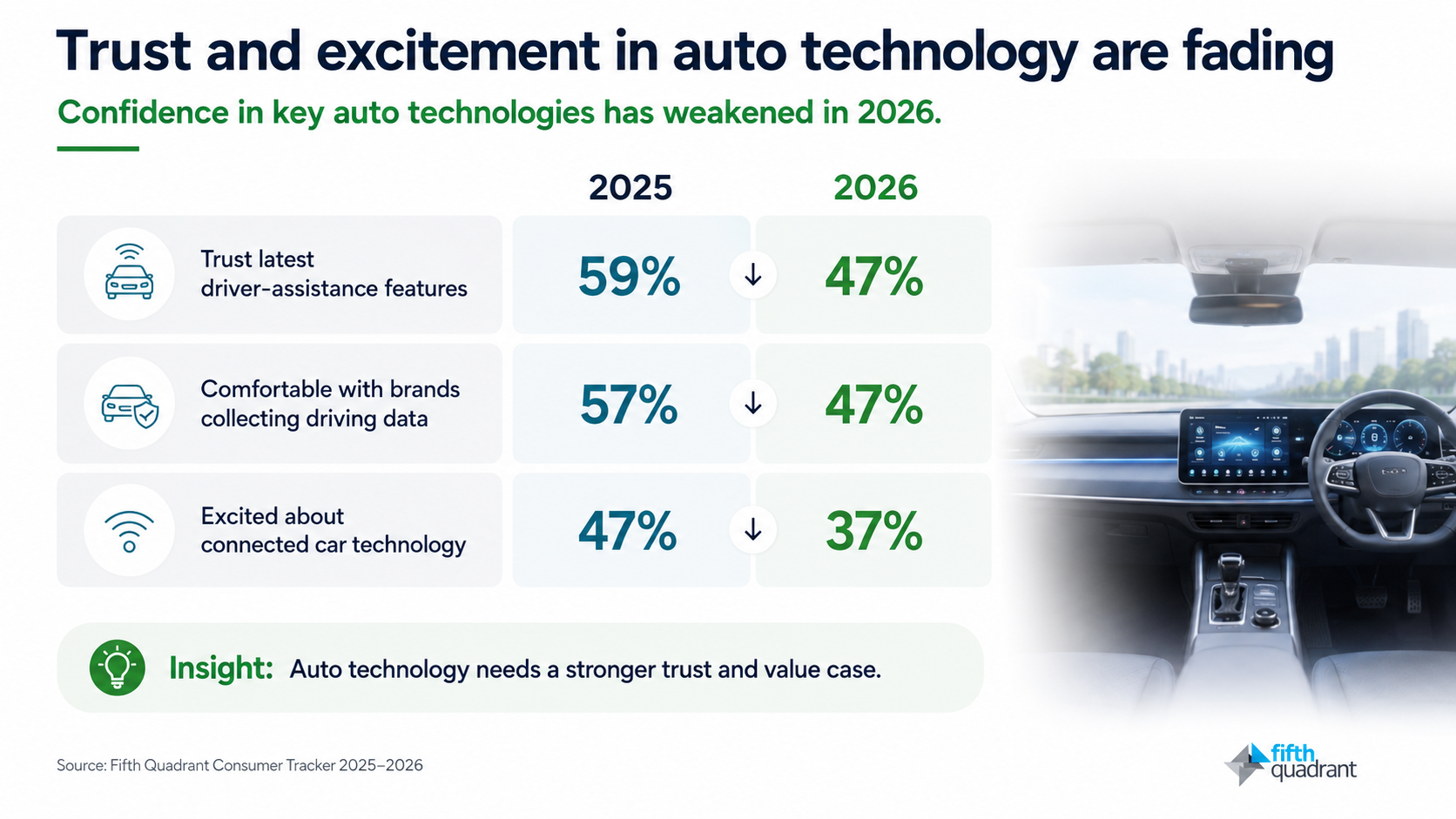
This is an important signal for the automotive market. Advanced driver-assistance systems are increasingly common in new vehicles, and they are often positioned around safety, confidence and convenience. However, the decline suggests consumers may not automatically accept the safety case simply because the technology is available. ANCAP has also responded to consumer concerns about intrusive driver-assistance systems, with its 2026 assessment criteria placing greater emphasis on smooth, intuitive operation and the real-world driver experience.
The same applies to connected car features and driving data. Connected services, usage-based insurance, predictive maintenance, over-the-air updates and in-car personalisation all depend on consumers accepting some level of data sharing. The challenge is that consumers may like the benefit, but remain uncertain about the exchange.
Lower insurance costs, improved safety or added convenience may be appealing, but they may not be enough unless brands are clear about what data is collected, how it is used, who has access to it and how consumers remain in control.
The broader issue is not technology itself. It is the value exchange. Consumers need to feel that automotive technology is useful, transparent and worth it. If connected car technology is framed as novelty, complexity or another subscription layer, it may struggle to build enthusiasm. If it is framed around convenience, safety, reliability, time savings and easier ownership, it has a stronger role to play.
Auto technology acceptance is becoming more segmented
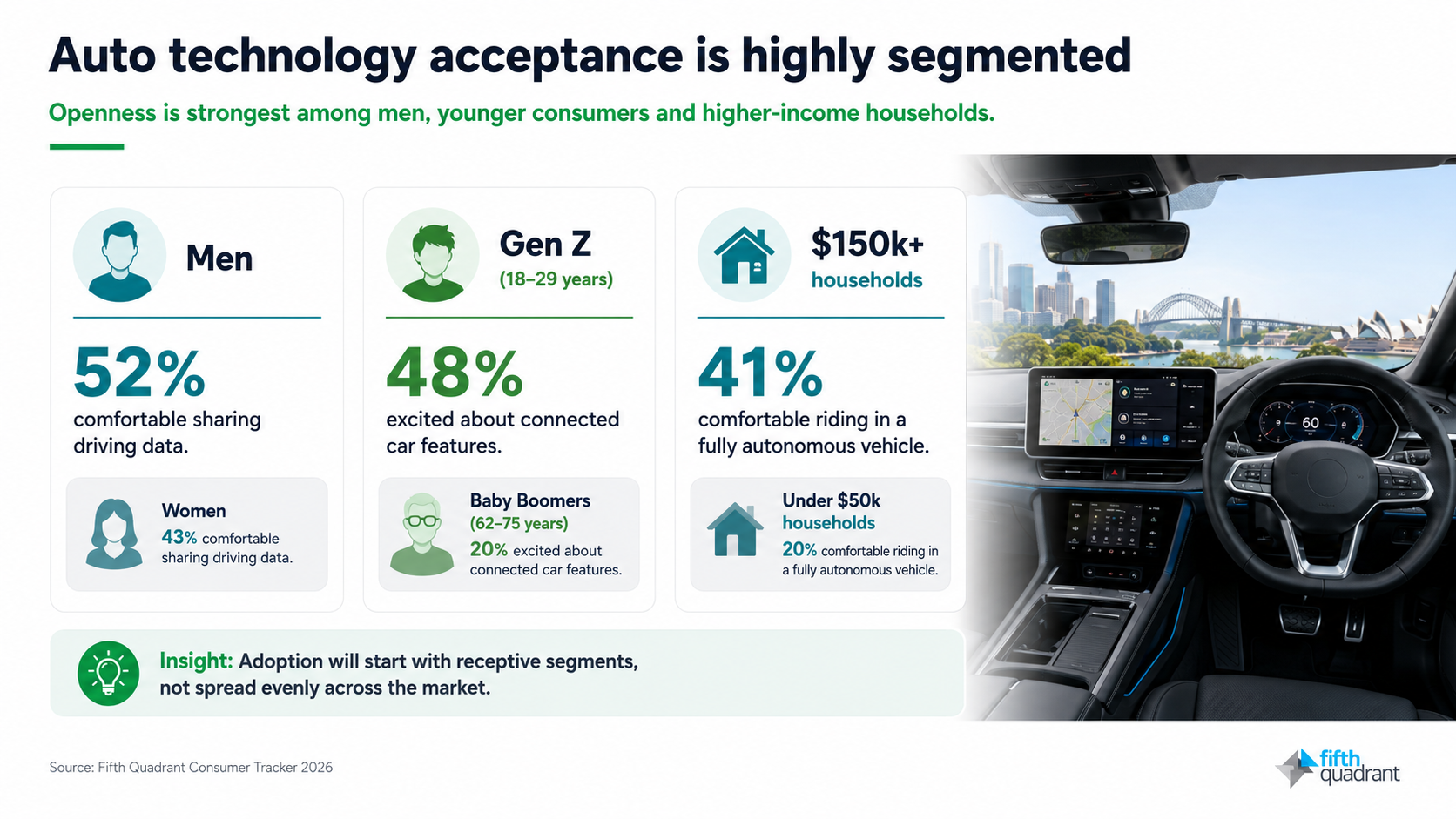
The demographic cuts show that technology acceptance is not disappearing, but it is becoming more segmented. Men are more comfortable than women with brands collecting driving data, at 52% compared with 43%. Gen Z is much more excited about connected car features than Baby Boomers, at 48% compared with 20%.
Income also matters. Among households earning $150k+, 41% are comfortable travelling in a fully autonomous vehicle, compared with 20% among households earning under $50k. This suggests the next phase of auto technology adoption is likely to start with more receptive segments rather than move evenly across the market.
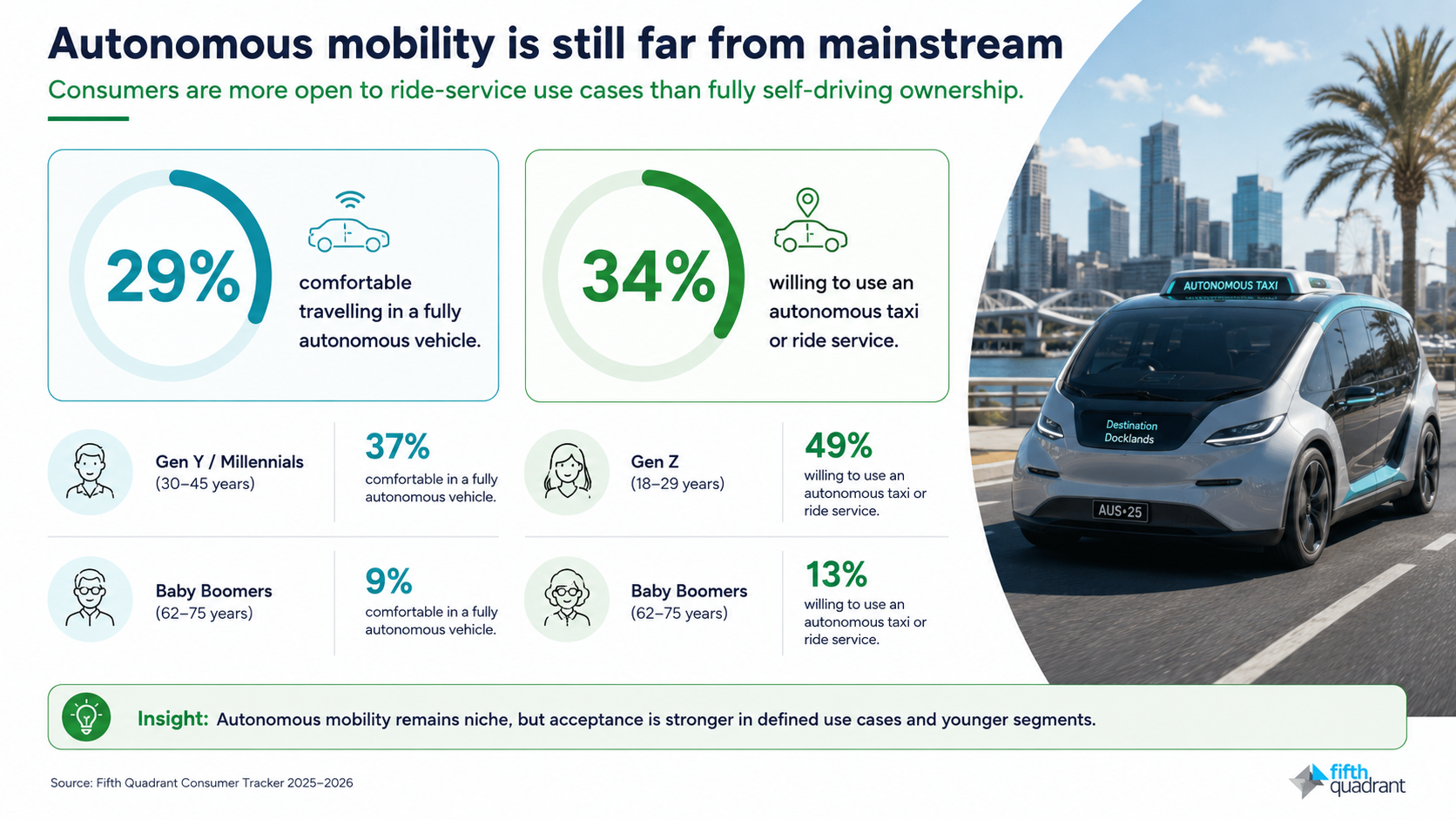
Autonomous mobility tells a slightly different story. Overall comfort with travelling in a fully autonomous vehicle is steady at 29%, unchanged from 2025. This means sentiment is not deteriorating, but it also shows that the market remains far from mainstream acceptance. Fewer than one in three Australians are comfortable with the idea of travelling in a fully self-driving vehicle without needing to take control.
Willingness to use an autonomous taxi or ride service is somewhat higher, at 34%. That gap matters. It suggests consumers may be more open to autonomous technology in defined use cases, such as a taxi or ride service, than they are to fully self-driving private vehicle ownership.
The demographic differences are also sharp. Gen Y comfort with fully autonomous vehicles sits at 37%, while Baby Boomers are much more cautious at 9%. For autonomous taxis or ride services, Gen Z is far more receptive at 49%, compared with 13% among Baby Boomers.
Trust, transparency and proof of value will drive adoption
For OEMs, dealers and technology providers, the implication is clear: the next phase of auto technology adoption will depend less on feature availability and more on trust-building.
Consumers need clearer explanations, stronger reassurance and more practical proof of value. Driver-assistance systems need to be communicated as support tools, not magic safety solutions. Connected car features need to be linked to real ownership benefits, not just innovation. Data sharing needs to be transparent, permission-based and clearly connected to consumer value.
The bigger risk is that technology becomes a source of friction rather than differentiation. If consumers are unsure how a feature works, do not understand what data is being collected, or feel that connected services add complexity, technology may weaken confidence rather than strengthen it.
Automotive brands should avoid assuming that more technology automatically creates more appeal. The data suggests the opposite: as vehicles become more advanced, consumers are becoming more selective about which technologies they trust and which ones they see as valuable.
The opportunity is not to slow innovation. It is to make innovation easier to understand, easier to trust and easier to justify. In the current market, auto technology needs more than capability. It needs a stronger consumer case.
If you want to understand how Australian consumers are responding to automotive technology, connected vehicles and changing expectations around trust and value, we can help. Fifth Quadrant delivers automotive market research that turns consumer attitudes into practical insights for OEMs, dealers, technology providers and industry partners. Contact us to discuss your automotive market research needs.
Sources: Fifth Quadrant Consumer Tracker 2025 and 2026; ANCAP research and 2026 vehicle safety assessment criteria
Posted in Auto & Mobility, B2B, Consumer & Retail, Uncategorized