
Federal Budget 2026: SMEs heard the message, but they didn’t buy it
Author: James Organ | Posted On: 08 Jun 2026
Has the Federal Budget 2026 given Australian SMEs confidence to invest, grow and hire, or has it missed the mark?
When Treasurer Jim Chalmers delivered the Federal Budget 2026, the Government positioned it as a roadmap for economic resilience, productivity and long-term growth. However, Fifth Quadrant’s latest SME Sentiment Tracker shows the Budget has failed to convince Australia’s small and medium-sized businesses that it will improve their outlook.
The Federal Budget 2026 reaction among SMEs reveals a significant gap between support for individual policy measures and confidence in the Budget’s overall impact. While some initiatives were welcomed, most businesses remain sceptical that the Budget will address the challenges affecting growth, investment and profitability.
SMEs were looking for answers
The Federal Budget achieved moderate cut-through among Australia’s SME sector, with 51% of business owners reporting that they followed the Budget either very closely or reasonably closely.
This level of engagement reflects the importance of government policy in an environment where many businesses continue to grapple with rising costs, labour shortages, regulatory complexity and slowing economic growth. SMEs were paying attention because they wanted to see practical measures that could improve business conditions.
Yet awareness did not translate into optimism.
Support for practical business measures
One of the more nuanced findings from the research is that SMEs were not universally critical of the Budget. Several individual measures attracted strong support, particularly those offering direct business benefits.
Making the $20,000 instant asset write-off permanent was the most popular initiative, supported by 76% of SMEs. Businesses also responded positively to measures focused on fuel security, reducing public sector spending, cutting compliance costs and supporting start-ups.
These results reinforce a consistent theme in SME sentiment. Business owners tend to favour practical policies that improve cash flow, reduce costs and support investment.
At the same time, support weakened considerably for tax reforms perceived to increase costs or reduce investment incentives. Proposed changes to discretionary trusts, capital gains tax arrangements and negative gearing all attracted more opposition than support.
A budget that missed the mark
Despite backing several individual measures, SMEs delivered a largely negative verdict on the Federal Budget 2026 overall.
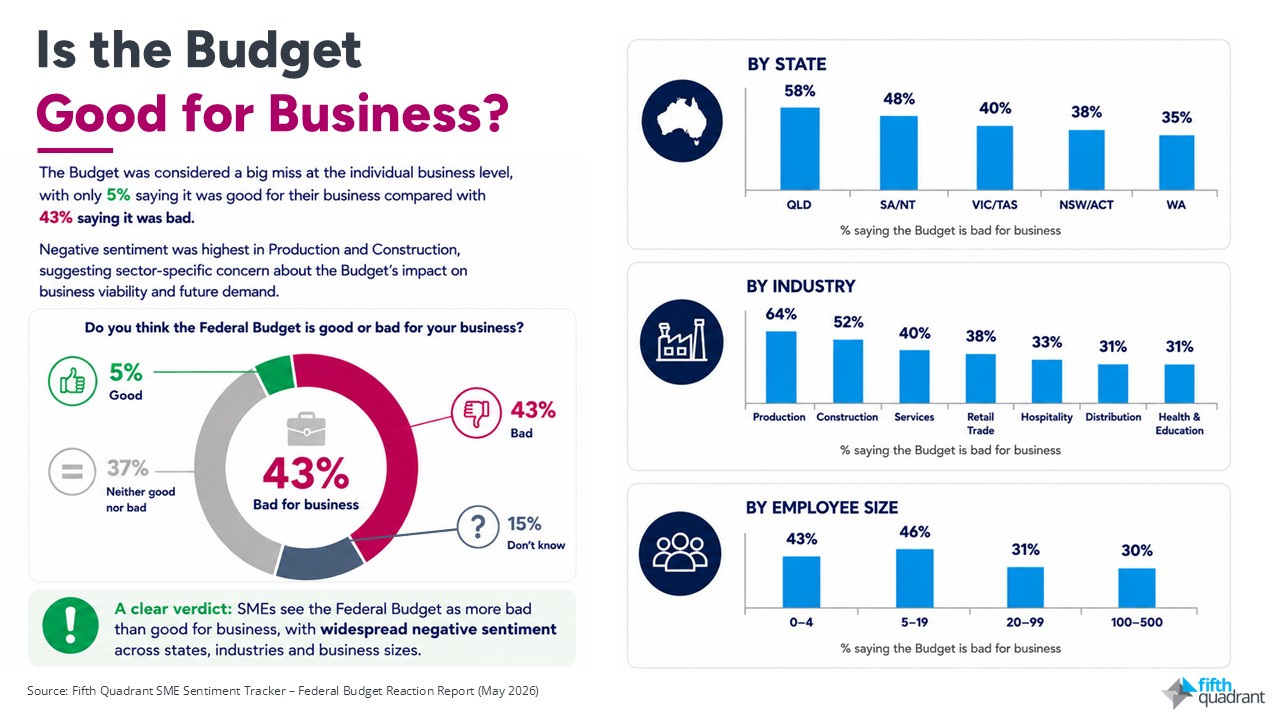
Only 5% of businesses believe the Budget is good for their business, while 43% say it is bad. More than a third believe it will make little difference either way.
The result suggests many business owners viewed the Budget as disconnected from the realities facing their organisations. While specific policies were welcomed, they were not enough to create confidence that the broader economic environment would improve.
Negative sentiment was particularly strong among production and construction businesses, highlighting concerns about future demand, operating costs and business viability.
SMEs don’t believe the budget will solve their biggest challenges
The most important finding may not be that SMEs disliked the Budget, but that they remain unconvinced it will deliver meaningful economic outcomes.
Only 17% believe the Budget will help reduce inflation and cost pressures. Just 16% think it will make Australia a more attractive destination for business investment, while only 15% believe it will support innovation and research. Most concerning, just 11% think it will improve workforce efficiency and productivity.
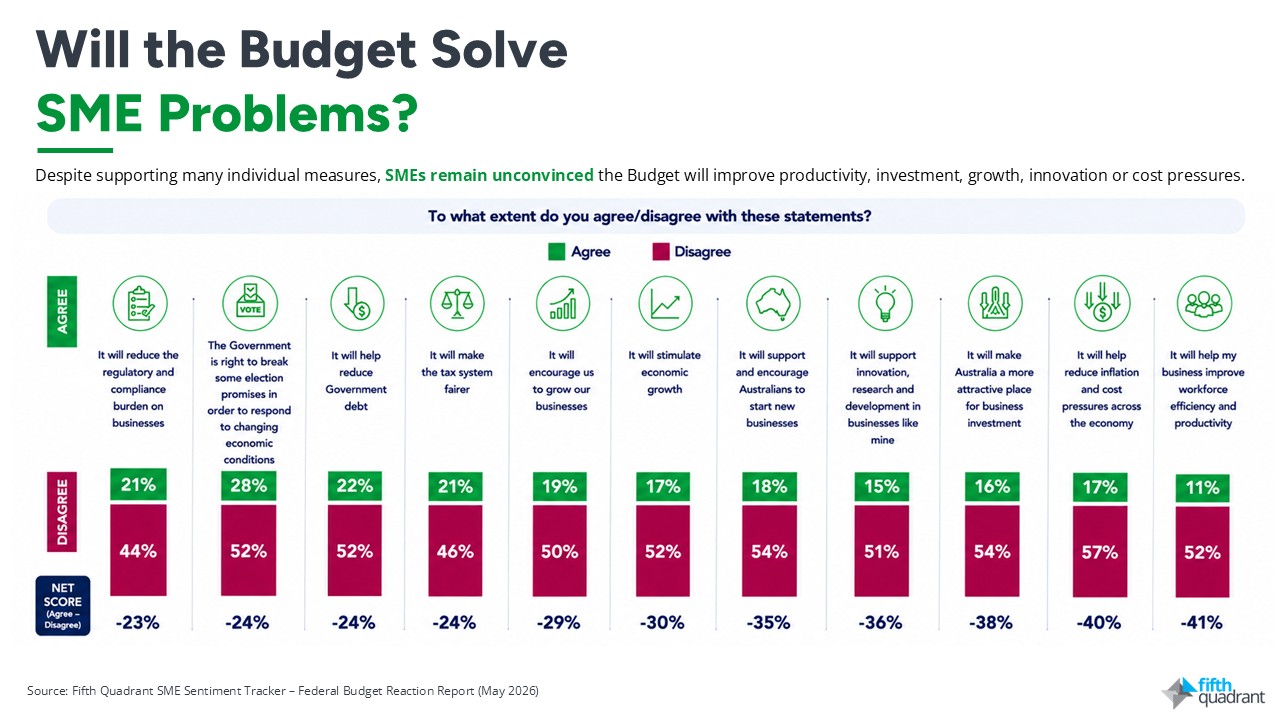
This helps explain the disconnect between support for individual initiatives and overall sentiment. SMEs appear to be distinguishing between policy announcements and real-world business outcomes.
For many business owners, the Federal Budget 2026 did not provide a convincing answer to the issues most affecting growth, investment and competitiveness.
Confidence in government support falls further
The reaction to the Budget also appears to have affected perceptions of government support more broadly.
Following the Budget, satisfaction with the Federal Government’s ability to deliver effective policies for SMEs fell to just 24%, the lowest level recorded in the past 12 months.
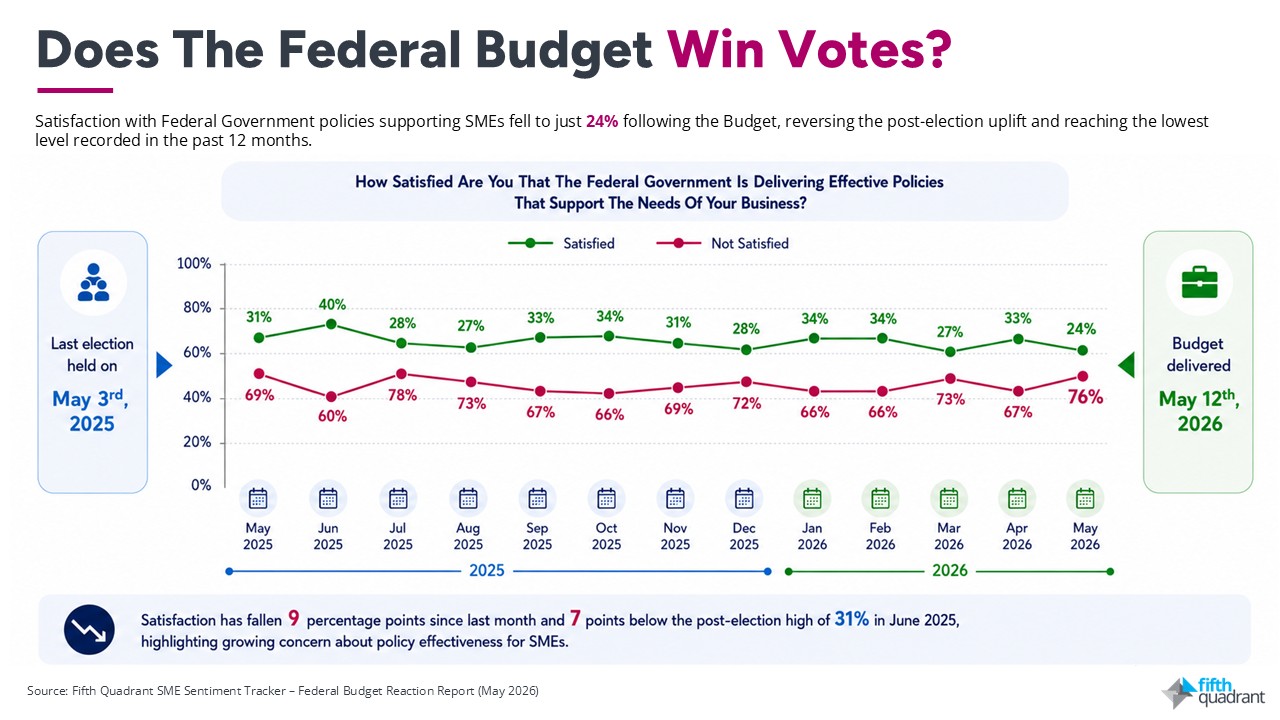
The decline reverses much of the improvement seen following the 2025 Federal Election and suggests many businesses view the Budget as a missed opportunity to strengthen confidence.
The bottom line
The Federal Budget 2026 contained several measures that SMEs support, particularly those focused on investment incentives, cost reduction and business practicality.
However, the overall SME reaction to the Federal Budget was overwhelmingly shaped by a lack of confidence in its ability to address bigger challenges. Rising costs, weak productivity, investment uncertainty and slowing growth remain key concerns.
Ultimately, budgets are judged not only by the policies they announce, but by the confidence they create. Based on the reaction from Australia’s SME sector, the Federal Budget 2026 has yet to convince businesses that better conditions lie ahead.
This article forms part of Fifth Quadrant’s broader Federal Budget 2026 research series examining how different groups of Australians responded to this year’s Budget. Alongside our national overview, Federal Budget 2026: The Disengagement Reality, we have published four companion pieces exploring the reactions of Australians Doing It Tough, Baby Boomers, Investment Property Owners and Gen Z. Together, these articles reveal how Australians experienced the same Budget through very different financial, generational and emotional lenses, highlighting the diverse expectations, priorities and concerns shaping public sentiment across the country.
For more insights into business confidence, policy sentiment and SME market trends, contact Fifth Quadrant or explore our latest research and thought leadership.
This article is based on findings from the Fifth Quadrant SME Sentiment Tracker: Federal Budget Reaction Report (May 2026), a national study of Australian small and medium-sized businesses examining awareness of, support for and reactions to the Federal Budget 2026.
Posted in Financial Services, Consumer & Retail, QL, Uncategorized