

Fleet electrification’s hidden pause: Hybrids surge ahead
Author: Ben Selwyn | Posted On: 07 Jul 2026
Why are Australian fleet electrification plans shifting towards hybrids even as net zero and EV targets remain in place?
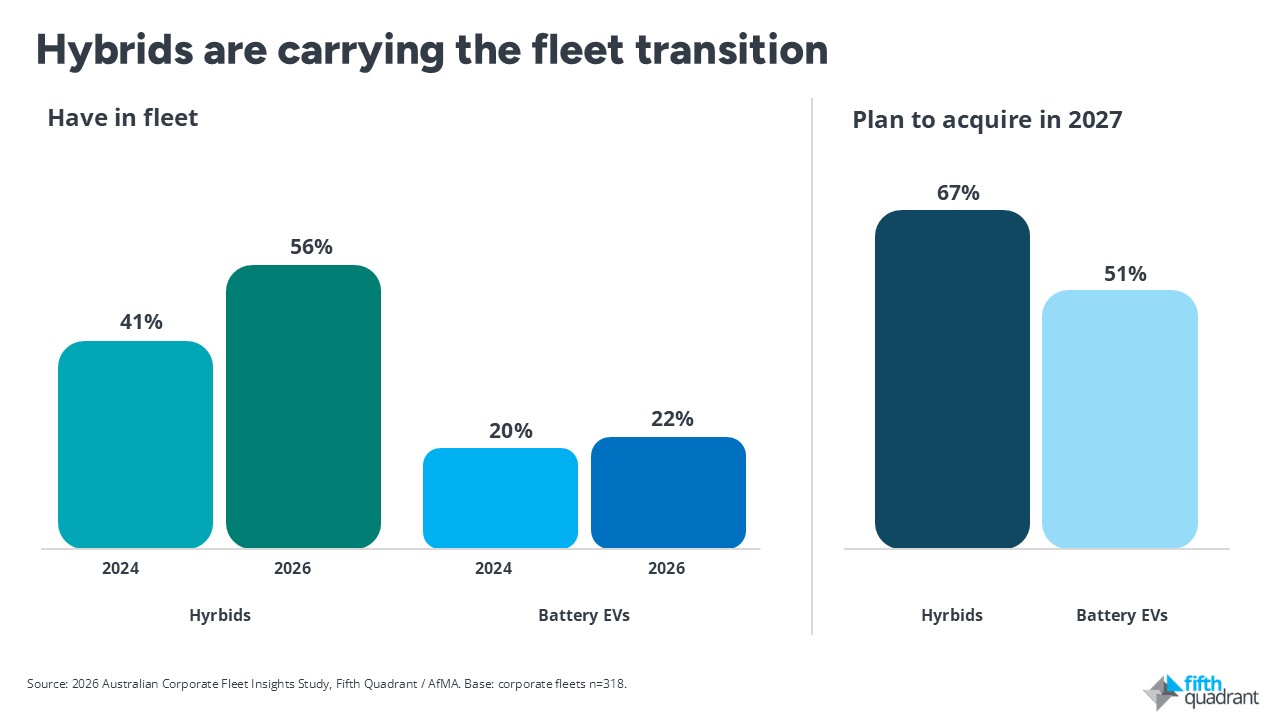
According to the 2026 Australian Corporate Fleet Insights Study, conducted by Fifth Quadrant in partnership with AfMA, battery EV penetration in corporate fleets has moved from 20% to just 22% in two years. Over the same period, hybrid ownership jumped from 41% to 56%. Fleet electrification is still underway, but it is following a different path to the one most operators planned, and there is now a clear gap between the targets fleets have set and the vehicles they are actually buying.
What fleet electrification plans look like for 2027
Fleets are still buying, but the mix has changed. Two thirds of corporate operators plan to add hybrids in 2027, while half (51%) intend to acquire battery EVs, though typically in modest volumes of one to four vehicles. The hybrid momentum also extends well beyond the big end of town. Among small fleets (1-19 vehicles), the share planning hybrid purchases has more than doubled since 2024, from 12% to 27%, making the hybrid the transition vehicle of choice across the whole market.
Focussing specifically on EVs, Government leads the way, with two in three fleets planning battery EV acquisitions, while Production and Construction fleets are the most cautious, with most holding off for now.
The size dynamics are relevant here too. Smaller corporate fleets have doubled their EV share since 2024, while mid-sized and larger operators have eased back. Electrification at scale appears to be proving harder than the plans assumed.
Ambition is running ahead of planning
Two thirds of corporate fleets hold a net zero target, clustering around 2035. Where fleets have set a specific EV target, the average commitment is 64% of the fleet, most commonly by 2030. Set those targets against a 22% penetration rate that has barely moved in two years, and the shortfall is substantial. For many operators, the EV target is currently functioning as an aspiration rather than a plan.
With all of that said, larger fleets are doing the work to build systematic capability, with around 70% having assessed government incentives, conducted feasibility studies or engaged dealers, manufacturers and FMOs on EV options. Among small fleets, most of those same activities sit below one in three, meaning the readiness gap between large and small operators continues to widen.
Experience is not the problem
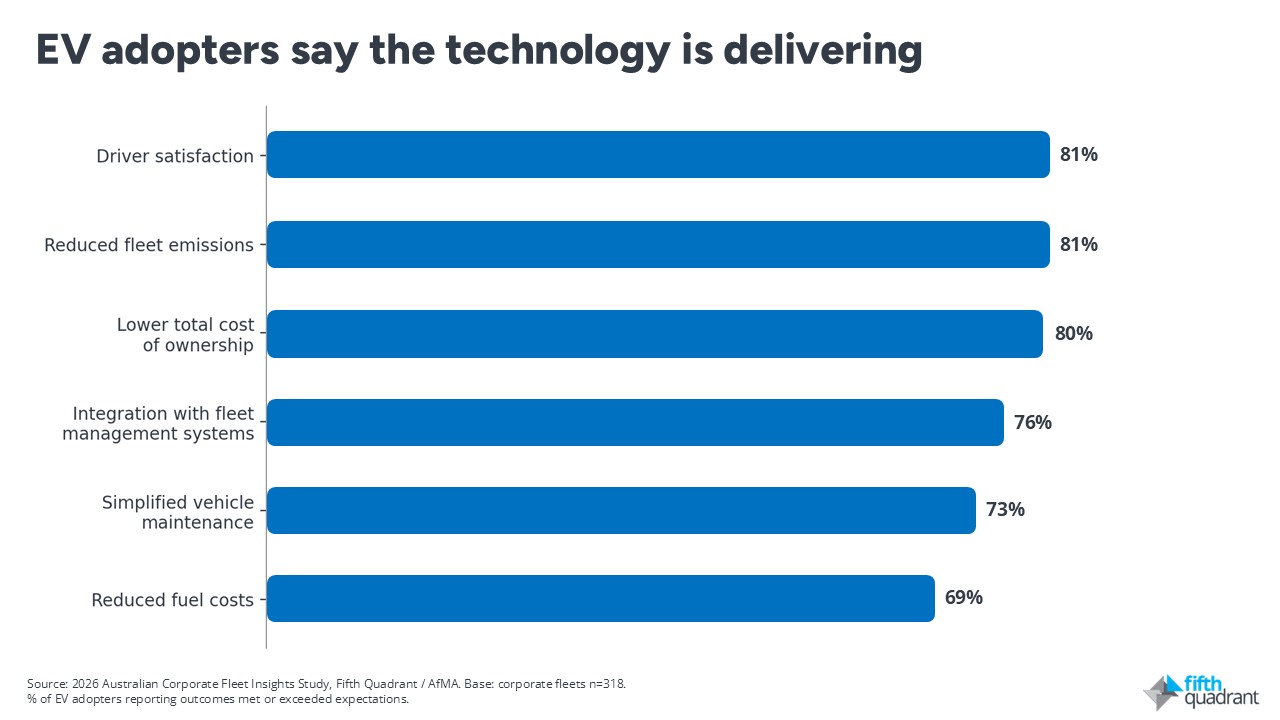
One could assume that this hesitation is the result of negative feedback, but the research says otherwise: for fleets that have adopted EVs, the technology is delivering. More than 80% of corporate operators report that outcomes met or exceeded expectations across emissions, driver satisfaction and total cost of ownership. Among small fleet adopters, roughly nine in ten say the same.
Once fleets cross the threshold, the performance case tends to become self-reinforcing. The pause is being driven by cost pressure (75% of fleets rate running cost reduction a high or top priority in 2026), vehicle availability in fit-for-purpose segments, and infrastructure uncertainty, particularly for the Production and Construction fleets running utes, vans and mixed configurations.
What this means for the industry
OEMs face a hybrid-heavy product story for the next planning cycle, with the fleets most resistant to battery EVs concentrated in workhorse vehicle segments. Charging and energy providers have a longer runway than 2030 targets imply, though the fleets that are moving are preparing methodically and will reward partners who engage early. For FMOs and lenders, electrification expertise is becoming a selection criterion, cited most strongly by the larger fleets that anchor portfolio profitability.
For fleet managers, the benchmark question is worth asking now: if your EV target assumes delivery by 2030, does your 2027 acquisition plan actually point there? On current numbers, only about half the market could answer yes.
Taken together, the 2026 data points to a transition on a longer, more segmented timeline than most fleet strategies currently assume, with hybrids carrying the load in the interim. Businesses that re-sequence their plans around that reality will be better placed than those still planning against 2024 assumptions.
At Fifth Quadrant, our fleet research program with AfMA has tracked this market since 2018.
The 2026 Australian Corporate Fleet Insights Report and 2026 Australian Small Fleet Insights Report are now available. Click here to request a copy of the reports, and a member of the Fifth Quadrant team will contact you to discuss your requirements or sign up for our monthly insights.
Research sources: Fifth Quadrant, 2026 Australian Fleet Insights Reports; Australian Corporate Fleet Insights: Fifth Edition (2026); Fifth Quadrant, Australian Fleet Industry Trends and Insights 2026; AfMA, 2024 Corporate Fleet Insights Report. The detailed 2026 figures are first-party findings from Fifth Quadrant’s proprietary report, and not all are reproduced on the public report pages.
Posted in Auto & Mobility, B2B, Uncategorized