

The new search journey: Search leads, social inspires, AI makes sense
Author: James Organ | Posted On: 13 Jul 2026
How are Australians using Generative AI alongside search engines and social media to make decisions?
The New Search Journey: Search Leads, Social Inspires, AI Makes Sense
Generative AI is becoming a more normal part of how Australians look for information, compare options and make decisions.
The latest Fifth Quadrant Consumer Tracker shows that search engines remain the first choice for most everyday tasks, but the role of Generative AI is continuing to expand. The shift is most evident in areas where people need help interpreting information, weighing up options or turning a broad question into a clearer decision.
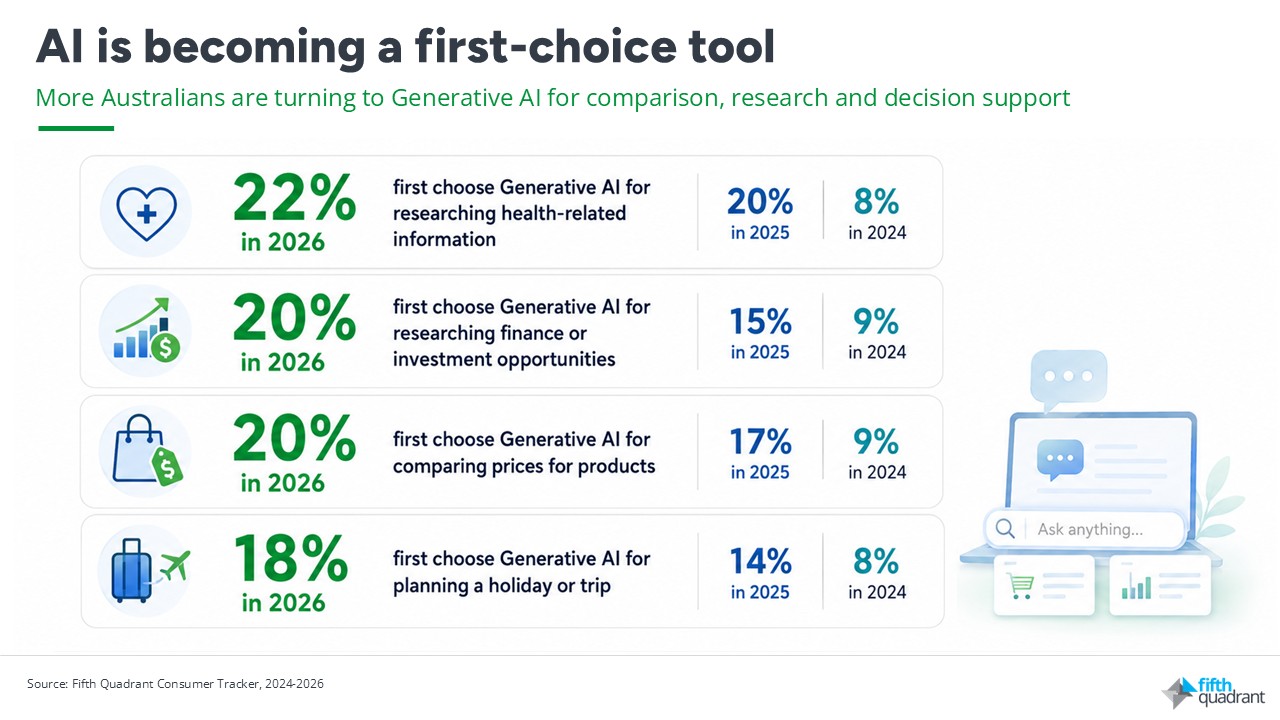
Generative AI is becoming part of everyday search behaviour
This is not a simple story of AI replacing search. Search engines still dominate product discovery, price comparison, travel planning, health information and finance research. However, across each of these categories, Generative AI has increased as a first-choice tool over the past three years.
The clearest gains are in health, finance and price comparison. In 2026, 22% of Australians nominate Generative AI as their first choice for health-related research, up from 20% in 2025 and just 8% in 2024. First-choice use has also risen to 20% for both finance and investment research and price comparison, more than double the 9% recorded for each in 2024.
The behaviour is also extending into practical everyday tasks. Generative AI is now the first choice for 18% of Australians when planning a holiday or trip, 19% when learning a new skill or hobby, and 22% when finding information for a school project or work assignment.
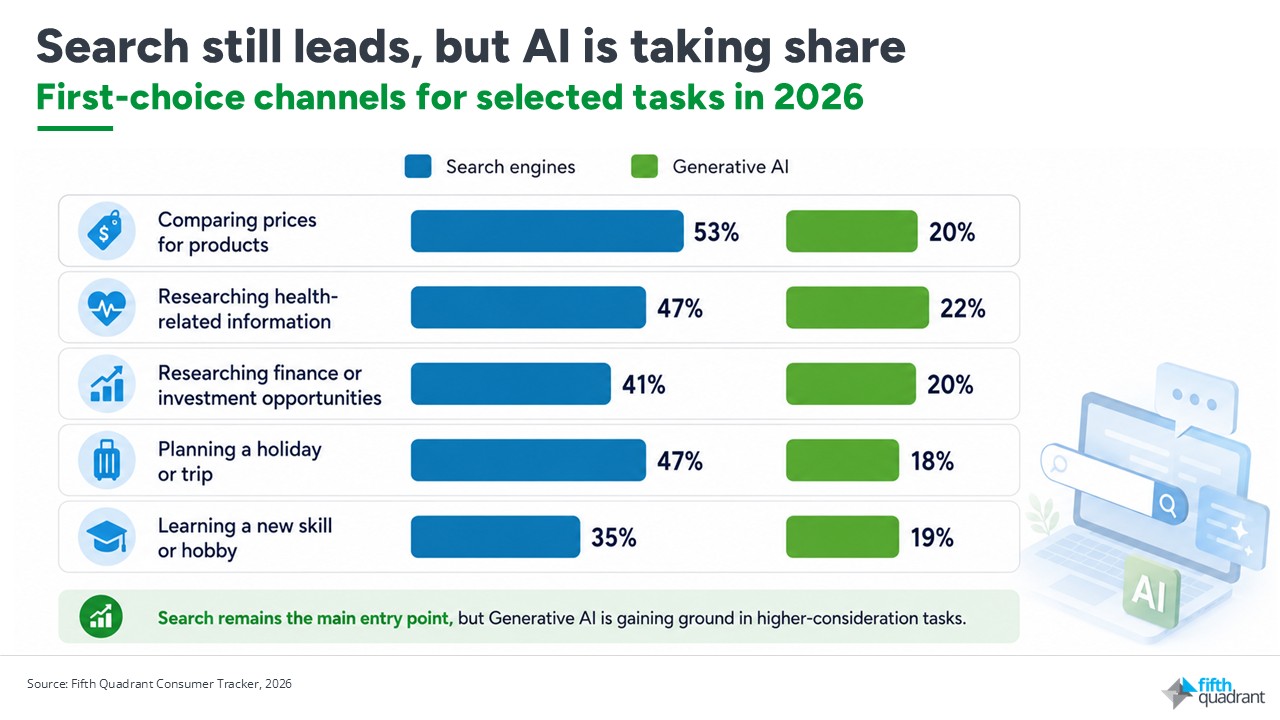
Search, social media and AI each play a different role
The channel story is becoming more nuanced. Search remains the main entry point for functional information, particularly when consumers are looking for a specific answer, product, price, location or source. Social media continues to play an important role in discovery and inspiration, especially where people are looking for ideas, recommendations, reviews, lifestyle cues or community validation. Generative AI is gaining ground in the middle: where consumers want information explained, summarised, compared or turned into a more useful decision pathway.
This means the information journey is becoming more fragmented. A consumer may discover an idea on social media, validate it through search, and then use Generative AI to compare options, summarise trade-offs or simplify the decision. For brands, this creates a more complex path to influence. It is no longer enough to think only about search rankings or social reach. Each channel plays a different role, and content needs to work across all three.
Who is leading AI search adoption?
The shift is being led by younger Australians, but it is not limited to them. Gen Z is the most likely generation to choose Generative AI first across key decision-making tasks, including health information, finance research, price comparison and work or study-related information. Higher-income households are also more likely to use AI first for finance, health, travel and learning, suggesting the behaviour is gaining traction among consumers making more complex or higher-consideration decisions.
There is also a consistent gender difference, with men more likely than women to nominate Generative AI as their first-choice tool across several key tasks, including health, finance, price comparison, travel planning and learning. However, both men and women show strong use of AI for work and study-related information, reinforcing that the shift is moving beyond early adopters and into more practical use cases.
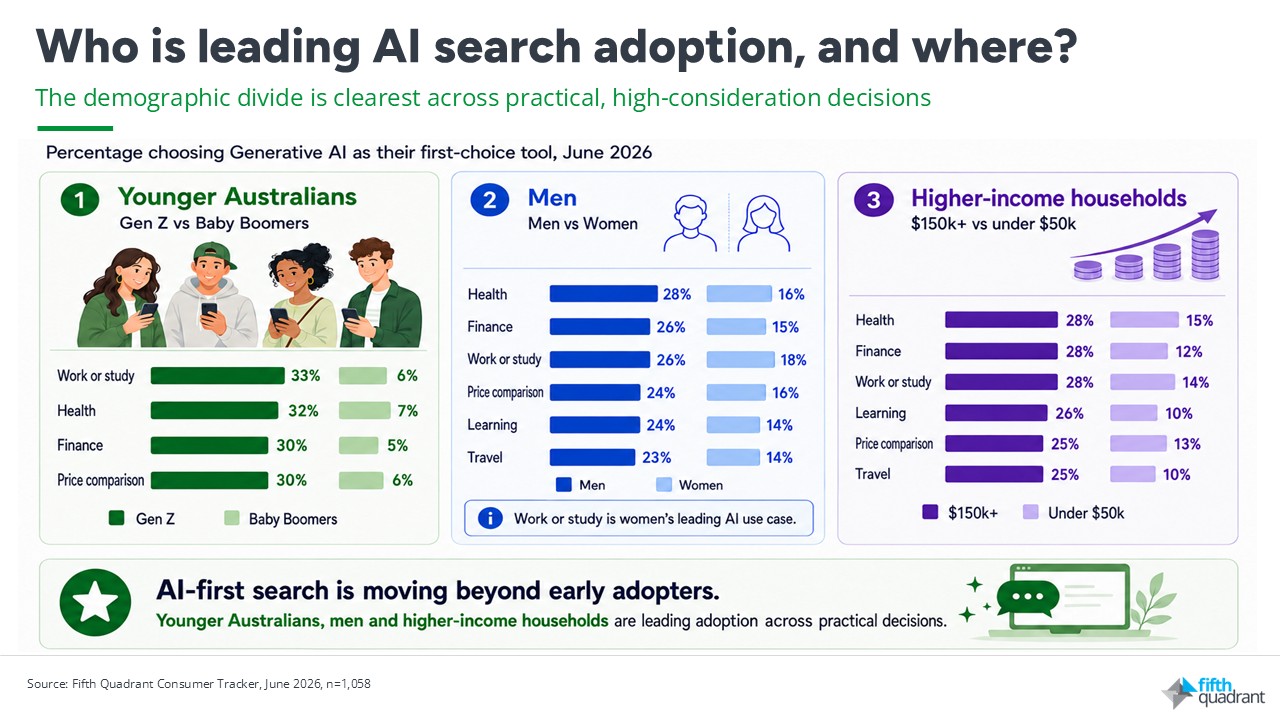
Why AI search changes content strategy
What is changing is not only where consumers go for information, but what they expect from the channel. Search is still useful when people know what they are looking for. Social media is powerful when people want inspiration, social proof or discovery. Generative AI becomes more useful when the task is less defined, the information is complex, or the consumer wants help moving from information overload to a clearer shortlist.
For brands, this has important implications. Being visible in search remains critical, but it is no longer enough to think only in terms of rankings, keywords and website traffic. As consumers increasingly use AI tools to compare, summarise and interpret options, brands need to consider whether their content is clear, credible and structured enough to be understood and surfaced in AI-assisted journeys.
This means investing in content that answers real customer questions, explains trade-offs, supports comparison and provides evidence rather than relying only on promotional claims. Social content still needs to inspire and build credibility, search content still needs to answer specific questions, and AI-readable content needs to be structured, evidence-based and easy to interpret.
The future of search is about being useful, not just discoverable
Generative AI is not replacing search, and it is not replacing social media. It is adding another layer to how consumers navigate information and make decisions. The opportunity for brands is to move beyond being discoverable and become genuinely useful across the full decision-making journey. Want to understand how AI, search and changing consumer behaviour are reshaping your market? Contact Fifth Quadrant to access evidence-based consumer insights that help you make better strategic decisions.
Data and insights referenced in this article draw on the Fifth Quadrant Consumer Tracker (2024–2026).
Posted in Consumer & Retail, B2B, Technology & Telco, Uncategorized