

Healthcare affordability is reshaping consumer behaviour
Author: James Organ | Posted On: 15 Jul 2026
How is healthcare affordability in Australia changing when, where and how consumers seek medical care?
Cost-of-living pressure is no longer confined to discretionary spending. For many Australians, it is now influencing how they manage their health.
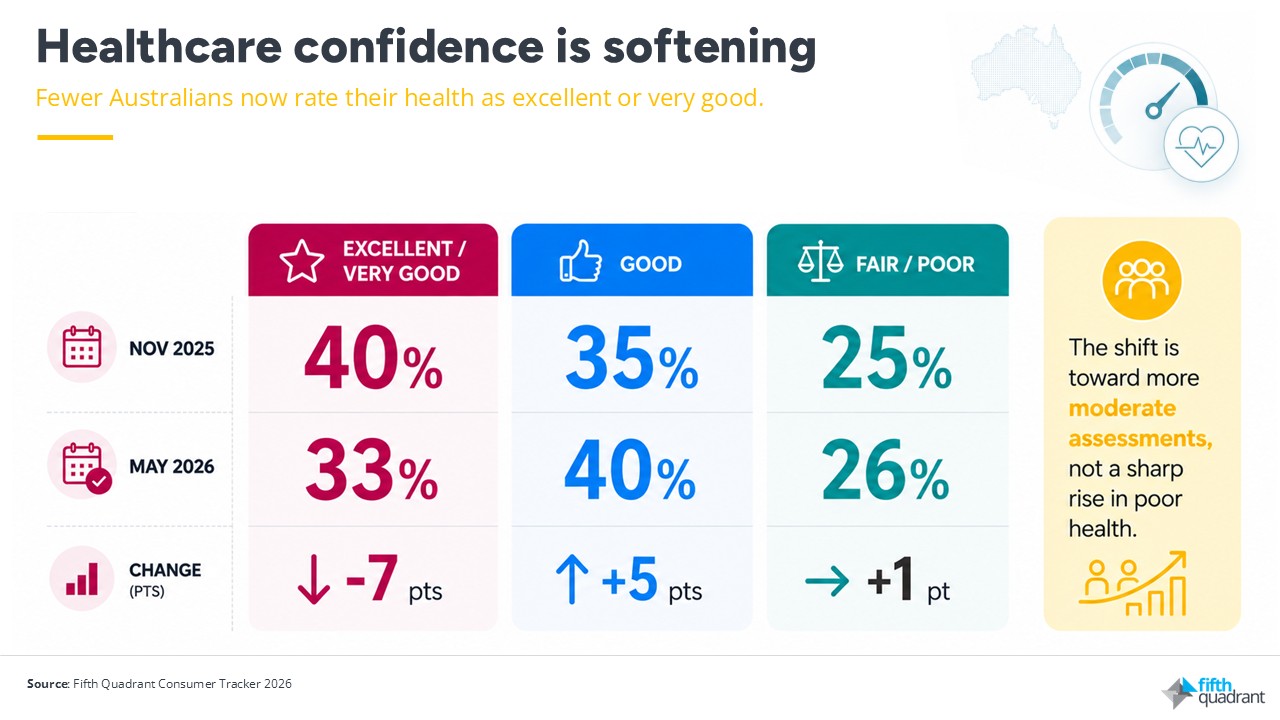
New research from Fifth Quadrant shows that while most Australians still rate their health positively, confidence in personal health has softened over the past six months. In November 2025, 40% of Australians rated their health as excellent or very good. By May 2026, this had fallen to 33%.
The shift is not towards poor health, but towards more moderate assessments, with more Australians describing their health as simply “good”. However, the more important story is not how Australians rate their health, but how rising healthcare costs are changing behaviour.
Australians are adjusting healthcare decisions to manage costs
Australians are increasingly adjusting their healthcare decisions to manage household budgets.
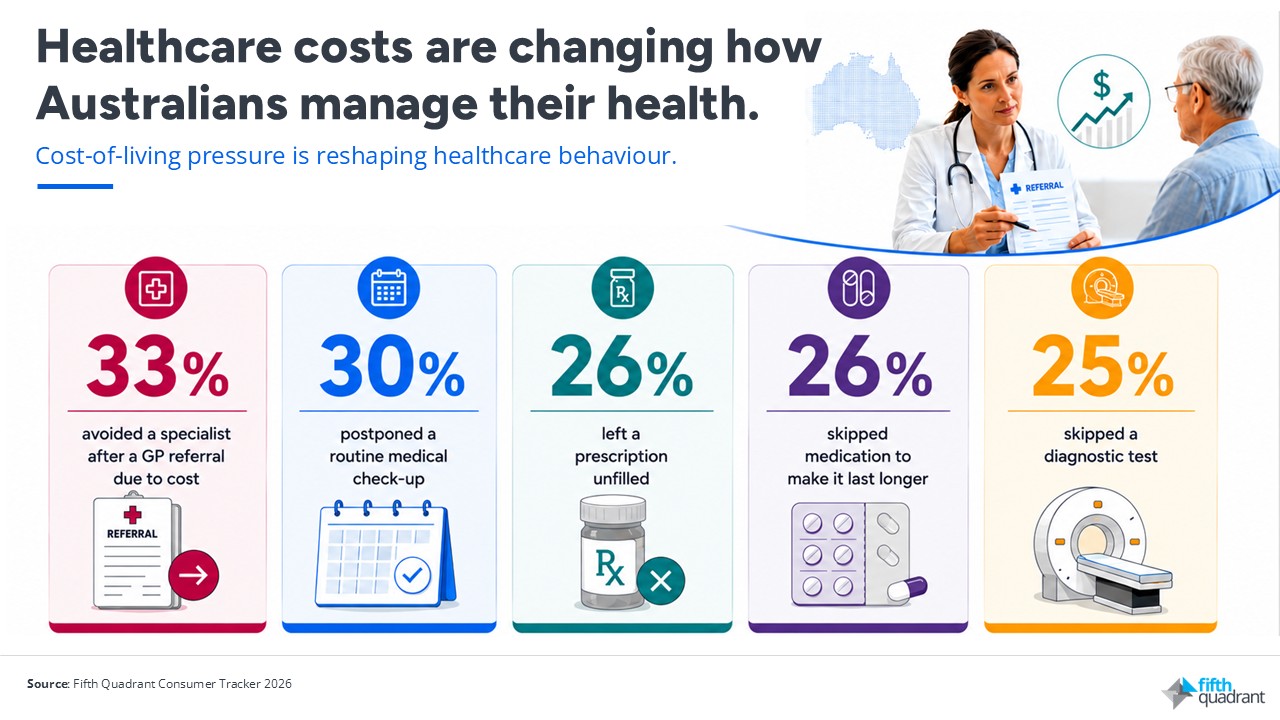
One in three have avoided seeing a medical specialist after receiving a GP referral because of cost. Three in ten have postponed a routine medical check-up, while around one in four have left a prescription unfilled, skipped medication to make it last longer or avoided a diagnostic test.
Cost pressures are also driving consumers towards digital alternatives. More than one-third have used online sources to investigate symptoms and self-diagnose rather than consult a healthcare professional.
These behaviours suggest affordability is no longer simply influencing where Australians spend their money. It is influencing when, where and how they seek healthcare.
Younger Australians are changing behaviour the most
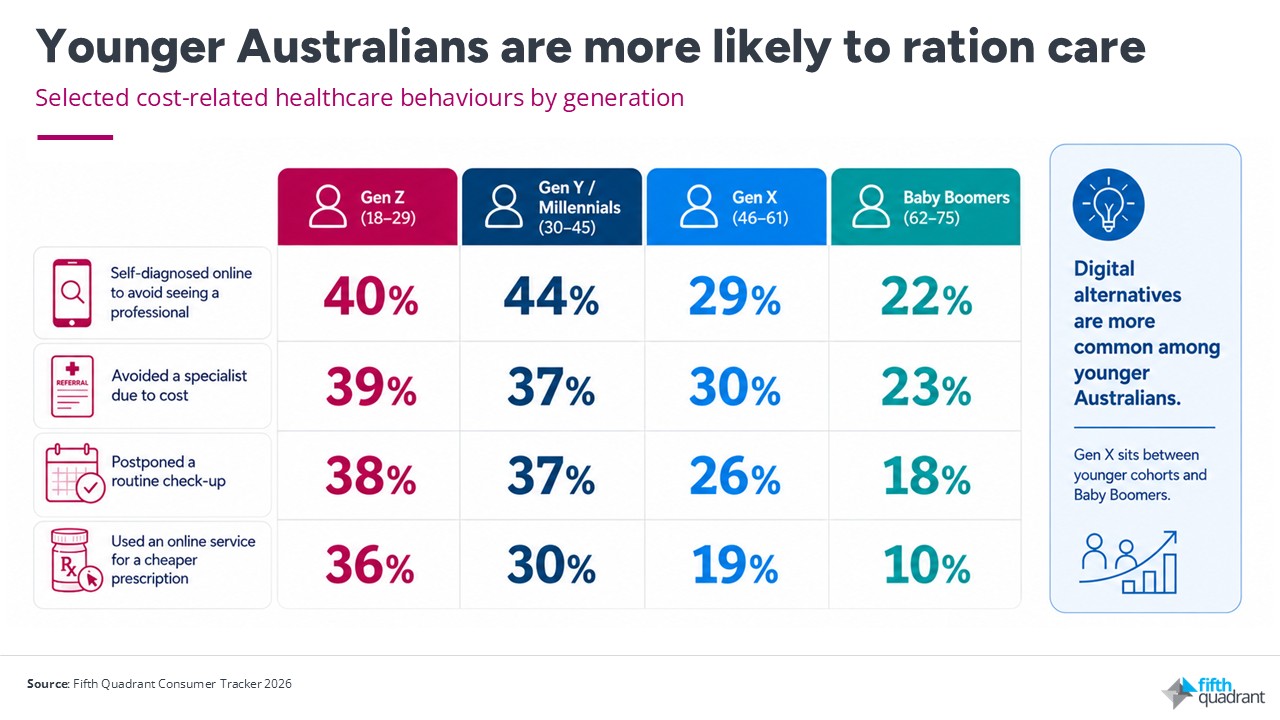
While older Australians are more likely to live with ongoing health conditions, younger Australians are more likely to change their healthcare behaviour because of cost.
Gen Z and Millennials are significantly more likely than Baby Boomers to self-diagnose online, postpone routine check-ups, avoid specialists and use online services for lower-cost prescriptions. Gen X typically sits between these younger and older cohorts, highlighting a clear age gradient in cost-driven healthcare behaviours.
The findings suggest younger Australians are embracing digital health solutions, but financial pressure is also increasing the likelihood that they delay or substitute professional care.
Healthcare affordability in Australia is becoming a major challenge
Australians continue to rate the quality of healthcare highly. Around three-quarters rate the quality of care they receive as good, very good or excellent, while ease of access and trust in the healthcare system also remain relatively strong.
Affordability, however, is emerging as the weakest part of the healthcare experience. More importantly, the behavioural evidence shows that financial pressure is already influencing healthcare decisions.
For healthcare providers, insurers and policymakers, this creates an important challenge. Access to quality care is only part of the equation if consumers increasingly delay appointments, avoid referrals or reduce medication because of cost.
Implications for the healthcare sector
Healthcare providers have an opportunity to better identify where affordability is creating barriers and communicate the value of early intervention, follow-up care and medication adherence.
For insurers, affordability should be positioned around improving access to care and reducing out-of-pocket costs, rather than simply competing on premiums.
Digital health providers also have an important role to play. Consumers are clearly embracing online tools and lower-cost services, but these solutions should complement professional care rather than replace it when financial pressure is the underlying driver.
Healthcare affordability is now a wellbeing issue
Australians remain broadly positive about their health, but confidence has softened and healthcare behaviours are changing.
When people postpone check-ups, avoid specialists, leave prescriptions unfilled or rely on self-diagnosis because of cost, affordability becomes more than a financial issue. It becomes a wellbeing issue.
The challenge for Australia’s healthcare sector is to ensure that cost pressures do not gradually translate into delayed treatment, poorer health outcomes and greater pressure on the health system over time.
Understanding how affordability is reshaping healthcare decisions has never been more important for providers, insurers, pharmaceutical companies and policymakers. Fifth Quadrant’s healthcare market research helps organisations uncover changing consumer behaviours, identify emerging barriers to care and make evidence-based decisions that improve health outcomes and customer experience. Contact us to learn how our healthcare research can help your organisation better understand the evolving needs of Australian consumers.
Research sources: Fifth Quadrant Consumer Tracker, November 2025 and May 2026.
Posted in Healthcare, B2B, Consumer & Retail, CX, Financial Services, Social & Government, Uncategorized