
Is Australia ready for a robotaxi revolution?
Author: Melissa Borg | Posted On: 16 Apr 2026
Robotaxi services are coming to Australia. Waymo, the autonomous vehicle arm of Alphabet (which is already completing roughly 450,000 paid rides per week across five US states), is accelerating plans to launch in this country as early as this year. It has been searching for Sydney office space, and also engaged a lobbyist to work with the NSW Government on testing permissions.
The commercial reality of driverless taxis is no longer hypothetical. What is far less certain is whether Australia has the regulatory foundations and public confidence needed to support the adoption of this technology.
A regulatory framework that doesn’t yet exist
Australia does not have a national automated vehicle safety framework. As the federal government works towards national regulations slated for 2027, currently, companies must negotiate approvals state by state, under rules that differ considerably between jurisdictions. That complexity matters because the commercial timeline is not waiting: Waymo is already preparing to expand to the UK and other international markets, and the regulatory decisions Australia makes now will shape how the technology lands here.
Researchers at RMIT University, in a study funded by the iMove Co-operative Research Centre, have urged regulators to be proactive, rather than reactive to autonomous vehicle technology. Their findings indicate that while autonomous vehicles could cut energy consumption by around 15 per cent and reduce congestion; they could equally increase total kilometres travelled, undermine public transport, and generate significant volumes of empty vehicle movements as robotaxis reposition between fares. Allowing private ownership of fully autonomous vehicles, permitting them to compete with public transport, and allowing driverless empty runs are among the specific risks RMIT flags. These are not passive outcomes; they are the result of regulatory choices made or avoided.
The trust gap is generationally divided
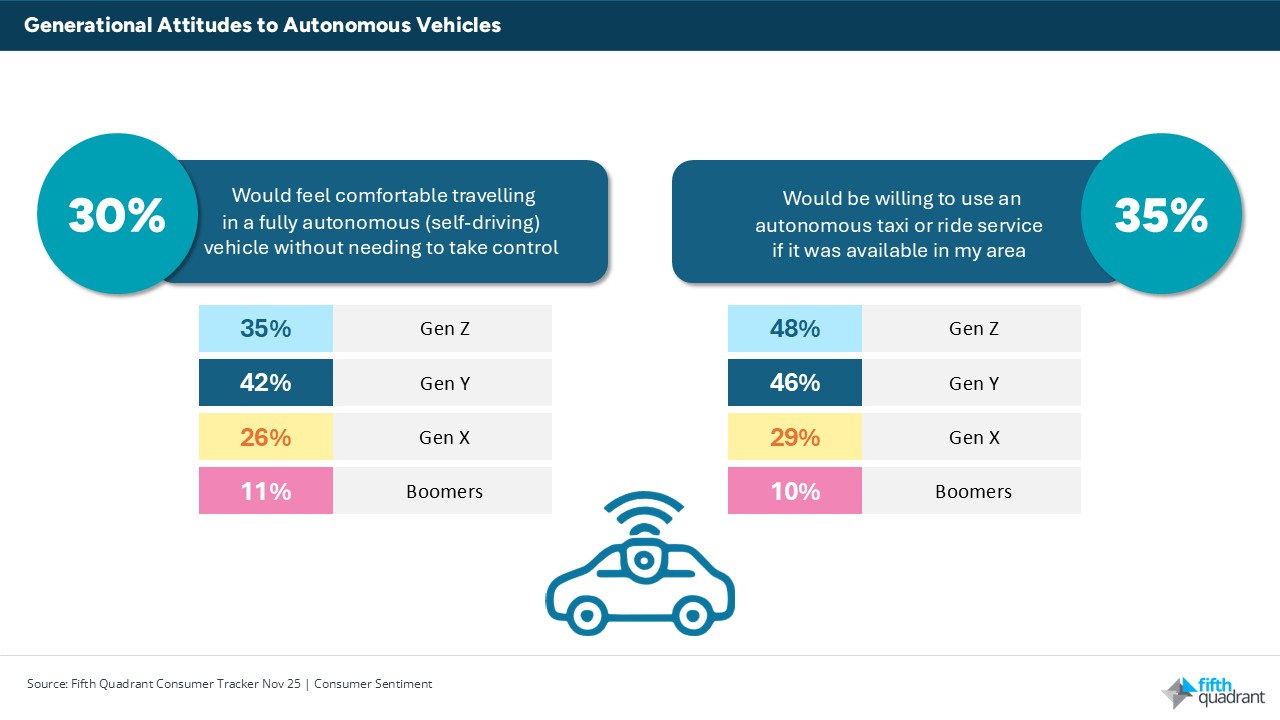
Regulatory readiness is one side of the equation. Public trust is the other. Fifth Quadrant’s consumer tracker finds that only 30 per cent of Australians would feel comfortable travelling in a fully autonomous vehicle. Willingness to use a robotaxi service is slightly higher at 35 per cent, but the generational split is stark: Gen Z and Millennials are much more willing to ride than their Baby Boomer compatriots. Winning trust across that divide will take time, requiring a demonstrated safety record and a regulatory environment that gives the public confidence that someone is accountable when things go wrong.
The decisions being made now will be hard to reverse
Transport Department connected and automated vehicle policy director, Darren Atkinson, has noted that environmental and social considerations cannot be addressed in isolation: “They need to be part of a package considering the social benefits.” That framing is right, but it requires active regulatory intent to deliver. Markets left to operate without that package tend to optimise for adoption speed rather than urban outcomes.
Australia is not short of the commercial interest required to make robotaxi services a reality. What it needs is the regulatory clarity to ensure that, when they arrive, they arrive on terms that work for Australian cities and Australian passengers. The window to shape those terms is open now, but it will not stay open indefinitely.
At Fifth Quadrant, we bring deep expertise in automotive, mobility, and transport research, from consumer attitudes to policy-facing thought leadership. Explore our Auto and Mobility insights or get in touch to discuss how we can support your next project.
Posted in Auto & Mobility, Consumer & Retail, QN, Uncategorized