

Workshop staffing: the hidden cost to customer loyalty
Author: Ben Selwyn | Posted On: 06 Oct 2026
How does workshop understaffing affect customer loyalty? Australian automotive research reveals how staffing shortages can undermine customer communication, trust and retention.
Around four in ten people working in automotive say their workplace is not adequately staffed, according to the latest Australian Automotive Workforce Pulse. Workshop operators are naturally concerned about this, but not necessarily considering that workshop staffing affects customers as much as it affects delayed jobs and idle bays.
Research Fifth Quadrant conducted for the Australian Automotive Aftermarket Association (AAAA) highlights the extent to which understaffing in workshops can impact business performance. Car owners judge a workshop largely on how the work is explained and followed up. When a team is stretched, the communication around the repair is the easiest thing to cut, and it is what undecided customers use to decide whether to return.
What short staffing does to a workshop team
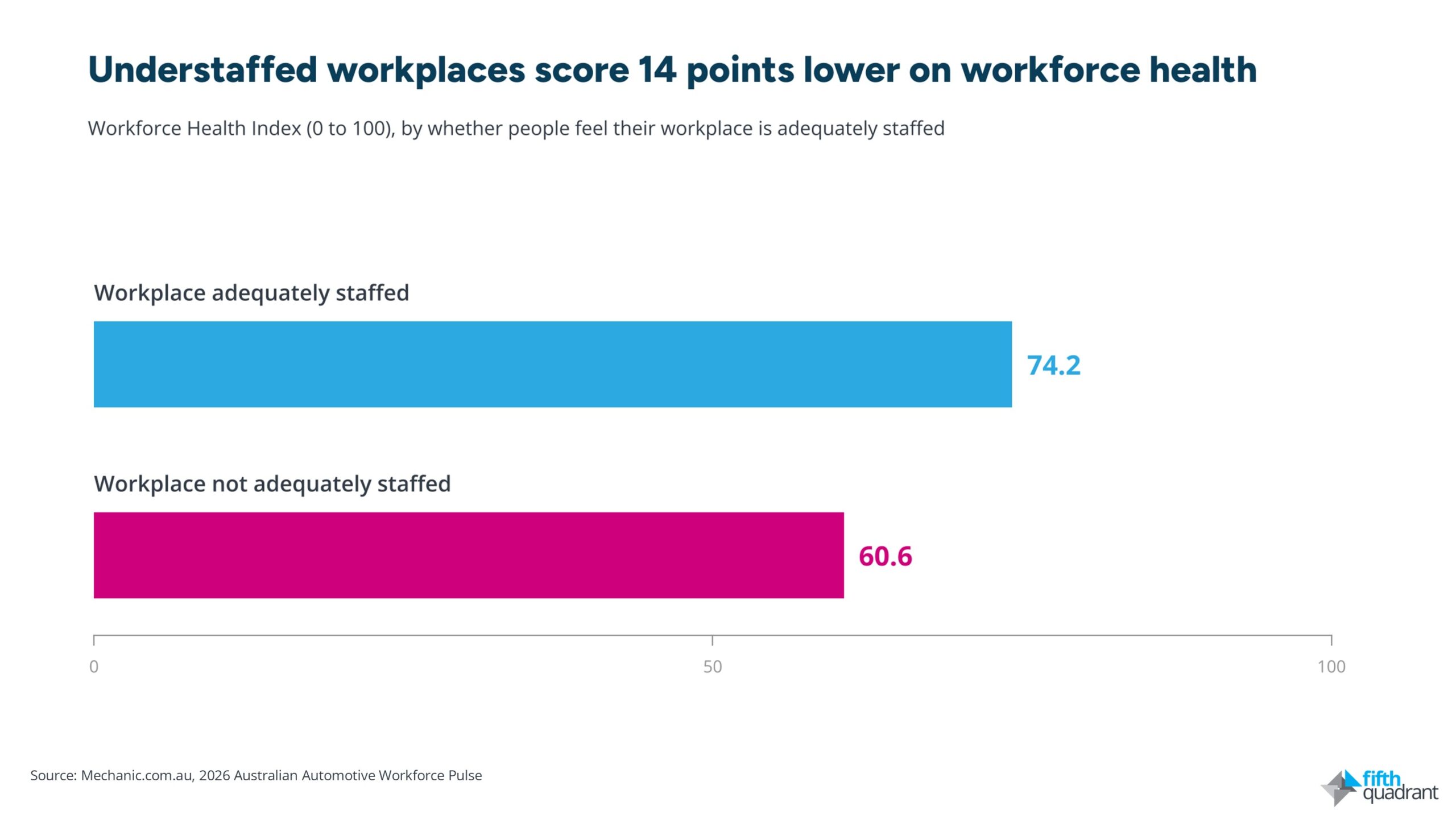
People in understaffed workplaces report a noticeably harder working life than those in adequately staffed ones. The same people cover more work, and tasks other than the repair are the first to give way. In many independent workshops, that puts added pressure on the technicians, because they typically handle the drop-off and pick-up conversations. When that technician is running behind, explanations get shorter and the customer is left feeling short-changed.
What car owners judge a workshop on
Trust and reputation drive workshop choice, and seven in ten owners say they would pay more for a workshop they trust. Owners put heavy weight on a clear explanation of what needs fixing now and what can wait, an itemised quote before work starts, and being kept informed during the job.
Price matters less than many operators assume. Undecided customers need a significant discount before they will seriously consider switching, which makes competing for them on price an expensive strategy.
Operators tend to rank the quality of the repair first. Owners largely take a competent repair as given and use the communication around it to decide whether a workshop has earned their trust. That difference in perspective is where staffing pressure matters.
Undecided customers
Around 13 per cent of owners have no regular workshop. Satisfaction is high overall, but loyalty weakens at booking, drop-off, pick-up and after-service care. These are also the moments that depend most on staff time.
Undecided customers are a minority, but they are the customers a workshop can still win. Most owners value being shown photos or video of a problem, yet few workshops send them. Follow-up after a service is also uncommon, even though a check-in within 48 hours is one of the simplest habits that supports retention.
Workshop staffing and the move to scale
Consolidation raises the bar. Continental’s sale of mycar Tyre & Auto to Chinese service platform Tuhu, valued at A$403 million and subject to regulatory approval, covers around 280 stores. Larger networks can spread the cost of front-of-house staff, booking systems and automated customer updates across many sites. Independents competing with them have to provide the same reassurance without the same headcount, and with the MTAA estimating a shortfall of 38,000 motor trades professionals and technicians, hiring their way there is unlikely.
What workshops and networks can do
The practical goal is to make good communication less dependent on spare technician time. That could mean a simple way to send a photo or short video from the bay, text updates at set points in each job, an automatic check-in after every service, or moving drop-off and pick-up to a front-of-house role once volumes justify it.
For a small independent, the job card is the place to start. Agree the points at which every customer hears from the workshop, such as when the car is inspected, when extra work needs approval and when it is ready. Updates then go out as part of the process instead of depending on a technician remembering mid-job. Once that routine is working, it becomes easier to judge whether a part-time service advisor would pay for itself.
Networks and parts suppliers can package these tools for independent members, helping them match larger chains on customer experience without adding staff.
There is a workforce benefit too. People in automotive put work-life balance and respect from management close behind pay when choosing an employer. Taking routine customer contact off an overloaded technician helps on both fronts.
Staffing and customer loyalty
Staffing decisions are usually made on capacity and cost, but they also shape loyalty. Workshops that keep communication steady when the team is stretched give undecided customers fewer reasons to leave. Watching staff capacity alongside customer feedback at handover and after service is a simple way to spot the problem before customers move on.
At Fifth Quadrant, we bring deep expertise in Auto & Mobility and customer experience research. Explore our latest automotive insights or get in touch to discuss your next move.
Sources: Australian Automotive Workforce Pulse 2026, Mechanic.com.au; Car Owners’ Needs & Workshop Delivery Alignment 2026, Australian Automotive Aftermarket Association; Continental Sells mycar Tyre & Auto to Tuhu, Continental, September 2026; and Automotive Workforce Must Be Part of Australia’s Skilled Migration Priorities, Motor Trades Association of Australia, September 2026.
Posted in Auto & Mobility, B2B, CJM, Consumer & Retail