

Australia’s fleet industry has two stories
Author: James Organ | Posted On: 22 Jul 2026
How are Australian fleet industry trends shaping corporate fleet management, small fleet priorities, fleet electrification and fleet technology adoption in 2026?
New research reveals that while corporate and small fleets face many of the same challenges, they are responding in very different ways.
It is easy to think of the Australian fleet industry as one homogeneous market. The reality is quite different.
For this research, small fleets are organisations operating 1 to 19 vehicles, while corporate fleets operate 20 or more vehicles.
Corporate fleets may represent just 23,500 organisations, but they manage around half of Australia’s business vehicle parc. Small fleets account for approximately 929,000 businesses, representing the vast majority of fleet operating businesses in Australia.
The latest Australian Corporate Fleet Insights Study and Australian Small Fleet Insights Study, conducted by Fifth Quadrant in partnership with the Australasian Fleet Management Association, bring these two fleet stories together.
Together, the studies provide one of the most comprehensive views of Australian fleet industry trends, including cost pressures, electrification, technology adoption and future investment priorities.
Every Fleet Decision Starts With Cost
Cost management has become the defining issue across the Australian fleet industry.
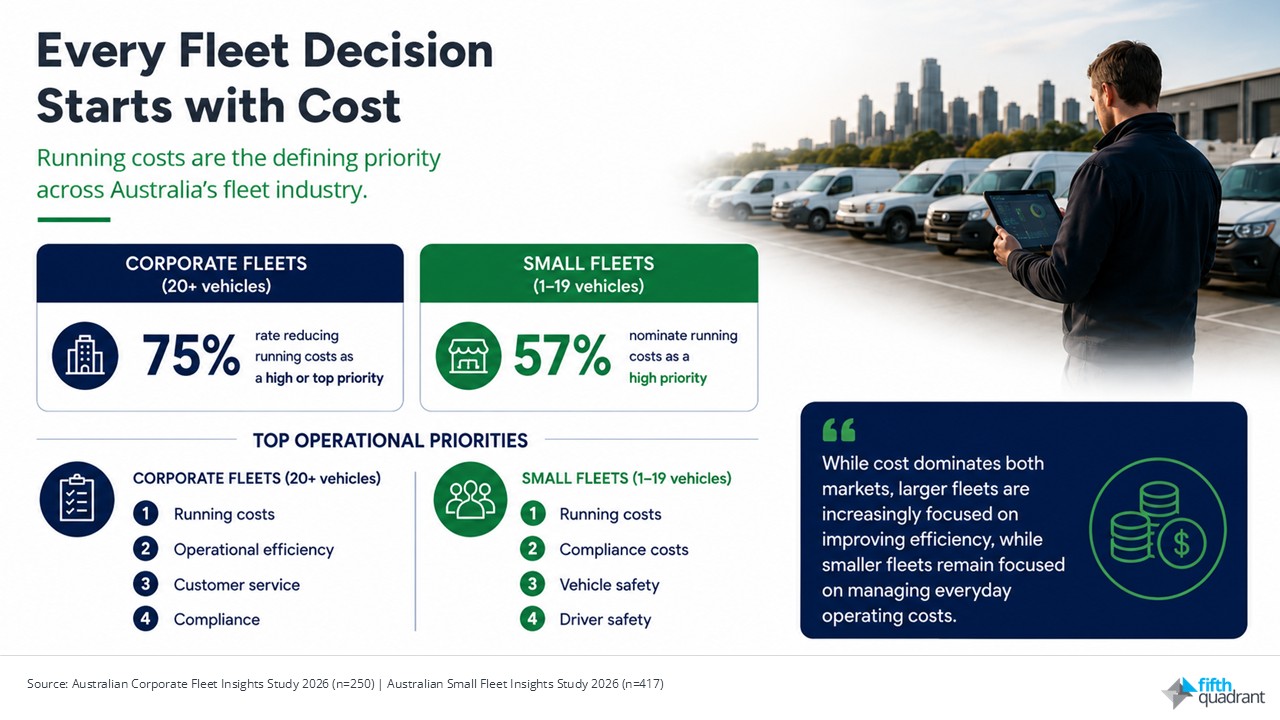
Among corporate fleets, 75% rate reducing running costs as a high or top priority, making it the number one issue facing fleet managers today. Improving operational efficiency, customer service and compliance also rank highly, reflecting the increasing complexity of managing larger fleets.
Small fleets share many of the same concerns, although their focus is more operational. Fifty-seven per cent nominate running costs as a high priority, followed by compliance costs, vehicle safety and driver safety.
Rather than pursuing large-scale transformation programs, many smaller operators remain focused on improving day-to-day operations while protecting already tight margins.
For fleet suppliers, this means value propositions need to demonstrate clear and measurable cost savings. Technology, finance and service offerings must connect directly to lower operating costs, reduced downtime or simpler administration.
Hybrid Vehicles Are the Bridge to Fleet Electrification
One of the clearest findings across both studies is that fleet electrification has entered a new phase.
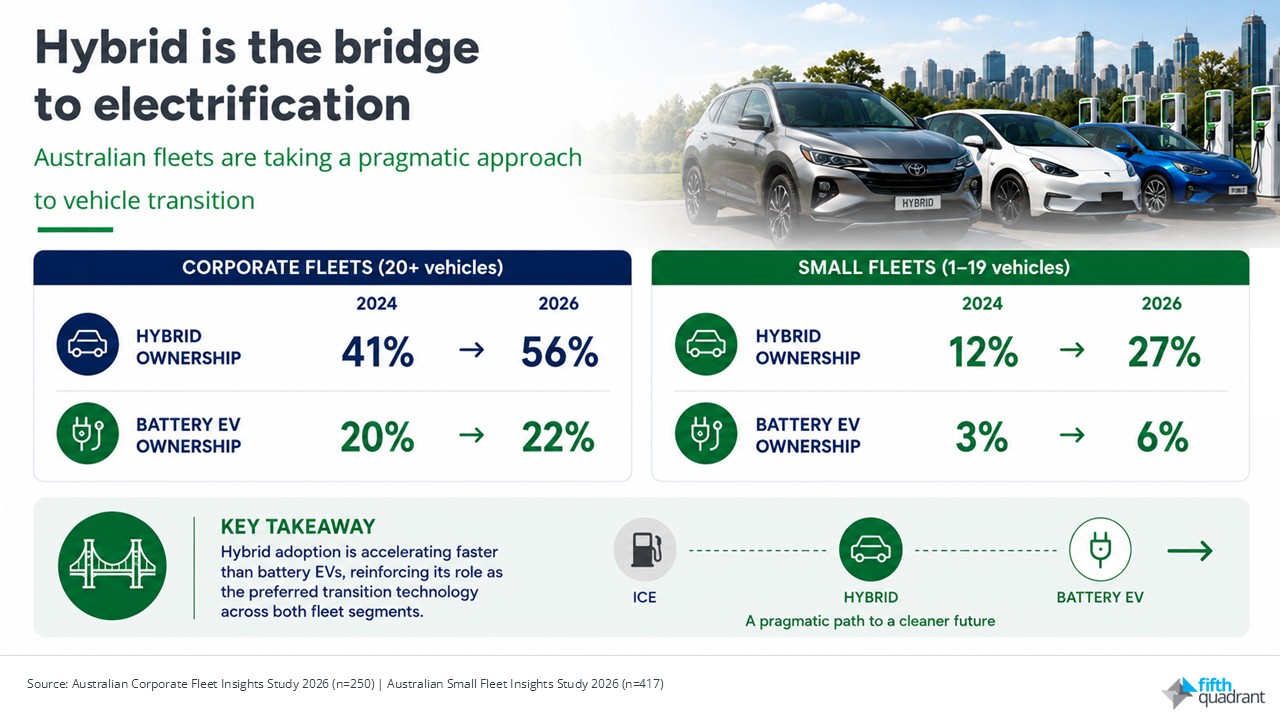
Among corporate fleets, hybrid ownership has increased from 41% to 56% in just two years, while battery electric vehicle ownership has increased only modestly, from 20% to 22%.
Small fleets are following a similar path. Hybrid ownership has more than doubled from 12% to 27%, while battery electric vehicle ownership has increased from 3% to 6%.
The message is clear. Australian fleets have not stepped back from electrification. They are taking a pragmatic approach, with hybrids emerging as the preferred transition technology across both fleet segments.
Hybrids allow operators to reduce fuel consumption and emissions without taking on every operational challenge associated with a fully electric fleet. For many businesses, they provide a practical step between internal combustion vehicles and battery electric vehicles.
This does not mean battery electric vehicles have been rejected. Instead, fleet operators are matching vehicle technology to operational requirements, charging access, whole-of-life costs and vehicle availability.
Fleet Technology Adoption Is Accelerating
Technology adoption is accelerating across the fleet industry, but not at the same pace.
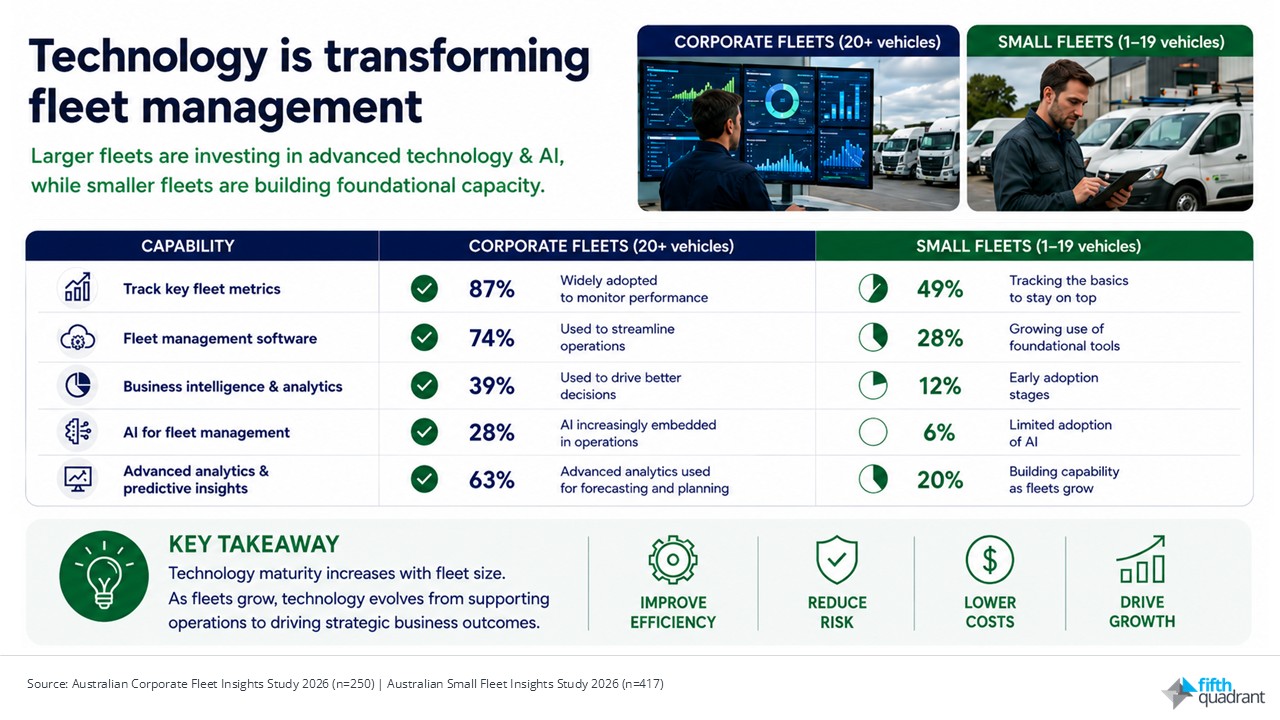
Corporate fleets continue to lead investment in fleet management software, analytics and artificial intelligence. They are using technology to improve efficiency, optimise operations and support better decision-making.
Small fleets are also embracing technology, but their focus remains on building foundational capability. Adoption continues to increase as fleet size grows, creating significant opportunities for technology providers across every stage of the fleet lifecycle.
As fleets grow, technology evolves from supporting day-to-day operations to becoming a strategic business capability.
The opportunity is not limited to the largest organisations. Fifth Quadrant’s 2026 research found that many mid-sized corporate fleets are already using or trialling artificial intelligence for administration, compliance, operational optimisation and other fleet tasks.
Providers will need different propositions for different fleet sizes. Smaller operators are more likely to value affordable, simple tools that can be implemented quickly, while larger fleets may require sophisticated analytics, integration, governance and implementation support.
One Australian Fleet Industry, Two Distinct Stories
The research confirms there is no single Australian fleet customer.
Corporate fleets are investing in operational efficiency, technology, artificial intelligence and structured electrification programs to improve performance and prepare for the future.
Small fleets are balancing many of the same pressures but continue to prioritise affordability, operational simplicity and incremental change. They are adopting new technologies at a pace that reflects their operational and financial realities.
For organisations supplying vehicles, finance, fleet management, servicing, telematics, software or charging infrastructure, understanding these differences is becoming a competitive advantage.
A product or sales strategy designed for a national corporate fleet may not translate effectively to a five-vehicle business. Fleet size influences buying processes, internal capability, technology requirements, access to capital and tolerance for operational disruption.
The businesses that outperform over the coming years will be those that recognise Australia’s fleet industry has two distinct stories and tailor their products, services and customer strategies accordingly.
What Is Inside the 2026 Fleet Insights Reports?
Together, the Australian Corporate Fleet Insights Report and Australian Small Fleet Insights Report provide detailed benchmarking and longitudinal analysis across:
- Fleet profile and market composition
- Fleet management priorities
- Fleet electrification and electric vehicle readiness
- Fleet technology adoption and artificial intelligence
- Safety initiatives and risk management
- Fleet management services
- Vehicle acquisition and disposal
- Fleet finance and insurance
- Industry and fleet size comparisons
- Longitudinal trends and benchmarking from 2018 to 2026
Whether your organisation serves corporate fleets, small businesses or the broader automotive ecosystem, the reports provide independent Australian benchmarks covering fleet behaviour, priorities, technology adoption and future intentions.
Available Now
At Fifth Quadrant, our fleet research program with AfMA has tracked this market since 2018. The 2026 Australian Corporate Fleet Insights Report and 2026 Australian Small Fleet Insights Report are now available. Click here to request a copy of the reports, and a member of the Fifth Quadrant team will contact you to discuss your requirements or sign up for our monthly insights.
Sources: The article draws on Fifth Quadrant’s 2026 Australian Corporate Fleet Insights Report, 2026 Australian Small Fleet Insights Report and its analysis of artificial intelligence adoption in Australian fleets. The reports were published in May and June 2026 and contain research conducted in partnership with the Australasian Fleet Management Association.
Posted in Auto & Mobility, B2B, Uncategorized