

Fifth Quadrant Happiness Index slips as pressure moves beyond the wallet
Author: James Organ | Posted On: 10 Jul 2026
Why is happiness declining in Australia in 2026 and what does the shift mean for businesses and brands?
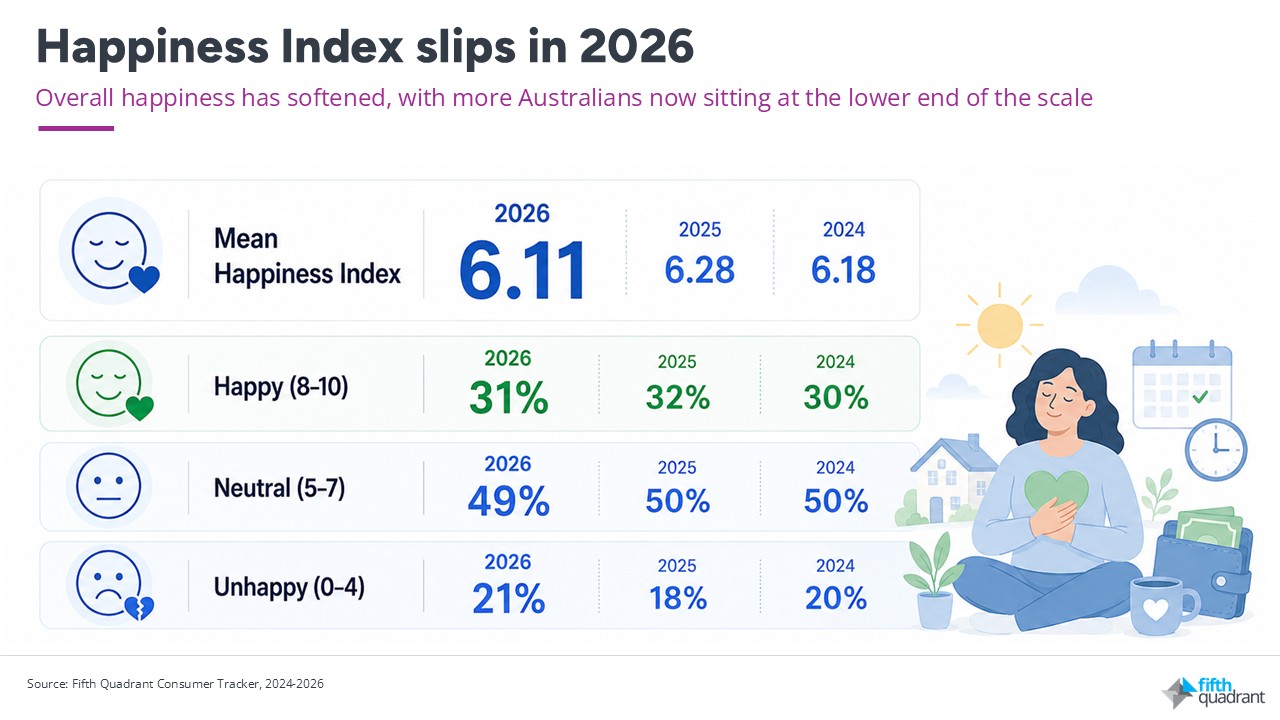
Australians’ overall happiness has softened in 2026, with pressure extending beyond financial concerns into broader areas of daily life.
The latest Fifth Quadrant Consumer Tracker shows the Australian Happiness Index falling to 6.11 out of 10, down from 6.28 in 2025 and slightly below the 6.18 recorded in 2024. While the headline movement is modest, the distribution of responses suggests more Australians are now sitting at the lower end of the happiness scale. In 2026, 21% of Australians rated their overall happiness in the unhappy range, compared with 18% in 2025.
What is driving the decline in Australian happiness index?
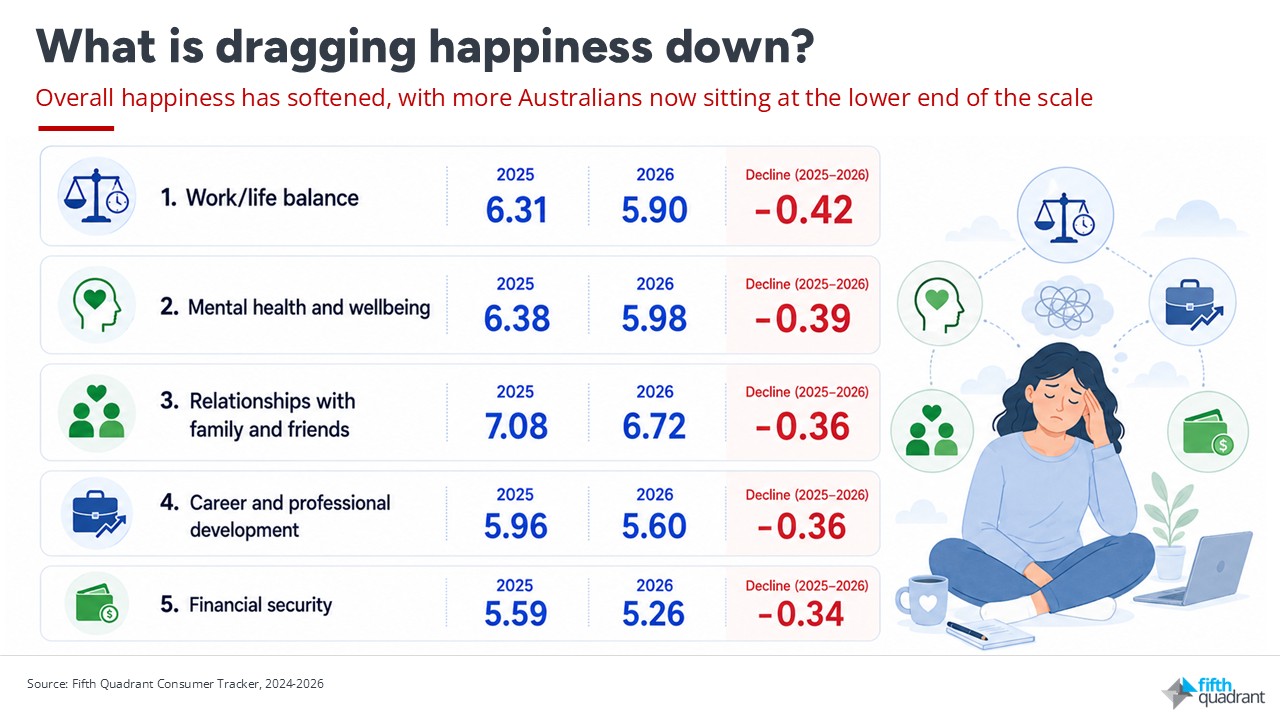
The underlying life satisfaction measures show the sharper story. The decline in happiness is not being driven by one issue alone, with softer scores across work/life balance, mental health, relationships, career development and financial security.
This reflects a broader view of wellbeing in which health, employment, income, housing and social connection interact to shape people’s quality of life and life satisfaction. The Australian Institute of Health and Welfare identifies mental health as having a particularly strong association with life satisfaction, while weaker social connections are also linked to poorer outcomes.
The largest fall is in work/life balance, which declined from 6.31 in 2025 to 5.90 in 2026. This is one of the clearest signals in the data, particularly because work/life balance often reflects a combination of cost pressure, workload, family responsibilities and general fatigue.
Mental health and wellbeing also softened, falling from 6.38 in 2025 to 5.98 in 2026. This is important because mental wellbeing is closely linked to how people interpret their financial position, manage uncertainty and make decisions.
The proportion of Australians rating their mental health in the unhappy range increased to 25%, up from 20% in 2025, making it one of the more concerning shifts in the tracker.
Financial security remains the weakest life satisfaction measure overall. It fell from 5.59 in 2025 to 5.26 in 2026, with 34% of Australians now rating their financial security in the unhappy range.
This reinforces the broader financial outlook story, but it also shows that pressure is not limited to expectations about the economy or cost of living. It is flowing through to how people feel about their own resilience.
External economic indicators provide context for this concern. The Australian Bureau of Statistics reported that living costs increased across every household type in the March 2026 quarter, while the Reserve Bank of Australia noted that higher energy prices and interest rates were expected to weigh on household consumption.
Career and professional development also declined, falling from 5.96 to 5.60, while relationships with family and friends fell from 7.08 to 6.72.
Relationships remain one of the highest-scoring areas overall, but the decline suggests that broader pressure may be affecting social and personal wellbeing as well as finances.
Which Australians are feeling the most pressure?
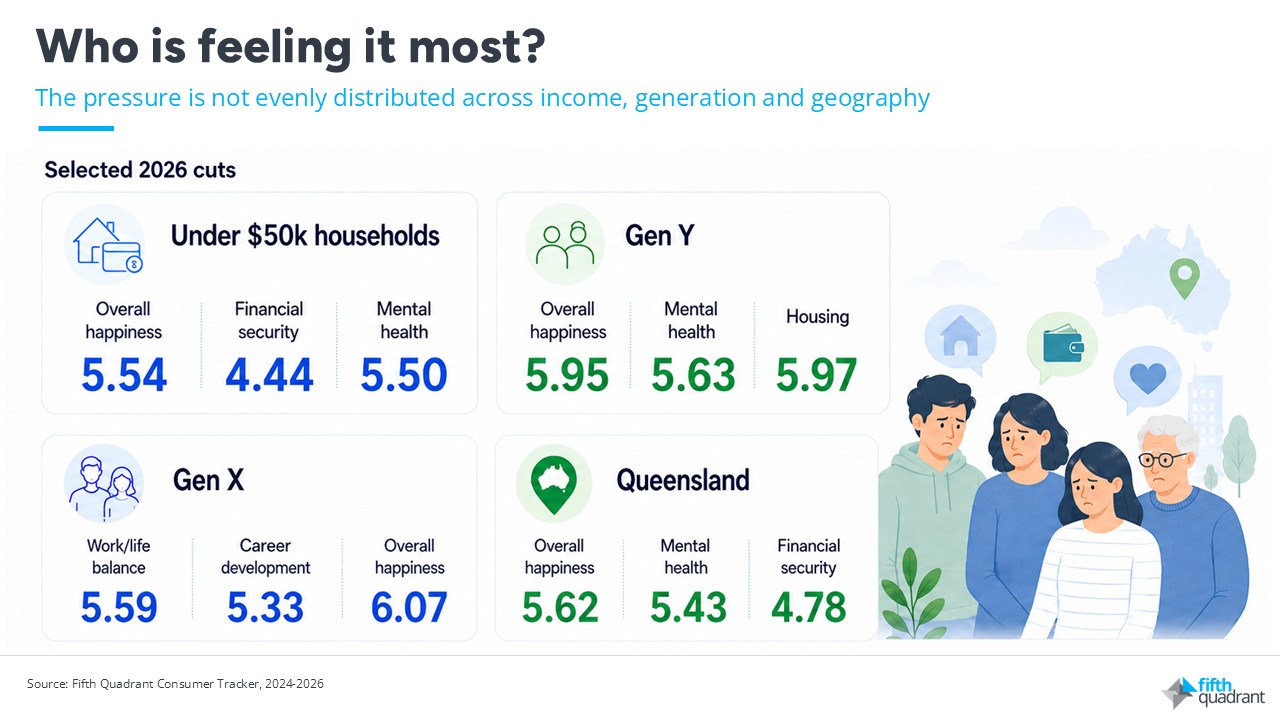
The demographic cuts show that the pressure is not evenly distributed.
Lower-income Australians are clearly more exposed, with those earning under $50,000 recording weaker scores across financial security, job security, physical health, mental health and overall happiness.
There are also generational differences. Gen Y appears more exposed on mental health, housing and overall happiness, while Gen X stands out on work/life balance and career development.
This suggests the wellbeing story is not simply about age; it reflects different life-stage pressures, including housing costs, family commitments, career demands and financial obligations.
Queensland is also worth watching, with weaker scores across several measures including overall happiness, mental health, physical health, financial security and housing.
This does not mean the pattern is unique to Queensland, but it does suggest some markets may be feeling the current environment more sharply than others.
What does declining consumer wellbeing mean for businesses?
For businesses, the implication is that consumers are not only financially cautious; many are also emotionally and mentally stretched.
This matters because wellbeing influences how people make decisions. When consumers feel less secure, less balanced and less optimistic, they are more likely to delay major purchases, scrutinise value, avoid unnecessary risk and gravitate towards brands that reduce friction or provide reassurance.
The opportunity for brands is to recognise that value is not only about price.
In this environment, consumers are likely to respond to products, services and communications that make life feel easier, more manageable and more certain. Brands that can help people save time, reduce stress, make confident decisions or feel more in control will be better placed than those relying only on promotional messages.
This creates four practical priorities for brands:
- Make choices and product comparisons easier.
- Communicate prices, conditions and benefits clearly.
- Reduce avoidable steps and service friction.
- Provide reassurance without overstating promises.
Conclusion
The Happiness Index has only softened modestly, but the underlying measures tell a broader story. Australians are feeling the squeeze across work, wellbeing, finances and personal resilience.
For brands, understanding that broader consumer context will be critical to staying relevant in an environment where confidence, value and trust matter more than ever. Businesses that invest in understanding changing consumer attitudes will be better positioned to identify emerging opportunities, strengthen customer relationships and make more informed strategic decisions.
Want to understand how your customers are responding to today’s changing market conditions? Fifth Quadrant delivers evidence-based consumer and retail market research that helps organisations uncover customer needs, test ideas and make confident decisions. Contact us to discuss how our research can help your business stay ahead of changing consumer behaviour.
Sources and context: Fifth Quadrant Consumer Tracker, 2024–2026; Australian Bureau of Statistics, Selected Living Cost Indexes, March 2026; Reserve Bank of Australia, Statement on Monetary Policy, May 2026; Australian Institute of Health and Welfare resources on life satisfaction, social connection and the social determinants of health.
Posted in Consumer & Retail, B2B, CX, Financial Services, Healthcare, Social & Government, TL, Uncategorized