

Australia’s AI evolution is becoming a two speed transition
Author: James Organ | Posted On: 17 Sep 2026
Is AI adoption in Australia entering a two-speed phase?
For the past two years, the AI story has largely been about adoption. More Australians have become familiar with generative AI, experimented with new platforms and incorporated them into their lives.
But Fifth Quadrant’s latest Consumer Tracker suggests the next stage of AI adoption in Australia may look quite different.
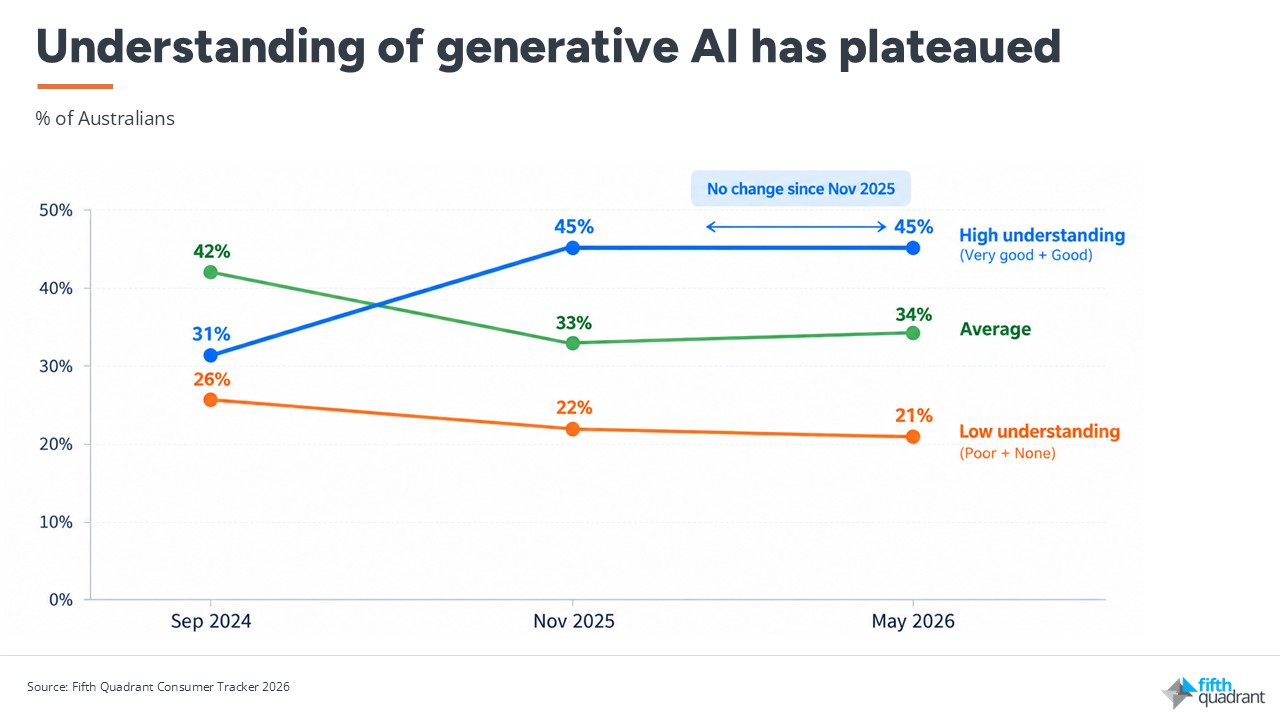
Self reported understanding of generative AI rose sharply between September 2024 and November 2025, with the proportion rating their understanding as good or very good increasing from 31% to 45%. By May 2026, however, it remained unchanged at 45%.
Rather than the whole population continuing to move forward at the same pace, Australia’s AI market may increasingly be separating into two groups.
Australia’s AI users are splitting into two groups
Today, 40% of Australians are heavier AI users, either using AI as part of their daily lives or frequently for specific tasks. The remaining 60% are lighter users, using it occasionally to experiment or only sporadically.
The important distinction is that heavier users are not simply using AI more frequently. Their behaviour is becoming fundamentally different.
ChatGPT was used in the past month by 77% of heavier users compared with 36% of lighter users. The same pattern appears for Gemini (51% versus 22%), Copilot (33% versus 14%) and Claude (19% versus 3%).
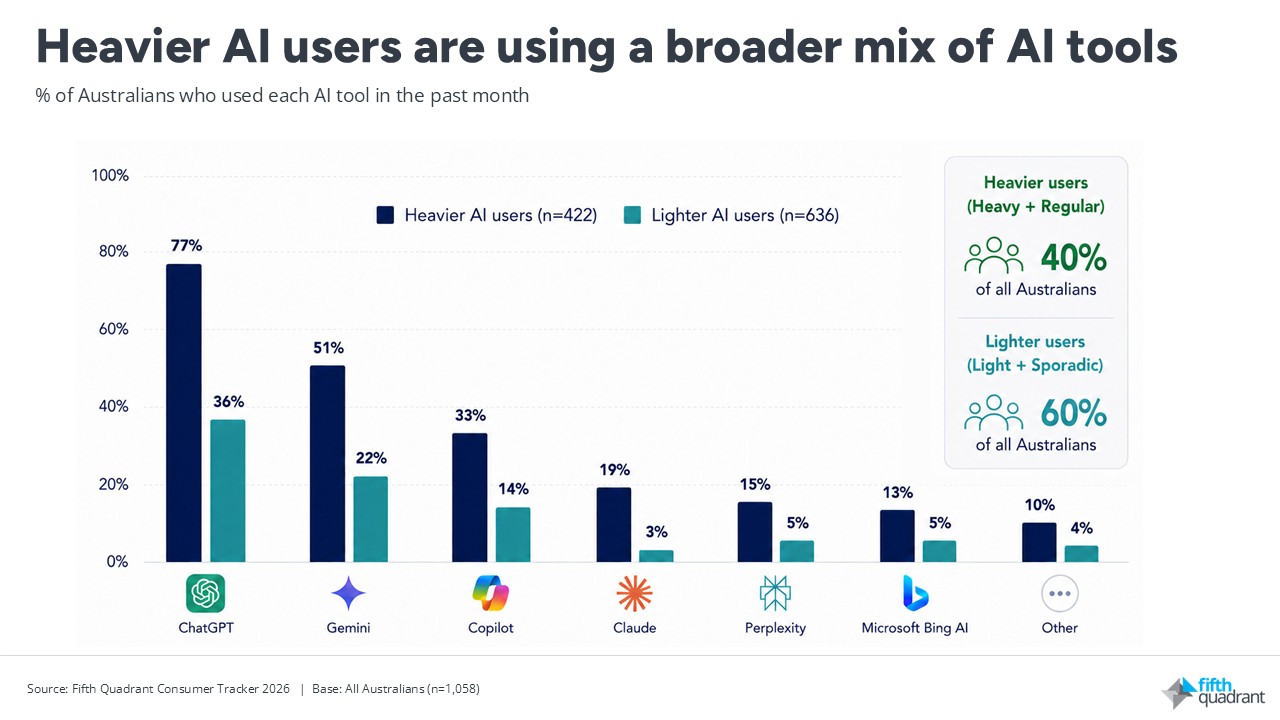
Greater experience with AI appears to encourage experimentation rather than loyalty to one platform. Heavier users are beginning to build their own AI toolkit, selecting different tools for different purposes.
But the more significant change may be happening elsewhere.
Heavy AI users are changing how they find information
Across every information category measured, heavier users are substantially more likely to turn to AI first.
For health information, 42% of heavier users choose AI first compared with just 8% of lighter users. For finance and investing, the difference is 40% versus 7%, while for school or work it is 37% versus 10%.
Traditional search remains dominant among lighter users, but among heavier users, the gap between search and AI has become remarkably narrow. For health information, 45% choose search compared with 42% choosing AI. For finance and investing, it is 43% versus 40%.
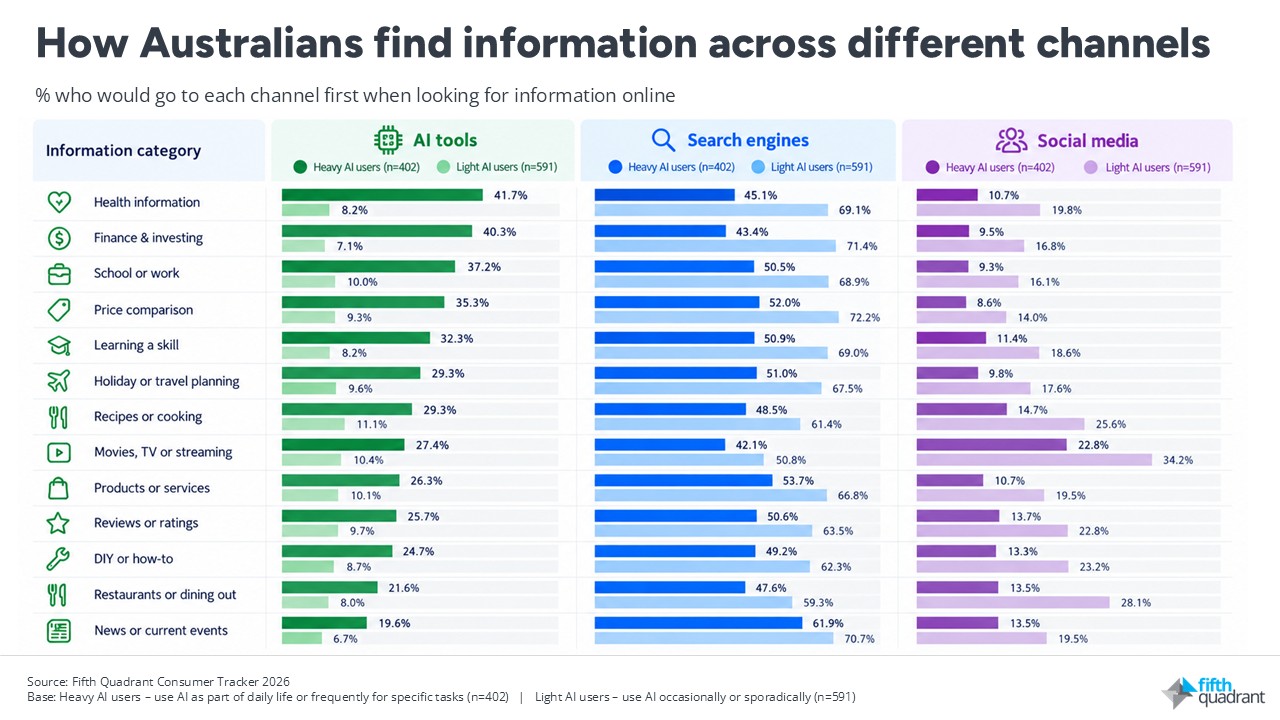
AI adoption may therefore eventually change much more than the technology people use. It could change how they access information, learn and make decisions.
Could Australia face a new AI divide?
The bigger question is what happens if lighter users do not simply follow heavier users along the same adoption curve.
If overall understanding has begun to plateau while heavier users continue developing their capabilities, Australia could experience a two speed AI transition.
There is already evidence internationally that adoption is uneven. OECD data show significant differences in generative AI use by age, education and income, with the largest divide occurring between age groups.
This matters because AI use can translate into capability. An OECD review of experimental studies found productivity improvements across a range of tasks, with some of the largest gains among less experienced or lower skilled workers. However, the benefits depend on using AI for appropriate tasks and having the skills to critically evaluate its outputs.
The implications for employment could be significant. The International Labour Organization estimates that one in four workers globally is in an occupation with some exposure to generative AI, although it concludes that job transformation is more likely than widespread replacement.
The emerging divide may therefore be less about who has access to AI and more about who develops the skills to use it effectively and capture its benefits.
The next phase of Australia’s AI evolution may not be about how many people have tried AI. The more important questions will be how deeply they use it, what they use it for and whether everyone has the opportunity to develop the skills to benefit from it.
The next digital divide may be less about access to AI and more about the ability to make it work for you.
Sources: Fifth Quadrant Consumer Tracker, 2026, OECD data on generative AI adoption and demographic divides; OECD research reviewing experimental evidence on generative AI productivity gains and the importance of user skills; International Labour Organization research on occupational exposure to generative AI and job transformation.
Posted in Consumer & Retail, B2B, CJM, Technology & Telco, Uncategorized