
Chinese car brands are winning the showroom. The workshop is the real test.
Author: Ben Selwyn | Posted On: 08 Oct 2026
Are Chinese car brands in Australia outperforming established Japanese, Korean and European brands on customer satisfaction?
Put a Chinese car brand in the same building as an established Japanese, Korean or European brand, run by the same dealer group, and customers will usually rate the Chinese showroom higher.
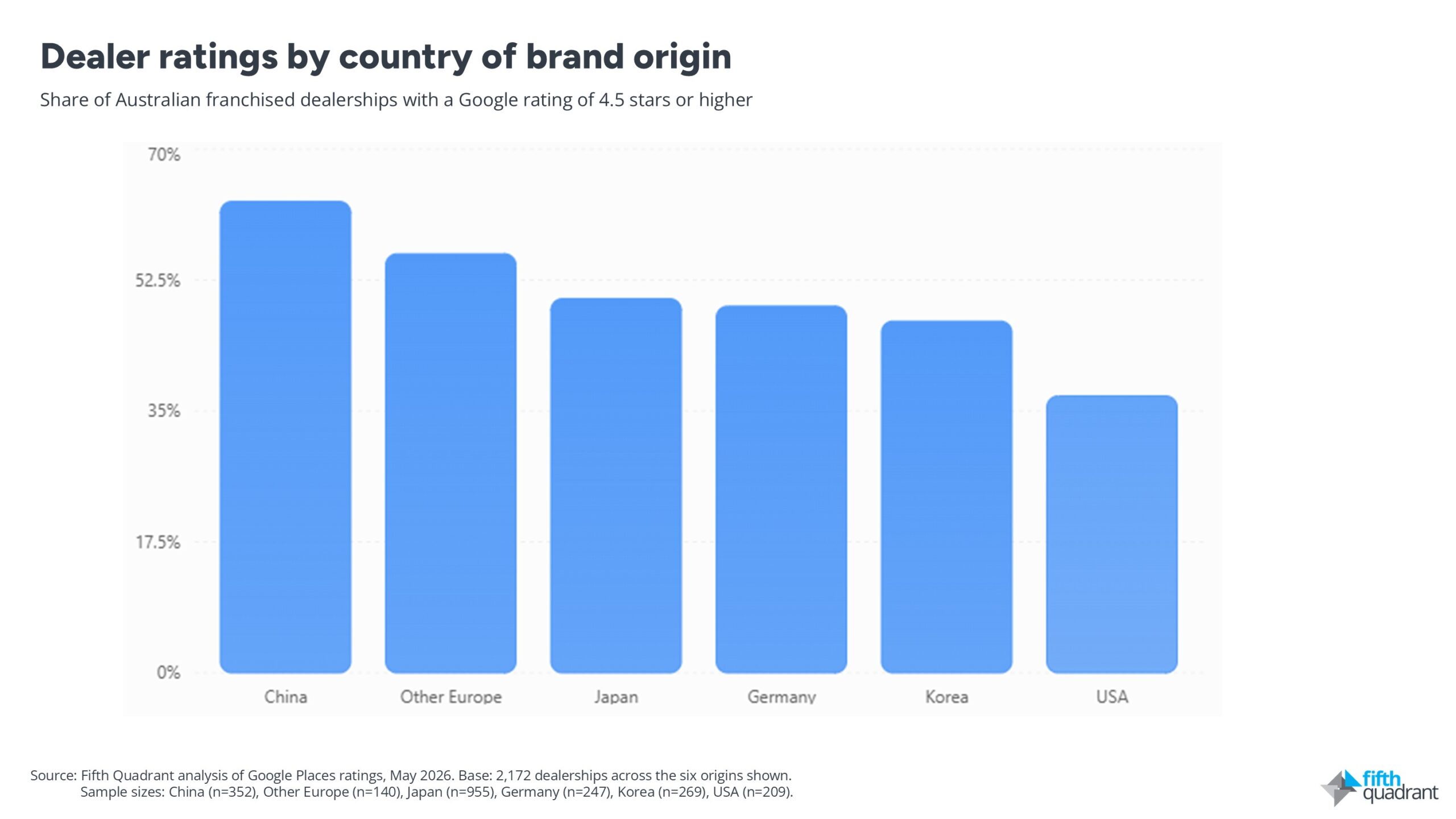
That pattern runs through Fifth Quadrant’s analysis of more than 720,000 Google reviews of 2,184 franchised car dealerships across Australia. Nationally, 63% of dealerships selling Chinese car brands hold a rating of 4.5 stars or higher. For the Japanese brands most Australian buyers grew up with, the figure is 50%.
These cars are no longer a niche purchase. Around one in four new vehicles sold in Australia between January and September 2026 came from a Chinese brand, and BYD is the second-biggest seller this year behind Toyota (VFACTS and EVC data). Whether Australians will buy Chinese vehicles is settled. Whether the experience around the car keeps them coming back is the open question.
Testing the lead for Chinese car brands
National averages can hide a lot. A handful of strong brands can lift a whole group, and newer networks tend to have fewer reviews. We therefore compared like with like.
We made two comparisons. At 190 sites where a Chinese franchise shares a building with a Japanese, Korean or European brand, the Chinese showroom rates higher in 64% of cases. Moving away from individual rooftops, for the 89 dealer groups that run both kinds of franchise, the Chinese side rates higher in 63% of groups.
Dealer ratings by Chinese brand
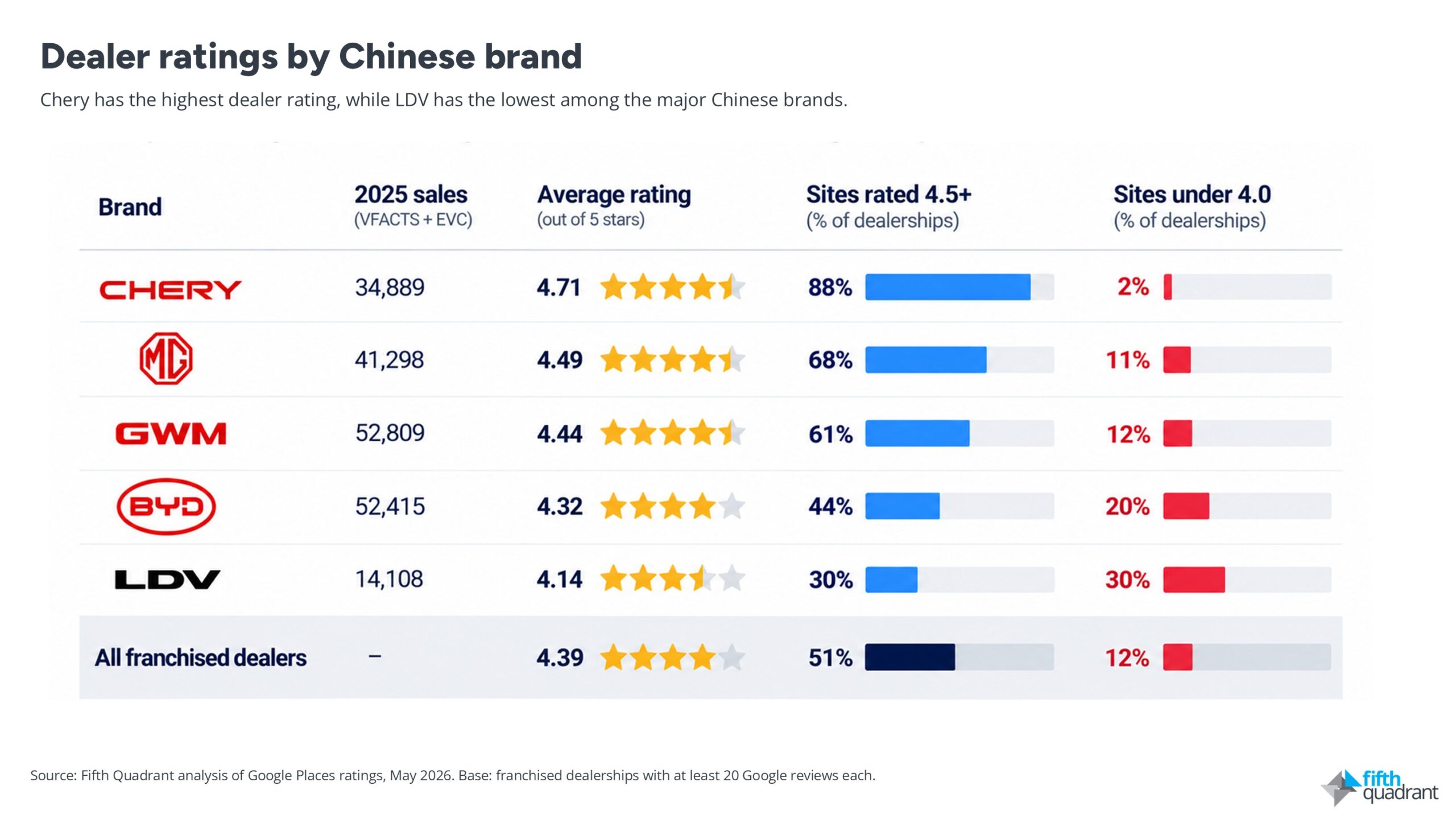
While we’re looking at them in the aggregate, the Chinese brands do vary widely. Chery has the highest average of any brand with ten or more dealerships, at 4.71 stars, with 88% of its sites at 4.5 or above. MG (4.49) and GWM (4.44) are both above the national dealer average of 4.39, BYD averages 4.32, and one in five of its dealerships is rated below 4.0, and LDV is lowest of the group at 4.14.
The service test ahead
These ratings come with an important caveat. Chinese-brand dealerships have about a third as many reviews as the established franchises they share buildings with. Their networks are young, and fewer of their customers will have reached a third service, waited on a back-ordered part or made a warranty claim. Ratings built mainly on the buying experience may not hold once ownership costs and service quality come into play.
What this means for dealers and OEMs
For Chinese car brands, the lead is genuine but recent. Over the next two years, ratings will increasingly reflect parts availability, service quality and resale value as these cars age. Brands that measure sentiment at the service stage, rather than relying on reviews left at handover, will see problems early enough to fix them.
Established brands face a harder question. Where one dealer runs both franchises under the same roof, customers rate the Chinese side higher. Because the owner and site are the same, the explanation probably lies in process, expectations and the product itself, and those are worth understanding in detail.
Google ratings show how customers feel about a business, but not the reasons. Talking to owners at their first and second service would show which brands are building lasting relationships and which are relying on a strong handover.
At Fifth Quadrant, we bring deep expertise in Auto & Mobility. Explore our latest automotive insights or get in touch to discuss your next move.
Sources: Fifth Quadrant analysed Google ratings for 24,847 Australian automotive business listings captured from Google Places in May 2026, excluding head offices, corporate entities and non-Australian listings. Brand comparisons use 2,184 single-brand franchised dealer rooftops with at least 20 Google reviews each (723,527 reviews in total). Google ratings reflect public sentiment rather than representative satisfaction, are influenced by how actively businesses ask for reviews, and combine sales and service experiences. We treat differences under 0.1 stars as indicative. Australian Automotive Dealer Association, September 2026 New Vehicle Sales; Federal Chamber of Automotive Industries, VFACTS 2026 reporting; and Electric Vehicle Council, October 2026 sales update.
Posted in Auto & Mobility, B2B, CJM, Consumer & Retail, Uncategorized