

The one-salary test for AI apps: What’s the real ROI?
Author: Hannah Hewes | Posted On: 06 Jul 2026
Can AI apps help businesses increase productivity without adding more staff?
AI apps are changing how businesses think about productivity, hiring and software ROI. For years, software was treated as a cost of doing business: a tool that helped employees work faster, collaborate better or reduce errors. But the latest wave of AI apps, copilots and agents does more than support work. It can help produce the work itself.
That changes the commercial question. Businesses are no longer just asking, “Will this software make our team more efficient?” They are asking, “Could this AI app stack help our current team produce more, remove repetitive admin and reduce the pressure to keep adding headcount?”
This is the “one-salary test”, and it is becoming a useful way to think about AI investment. Gartner forecasts that 40% of enterprise applications will include task-specific AI agents by the end of 2026, up from less than 5% in 2025, highlighting how quickly AI functionality is becoming embedded into everyday business software.
From software subscription to capacity investment
AI apps should not be viewed as a simple replacement for people. That framing is too blunt and often creates the wrong conversation. A more practical view is that AI may reduce the need for some additional hires by increasing the capacity of existing teams.
In other words, AI may not replace the people a business already has. But it may help delay the next hire, reduce contractor or agency spend, shorten turnaround times, increase client capacity or free employees from lower-value work.
The cost comparison is hard to ignore. The Australian Bureau of Statistics shows that full-time adult average weekly ordinary-time earnings were $2,051.10 in November 2025, equal to around $106,657 per year before additional employment costs such as superannuation, payroll tax, workers compensation, recruitment, onboarding, equipment and training are included. With the super guarantee at 12% from 1 July 2025, that becomes around $119,456 before many of those additional employment costs are considered.
By comparison, many AI app subscriptions are a fraction of that cost. Microsoft’s Australian pricing lists Microsoft 365 Copilot Business at AU$31.40 per user per month, paid yearly and excluding GST. At that price, equipping 30 users would cost around AU$11,304 per year before GST, materially less than one average full-time salary-plus-super benchmark.
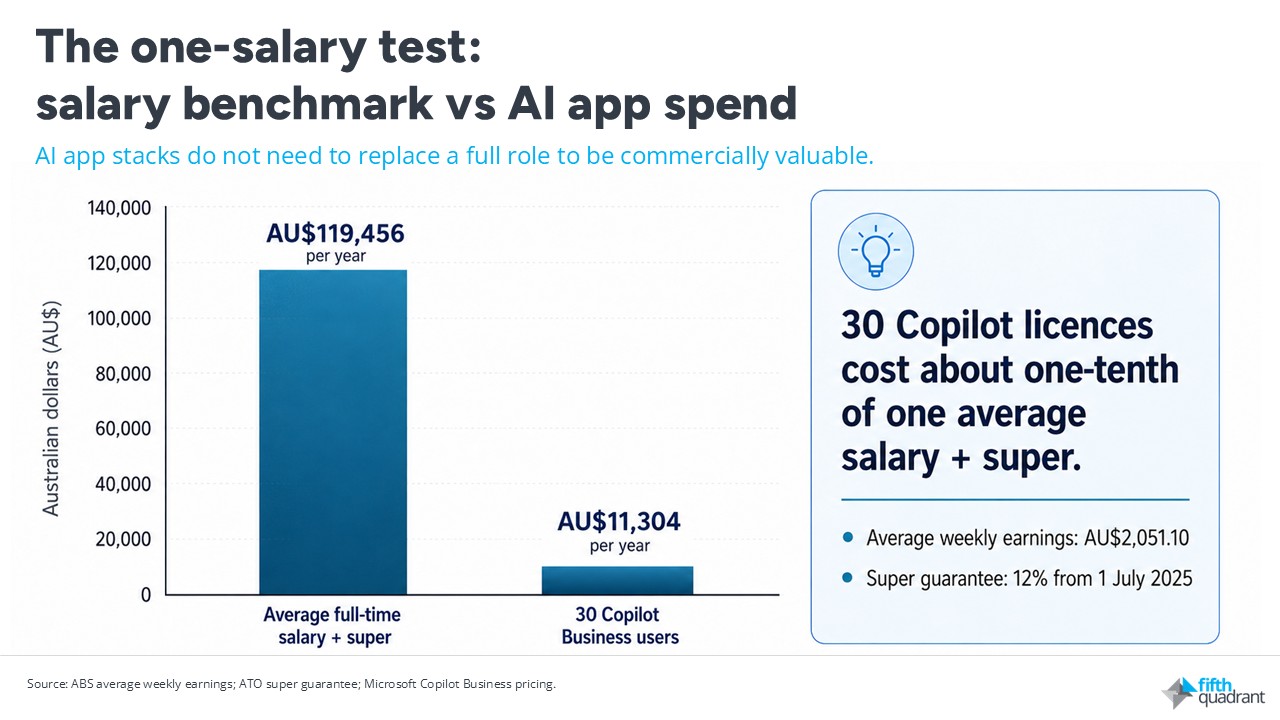
The point is not that one AI tool equals one employee. The point is that AI apps do not need to replace a full role to be commercially valuable. If a relatively modest AI app investment helps a team produce 10% to 20% more useful output, the productivity case can become compelling.
The productivity gains are real, but uneven
Research shows AI can materially improve productivity, particularly in repeatable, knowledge-heavy and text-heavy workflows.
A major NBER study of more than 5,000 customer support agents found that access to a generative AI assistant increased productivity by 14% on average, measured by issues resolved per hour. The gains were even larger for novice and lower-skilled workers, who improved by 34%.
A Harvard Business School and BCG field experiment also found strong results. For tasks within AI’s capability frontier, consultants using GPT-4 completed more tasks, worked faster and produced higher-quality outputs than those without AI.
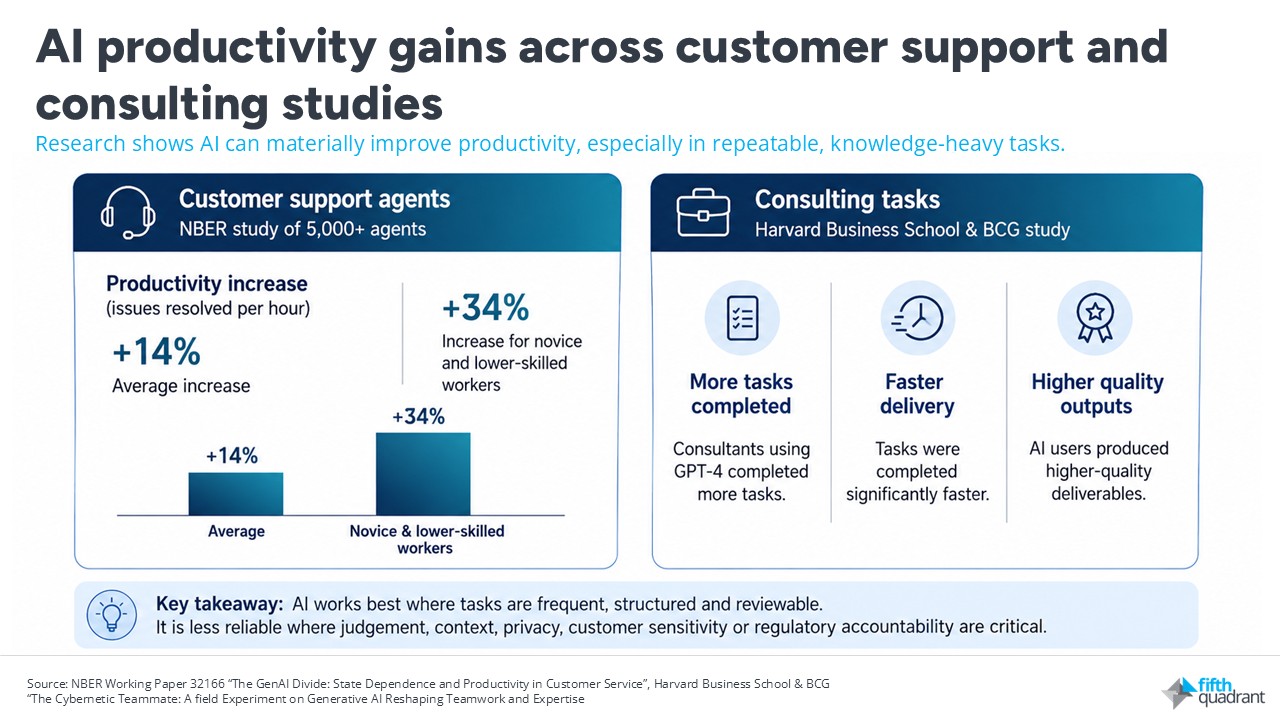
However, these results also show why AI ROI should not be treated as automatic. AI works best where tasks are frequent, structured and reviewable. It is less reliable where judgement, context, privacy, customer sensitivity or regulatory accountability are critical.
The employee benefit: less admin, more meaningful work
The productivity case for AI apps should not only be measured through cost savings. There is also an employee experience case.
Used well, AI apps can remove some of the repetitive, low-value work that takes time away from more meaningful tasks. Summarising meetings, drafting first versions, searching internal documents, formatting reports, preparing follow-up notes and handling routine admin are all areas where AI can reduce friction in the working day.
That matters because productivity is not just about producing more. It is also about helping employees produce better work with less unnecessary effort. When AI tools give people a stronger starting point, employees can spend more time applying judgement, creativity, customer understanding and commercial thinking.
However, the employee benefit depends on how AI is introduced. If AI is framed only as a way to cut costs or increase workload, it can create anxiety and resistance. If it is framed as a tool to remove low-value tasks, improve quality and help people focus on higher-value work, it is more likely to support morale, adoption and trust.
Adoption is ahead of workflow redesign
AI adoption is already widespread, but many organisations are still at an early stage of turning usage into measurable business value.
McKinsey’s 2025 research found that 88% of respondents reported regular AI use in at least one business function. However, only around one-third said their companies had begun to scale AI programs.
In separate research, McKinsey found that workflow redesign had the biggest impact on whether organisations saw EBIT gains from generative AI, yet only 21% of respondents using generative AI said their organisations had fundamentally redesigned at least some workflows.
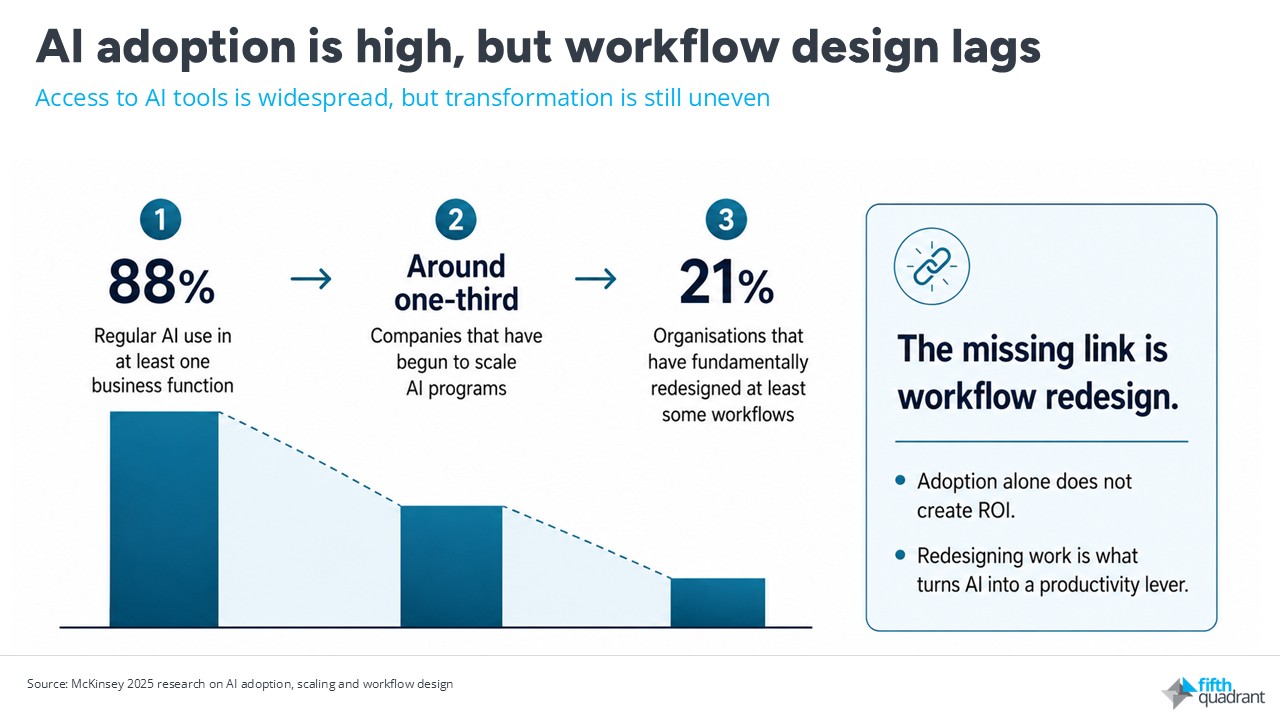
This is the real challenge. Many businesses are giving employees access to AI tools without redesigning how work gets done. That makes AI another underused software subscription rather than a genuine productivity lever.
The smarter way to evaluate AI ROI
To evaluate AI apps properly, businesses need to move beyond usage metrics. The important question is not how many employees have logged in, but whether AI is changing output, quality and capacity.
Useful metrics include output per employee, revenue per employee, time to output, quality-adjusted productivity and avoided hiring cost. Can the same team produce more reports, proposals, customer responses, code or campaigns? Can a five-day task become a one-day task? Can a team take on more work without increasing headcount at the same rate?
This is where market research can guide smarter AI decisions. Businesses need evidence on which workflows are suitable for AI, where employees are spending the most time, which tasks customers are comfortable seeing AI support, and where quality, trust or compliance risks are too high.
A practical framework for business leaders is:
AI app ROI = avoided labour cost + increased output + faster turnaround + quality improvement, minus subscription, training, integration, governance and rework costs.
AI apps should not automatically be viewed as a direct reduction in employee costs. But they should be considered part of workforce planning and employee experience. The strongest opportunity is not replacing people. It is increasing the productive capacity of the people already in the business, while helping them spend less time on low-value work.
AI investment decisions should not be based on hype or vendor promises alone. While AI apps may offer a strong productivity case, businesses also need to understand how employees and customers will respond to their use.
Fifth Quadrant helps organisations build evidence around the human side of AI adoption. Through employee and customer research, we can identify where AI is seen as useful, where concerns or barriers exist, and what conditions are needed for AI-supported services to feel trusted, practical and valuable. Contact us to discuss how we can support your AI strategy.
This article draws on data from Gartner on enterprise AI agents, the Australian Bureau of Statistics on average weekly earnings, the Australian Taxation Office on the super guarantee rate, Microsoft on Copilot pricing, NBER research on generative AI in customer support, Harvard Business School and BCG research on AI productivity in consulting, and McKinsey research on AI adoption, scaling and workflow redesign.
Posted in Technology & Telco, B2B, Consumer & Retail, TL, Uncategorized