

Is half your strategy missing?
Author: Dr Steve Nuttall | Posted On: 21 Apr 2026
At its core, strategy is the answer to two questions: where to play, and how to win. In B2B industrial markets, where supplier relationships often run for years, procurement cycles involve multiple decision-makers, and switching costs are high, answering both questions demands rigorous evidence, not gut feel and intuition. Yet most organisations attempt to answer them with only half the picture. They commission competitive intelligence to understand the landscape, or they define a market positioning strategy based on internal assumptions. Rarely do they treat competitive intelligence and market positioning as the complementary capabilities they are: two different vantage points on the same strategic question, both essential, neither sufficient alone.
Two vantage points, not one exercise
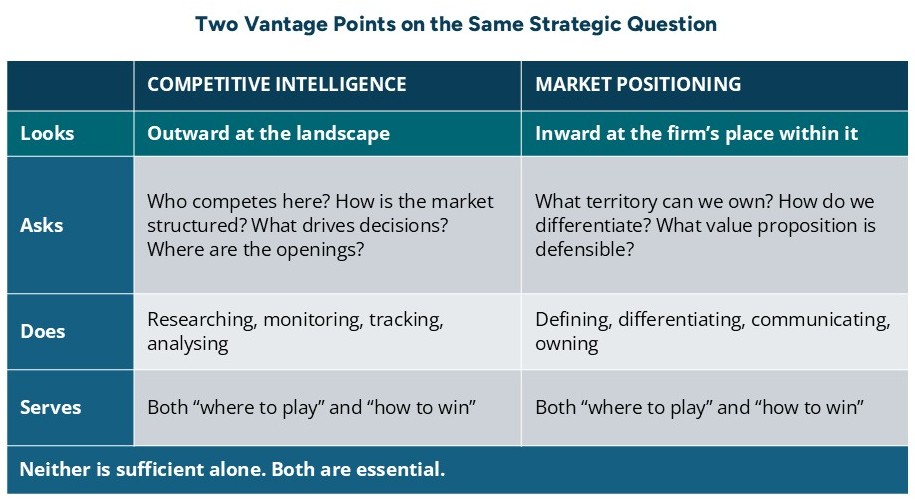
Competitive intelligence and market positioning are routinely conflated or treated as sequential steps in the same process. They are neither. They are distinct capabilities that look at the competitive world from different directions.
Competitive intelligence looks outward. It maps the landscape: who the competitors are, how the market is structured, what drives purchasing decisions, and where relationships are genuinely contestable. It answers questions about the world as it is.
Market positioning looks inward. It defines the firm’s distinctive place within that landscape: what territory to own in the buyer’s mind, how to differentiate, and what value proposition will be defensible over time. It answers questions about choices the firm must make.
Both capabilities serve both strategic questions. You cannot decide where to play without understanding the competitive landscape, but you also cannot make that choice without understanding which positioning territory is available and ownable. You cannot decide how to win without knowing where differentiation is possible, but the act of choosing how to win is itself a positioning decision. The two are not input and output in a linear sequence. They are complementary lenses that sharpen each other.
The evidence gap in B2B markets
The problem is acute in B2B industrial markets. Competitive dynamics are shaped by relationships, procurement cycles, and technical credibility rather than consumer sentiment. The most commercially significant intelligence is almost never publicly available. Annual reports reveal financial performance. They do not reveal why a customer chose one supplier over another, what triggers a procurement review, or which attributes buyers actually use to differentiate between competitors.
Consider a supplier defending market leadership in mining consumables. Quantitative tracking data might confirm a dominant share position and strong brand awareness. But it will not explain what happens when a competitor’s account manager offers a site visit and a technical review at precisely the moment a supply contract is up for renewal. That intelligence lives in the heads of procurement managers and operations directors. It does not appear in a desk research report, and without it, neither landscape understanding nor positioning strategy can be grounded in reality.
Building both capabilities
The most effective programs build both capabilities deliberately. The competitive intelligence work (desk research, contestability analysis, qualitative interviews, quantitative benchmarking) is designed from the outset so that every finding informs positioning decisions as well as landscape understanding. The language buyers use to evaluate suppliers becomes the basis for perceptual mapping. The attribute gaps that emerge from benchmarking point to differentiation opportunities. The switching triggers uncovered in qualitative research reshape both the competitive picture and the positioning strategy. This does not mean every engagement must run every phase. Some clients need only the intelligence; they already have the internal capability to make positioning choices. Others need the complete program from landscape through to activation. The methodology should be modular enough to flex to the brief, but the intent should always be the same: building the evidence base that lets a client answer both strategic questions with confidence.
Answering both questions
A well-executed competitive intelligence and market positioning program should leave a client able to answer four questions with confidence. Where do we stand relative to competitors, and on which dimensions? Why do we win and lose, and what drives those outcomes? Where is the positioning white space that no competitor currently owns? And what specific choices will shift our competitive position over the next 12 months?
If your program answers only the first pair, you understand the landscape but have not made a positioning choice. If it answers only the second pair without rigorous evidence behind it, your positioning is built on sand. Strategy requires both halves.
At Fifth Quadrant, we bring deep expertise in B2B competitive intelligence and market positioning across industrial, transport, healthcare and technology sectors. Explore our B2B research capabilities or get in touch to discuss your next move.